Industry
Pallets for construction, where the site eats them.
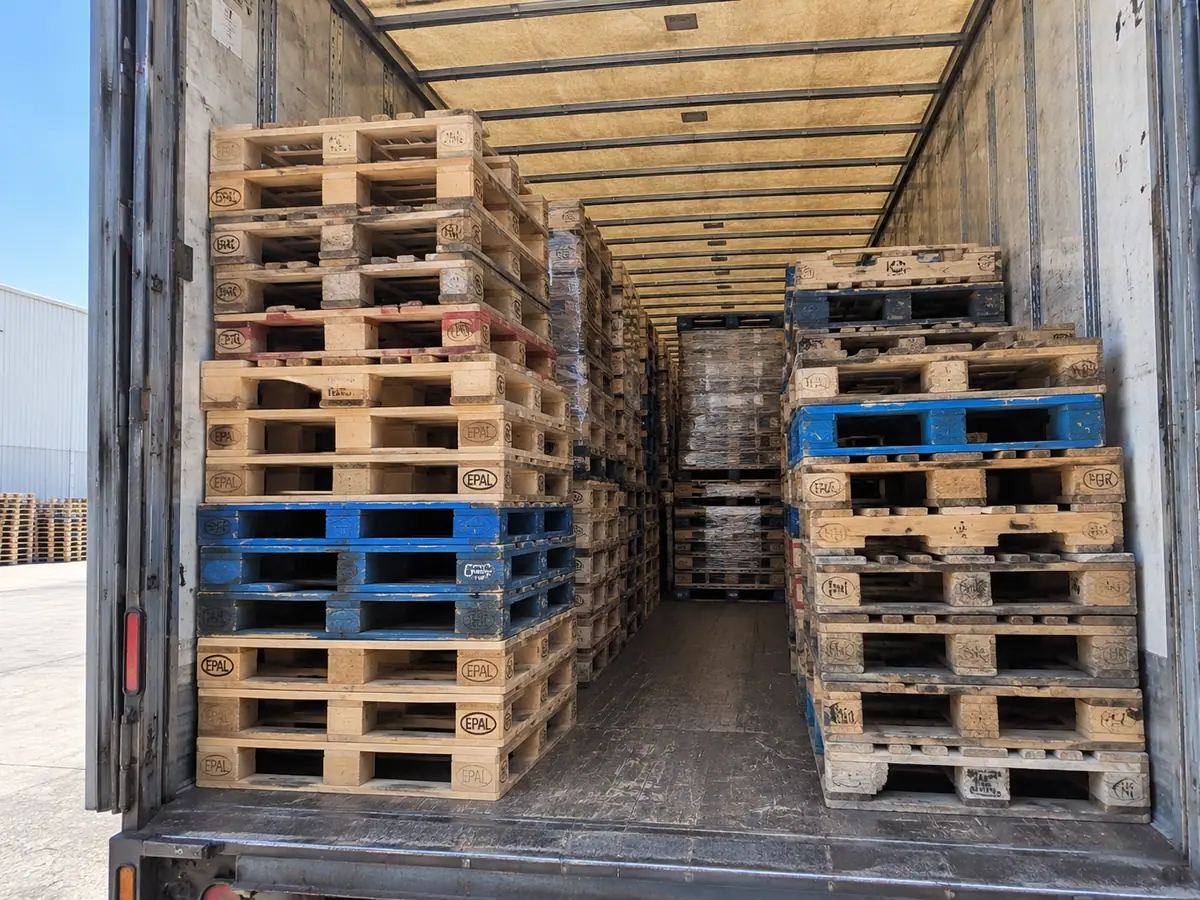
Talk to us about construction & building
Give us the quantity, the size and the ZIP. You'll get a written quote with the grade, the freight and the pickup window — not a sales call.
- Written quotes, usually inside one business day
- Loads from 100 pallets to full 53' trailers
- We buy as readily as we sell — tell us which way it flows
Inside the building
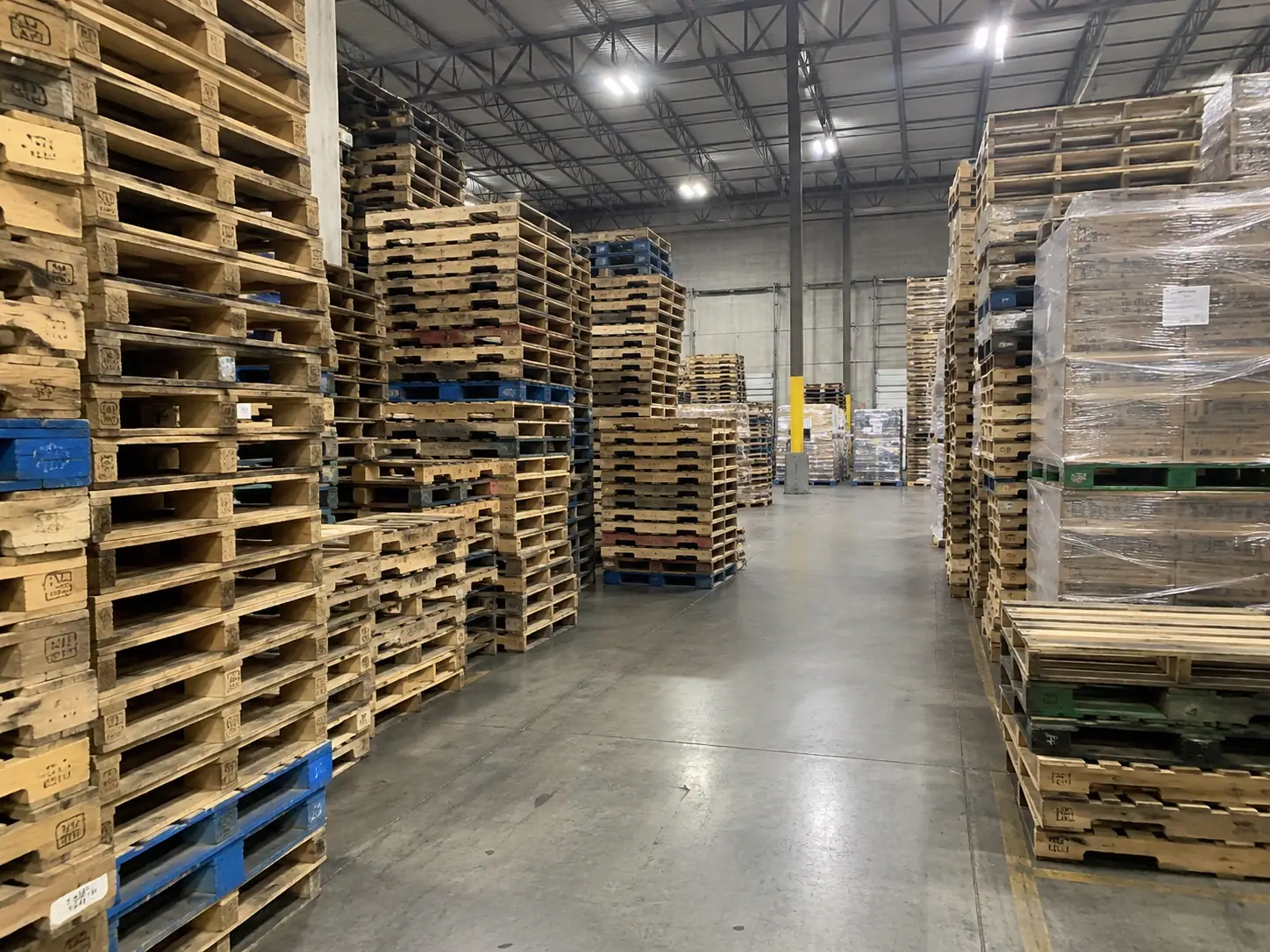
The sort aisle at half past seven. Graded stock on the left, waiting to be worked on the right.
Dense loads, cheap platforms
The two requirements pull in opposite directions.
Building product is heavy: a cube of brick is around 2,600 lb, a pallet of shingles about 2,300, a bundle of block often more. Those numbers push you toward a strong pallet.
But the pallet is never coming back. It gets unloaded on a muddy site by a rough-terrain forklift and left there, which pushes you toward the cheapest thing that works. The answer is usually a heavy-deck Grade B or a purpose-built remanufactured unit with thicker boards and a shorter expected life — strong where it needs to be, cheap everywhere else.
We build these specifically. They are not glamorous and the margin is thin, but they are the correct product for the job.
- Heavy-deck construction on an expendable price basis
- Grade B and remanufactured stock in volume
- Bulk delivery direct to yards and merchant depots
- Site and yard clear-outs for accumulated empties
- Ground fibre and mulch supply back the other way
Questions
Construction questions
What grade should we buy for brick and block?
Usually a heavy-deck Grade B. Grade A structure is wasted on a one-way delivery, but standard-deck stock will fail under a dense cube. It is a specific combination and it is worth asking for by name.
Can you clear a site?
Yes, subject to access — we need firm ground and room for a 53-foot trailer. Tell us the access situation honestly in the message field; a wasted trip costs us both.
Do you buy construction pallets back?
Rarely at a positive price. Site-returned stock is usually wet, muddy and broken, which makes it a removal job rather than a purchase. We will tell you which one it is before we come.
Do you supply mulch to landscape contractors?
Yes, in bulk. See mulch and wood fibre — it is often the same customers in the other direction.
Load reference
What building products actually weigh
| Product | Typical unit load | Deck requirement | Notes |
|---|---|---|---|
| Cube of brick | 2,300 – 2,900 lb | Heavy deck, 4 stringers | Concentrated, and stacked outdoors |
| Pallet of concrete block | 2,400 – 3,200 lb | Heavy deck, 4 stringers | Often banded directly to the deck |
| Bundle of shingles | 2,000 – 2,400 lb | Heavy deck | Rooftop delivery adds a handling case |
| Bagged cement, 42 × 80 lb | ≈ 3,400 lb | Heavy deck, tight gaps | Bags sag between wide-spaced boards |
| Sheet goods, plywood or OSB | 1,500 – 2,600 lb | Flat deck, low gaps | Wants a flat surface more than strength |
| Ceramic tile | 1,800 – 2,600 lb | Heavy deck | Fragile and dense together |
| Insulation | 200 – 500 lb | Any grade | Light, bulky, cube-limited |
| Rebar bundles | 2,000 – 5,000 lb | Skid or engineered | Frequently better on runners than a pallet |
Site delivery
What makes a construction delivery work
- 01Confirm site access before the first loadFirm ground, turning room and overhead clearance. Construction sites change weekly and what worked in March may not work in June.
- 02Specify expendable and mean itNothing comes back from a building site. Paying for Grade A structural margin on a one-way delivery is money that stays on the site with the pallet.
- 03Heavy deck, not high gradeThe requirement is deck thickness and stringer count, not cosmetic condition. A heavy-deck Grade B is the correct product and it is rarely offered unless you ask.
- 04Plan the clear-out in advanceEmpties accumulate on sites until somebody notices. A scheduled collection during the build costs less than a clear-out at handover.
- 05Watch weather exposure on staged stockMaterial staged outdoors for weeks loses grade fast. If pallets are being stored on site before use, get them off the ground and covered.
Merchant and yard supply
The other half of construction pallet demand
Builders' merchants and supply yards sit between the manufacturer and the site, and they have a genuinely different problem: they receive on pallets, break bulk, and re-deliver on pallets, all outdoors.
Weather exposure is the defining constraint. Yard stock lives outside by necessity, which means grade degrades continuously and the economic answer is a lower grade replaced more often rather than a higher grade preserved.
Return flow is intermittent and unsorted. Merchants accumulate a mix of everything their suppliers used, in every condition, which is exactly the load profile that suits a recycler with a proper sort deck and suits a broker badly.
Delivery vehicles are often crane-equipped rather than dock-based, which changes the handling case — slings and forks from a lorry-mounted crane put loads on a pallet that a warehouse forklift never would.
Questions
More construction questions
What grade should we buy for brick and block?
Heavy-deck Grade B. Grade A structural margin is wasted on a one-way delivery, but standard-deck stock will fail under a dense cube. It is a specific combination and worth asking for by name.
Can you clear a live site?
Yes, subject to access. Tell us honestly what the approach is like — a wasted trip costs us both, and construction sites are where wasted trips happen most.
Do you buy construction pallets back?
Rarely at a positive price. Site-returned stock is usually wet, muddy and broken, which makes it a removal job. We will tell you which it is before we come rather than after.
Are pallets suitable for crane handling?
Standard pallets are not designed for sling handling and can fail at the deck when lifted from the edges. If loads are craned, specify it — winged pallets or engineered skids are the right answer.
Do you supply mulch to landscape contractors?
Yes, in bulk, and it is frequently the same customers in the other direction. See mulch and wood fibre.