Service 02 — Buying from you
Sell your pallets. Get paid for the ones worth money, and a fair price on the rest.
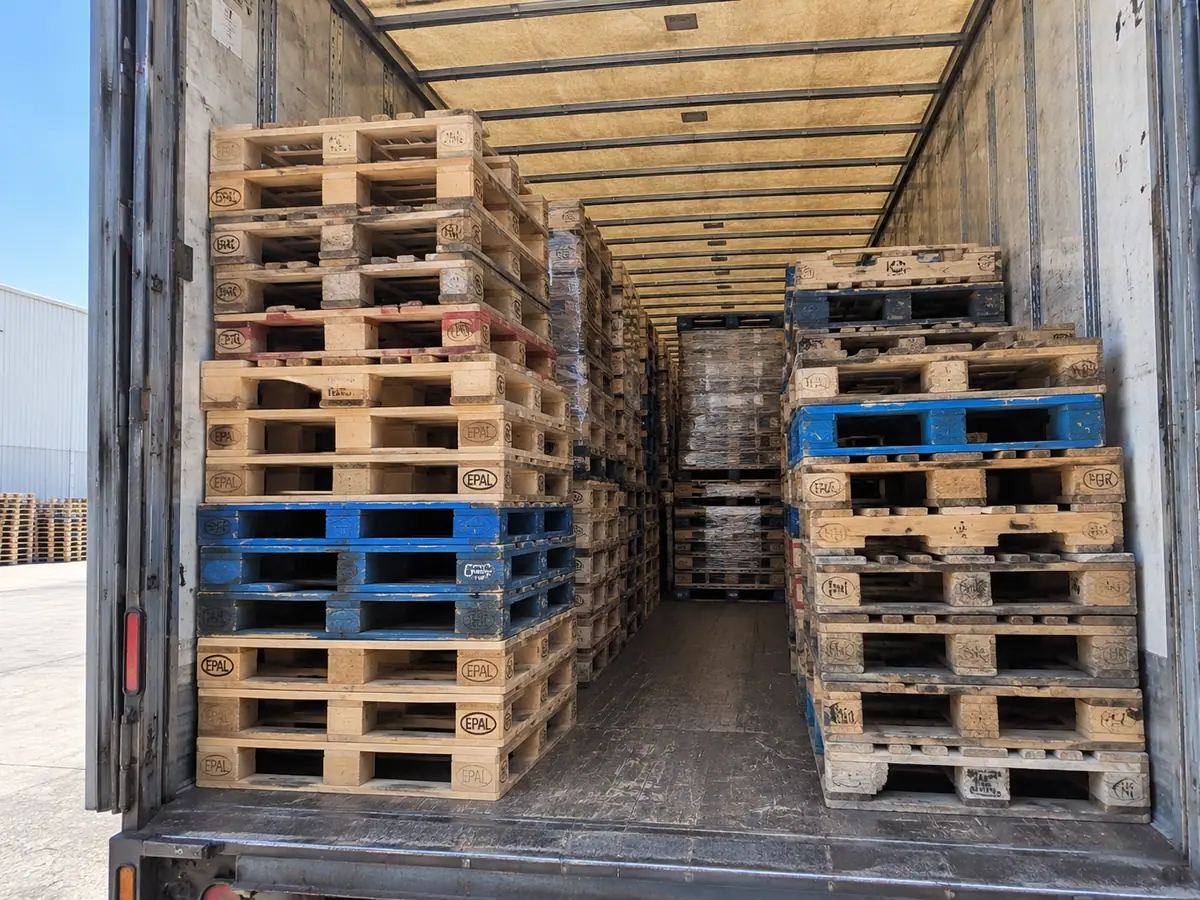
Get a price on your cores
Give us the quantity, the size and the ZIP. You'll get a written quote with the grade, the freight and the pickup window — not a sales call.
- Written quotes, usually inside one business day
- Loads from 100 pallets to full 53' trailers
- We buy as readily as we sell — tell us which way it flows
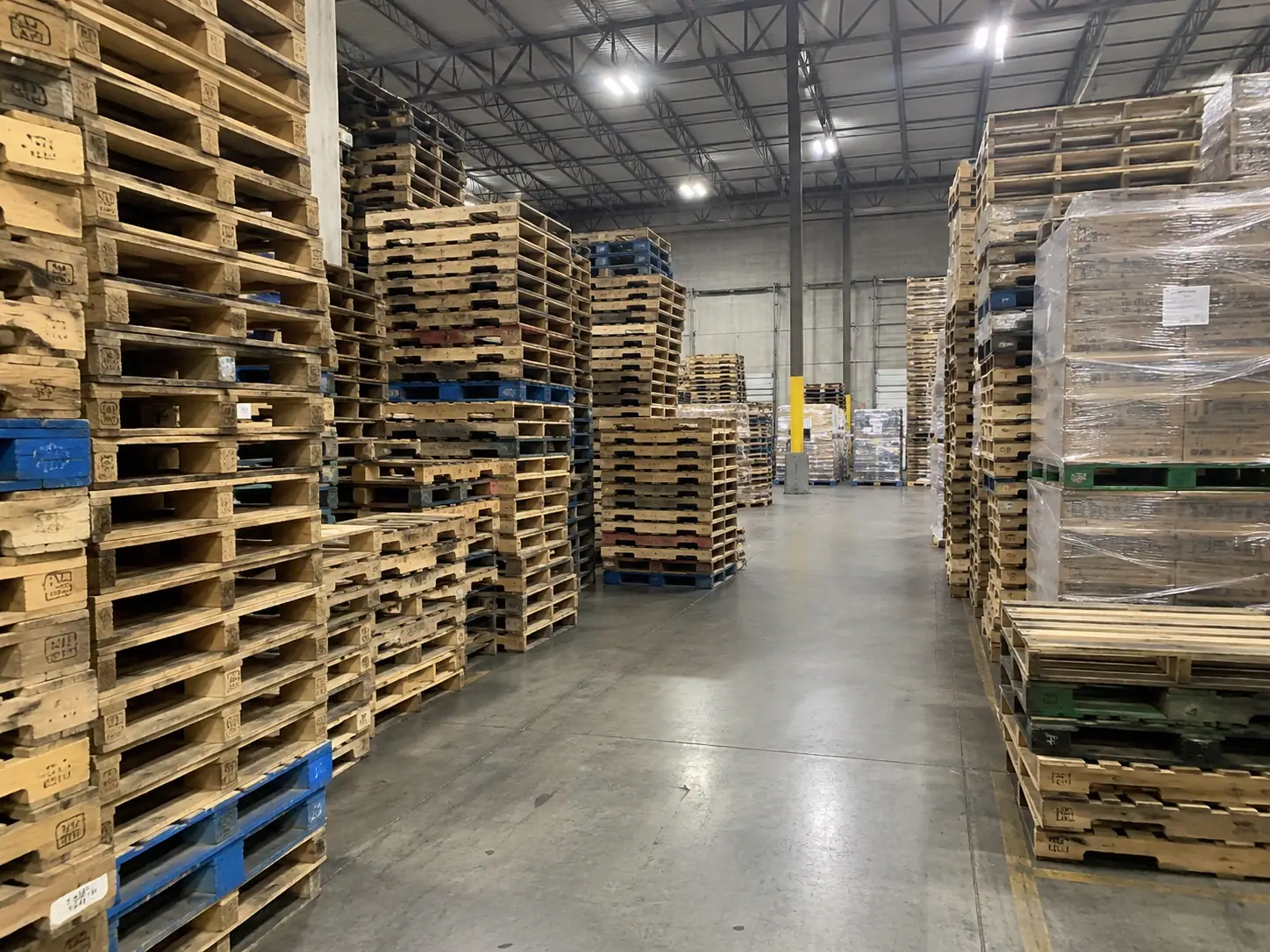
Inside the building
The sort aisle at half past seven. Graded stock on the left, waiting to be worked on the right.
How selling works
Four steps, and only one of them is yours.
- Step 01
Send a photo and a count
One photo of a representative stack and an approximate number. That is genuinely enough for a first price. Use the form on this page.
A photo beats a description every time.
- Step 02
We quote in writing
Price per unit by grade, the pickup window, and whether we pay you or invoice for removal. No verbal numbers that change on arrival.
Usually inside one business day.
- Step 03
We collect
Our trailer arrives in the agreed window. Your team stacks, ours counts on the dock and signs a ticket with the count you both agree.
Live load or we drop a trailer for you to fill.
- Step 04
You get paid
Cheque or ACH on our standard 15-day terms, or same-day cash settlement for one-off clean-outs above 400 units.
The ticket is the invoice. No reconciliation games.
What your pallets are worth
A realistic picture of core values
| What you have | Condition | Indicative value | What we do with it |
|---|---|---|---|
| 48×40 GMA, whole | No broken boards or stringers | $4.00 – $6.00 each | Cleaned, graded A, back to service |
| 48×40 GMA, repairable | One or two broken deck boards | $2.25 – $4.00 each | Repaired with recovered boards |
| 48×40 GMA, damaged | Broken stringer, splits | $1.50 – $2.50 each | Dismantled; lumber becomes repair stock |
| Odd sizes, whole | Any | $0.75 – $3.00 each | Sorted; resold or remanufactured |
| Mixed and broken | Wet, mouldy, painted | Removal fee applies | Ground for mulch and boiler fibre |
| Block / Euro pallets | Whole | $3.00 – $9.00 each | Inspected, resold into export lanes |
Getting the best price
Three things that move your number more than negotiation does.
Sorting is the single biggest lever. A trailer of clean 48×40 cores is worth substantially more per unit than the same trailer with 15% odd sizes buried in it, because we have to pay someone to pull those out.
Keeping stacks dry is the second. Wood over about 19% moisture content loses grade, gains weight and can grow mould in a week of humid weather under a tarp. Indoors or under cover is worth real money.
Volume and predictability are the third. A standing weekly pickup lets us route a truck efficiently, and we pass a share of that back. Call-when-full costs us a dedicated run.
- Separate 48×40 from everything else — it is the fastest money you will make
- Keep stacks under cover; wet pallets lose a grade
- Stack no higher than 15 for GMA so a forklift can move them safely
- Tell us about nails, banding and film left on the stack — it changes the number honestly
The core we want most
The awkward part
Sometimes the answer is no
There is a persistent myth in this industry that all pallets are worth money. They are not. A load of soaked, mouldy, mixed-size units with broken stringers costs us more in labour and grinding than the recovered fibre is worth, and a buyer who tells you otherwise is planning to renegotiate on arrival.
When that is what you have, we will say so and quote a removal fee instead — usually between $95 and $180 per trailer load in central Ohio, which is still well below landfill tipping plus your own freight. And it still gets recycled: ground for landscape mulch and boiler fibre, not buried.
If you want to understand what separates the two outcomes before you call anyone, our guide on how to sell used pallets walks through the grading in detail.
Questions
Selling questions
How many pallets do I need before it is worth a pickup?
Around 200 units makes the freight work on its own. Below that we can often add you to an existing route — tell us where you are and we will check what already runs past you.
Do you take pallets with our brand printed on them?
Branded and coloured pallets are usually the property of a pooling company, not yours to sell. We sort those out and return them into the pool rather than reselling them. It protects you as much as us. More on that in pooling versus buying.
Can you provide documentation for our waste diversion reporting?
Yes. Every collection generates a weight ticket, and we issue a monthly diversion statement showing tonnage collected, tonnage returned to service and tonnage converted to fibre. Details on the zero-waste promise page.
What about the nails and banding left behind?
We handle it. Ferrous metal is separated magnetically during grinding and goes to a scrap processor. It is not a reason to hold up a load.
Preparing a load
Six things to do before the truck arrives
- 01Separate 48×40 from everything elseThe single highest-return activity available. GMA cores are the liquid product and everything else is a discount. Two people and a forklift for an afternoon is usually worth more than any negotiation.
- 02Pull the obviously broken unitsCracked stringers, missing deck boards, anything soaked. Stack them separately and price them separately rather than letting them drag the average down.
- 03Get them under coverWood above 19% moisture loses a grade, gains weight and grows mould within a week under wrap. Indoors is best; a roof with open sides is nearly as good; a tarp is worse than nothing.
- 04Band the stacksA banded stack of fifteen unloads in seconds. A loose pile takes an hour and needs sorting, and that difference is worth about $0.35 a unit in handling that comes out of your price.
- 05Pull the pooled and branded unitsBlue, red, brown and branded pallets belong to a pooling operator and are not yours to sell. We segregate and return them, but finding them on our deck rather than yours slows everything down.
- 06Photograph a representative stackOne clear photo and an approximate count is enough for a real number. Vague descriptions get conservative prices, because conservatism is how a buyer manages uncertainty.
Seasonality
When to sell, if you have the choice
| Period | Core demand | Indicative 48×40 whole core | What to do |
|---|---|---|---|
| January – February | Softest | $3.25 – $4.50 | Accumulate if you can store dry |
| March – May | Tightest of the year | $4.75 – $6.00 | Sell everything you have |
| June – August | Easing | $4.00 – $5.25 | Steady collections |
| September – November | Second peak | $4.25 – $5.50 | Sell ahead of winter |
| December | Soft | $3.50 – $4.75 | Hold if dry storage allows |
The collection itself
What actually happens on the day.
A driver arrives inside the agreed window with a signed ticket book. Your team stacks or has stacked; ours counts on the dock, in front of you, and both parties sign the count. That ticket is the invoice and the record.
We do not reconcile counts later at our yard. It is a common practice in this trade and it is where most disputes start, because a count taken out of your sight is a count you cannot dispute.
For sites generating more than a trailer a fortnight we will drop an empty trailer instead and swap it on a schedule, so the accumulation happens inside a trailer on your yard rather than in a heap against your wall.
- Count agreed and signed on your dock, not at our yard
- Weight ticket generated at our inbound scale and shared
- Payment on 15-day terms, or same-day settlement above 400 units
- Trailer drops available for sites over a trailer a fortnight
- Pooled and branded units segregated and returned, and we tell you how many
Volume and access
What makes a site easy or expensive to collect from
Access is the thing nobody mentions and everyone should. We need firm ground and room to turn a 53-foot trailer. A site where the only approach is a tight residential turn, or where the yard turns to mud after rain, costs us a wasted trip or a smaller vehicle, and both come out of your price.
Stack height matters more than it sounds. Fifteen high for GMA is what a standard forklift handles safely. Twenty-high stacks look efficient and are a safety conversation we would rather have before the driver arrives than after.
Consistency beats volume. A standing weekly pickup of 250 units is worth more per unit to us than a call-when-full arrangement at 600, because the truck is already routed. If your generation is predictable, say so and it moves the price.
Tell us about contamination honestly. Oil staining, chemical residue, a pallet that carried something unpleasant — we would far rather know at quote stage than find it on the sort deck. It changes the number, and finding out late changes it further.
Questions
More selling questions
How do you decide whether to pay or charge?
By what the load will produce. Whole cores go back to service and are worth real money; broken and wet material has to be dismantled or ground, which costs labour and produces low-value output. A mixed load frequently nets out close to zero, and we will show you the split.
Will you take one-off clean-outs?
Yes, including yards that have been accumulating for years. Those are usually a removal job rather than a purchase because of the weather exposure, and we will tell you which before we come rather than after.
Can we sell to you and buy from you?
That is the most common arrangement we have, and it should be one movement rather than two. Ask for it explicitly — combined collection and delivery does not happen automatically and it is worth real money on both sides.
What documentation do we get?
A signed count ticket per collection, a weight ticket from our inbound scale, and a monthly diversion statement showing tonnage by outcome. That last one is what a sustainability audit actually needs — see the zero-waste promise.
Do you buy plastic pallets?
Yes, separately. Sound HDPE units are reconditioned and resold; broken ones go to a resin recycler rather than into our wood stream. Mixing the two is how a diversion rate gets ruined.
There is money sitting behind your dock.
Send a photo and a rough count. Worst case, you find out what it is worth and decide to keep doing what you are doing.
Keep reading
Sell Your Pallets is delivered from our yard at 7240 S Access Rd, Columbus, OH 43217, Monday to Friday 7:00 AM to 5:00 PM and Saturday mornings.