Product 02
New wood pallets, for the jobs where recycled genuinely will not do.
Quote a new build
Give us the quantity, the size and the ZIP. You'll get a written quote with the grade, the freight and the pickup window — not a sales call.
- Written quotes, usually inside one business day
- Loads from 100 pallets to full 53' trailers
- We buy as readily as we sell — tell us which way it flows
Inside the building
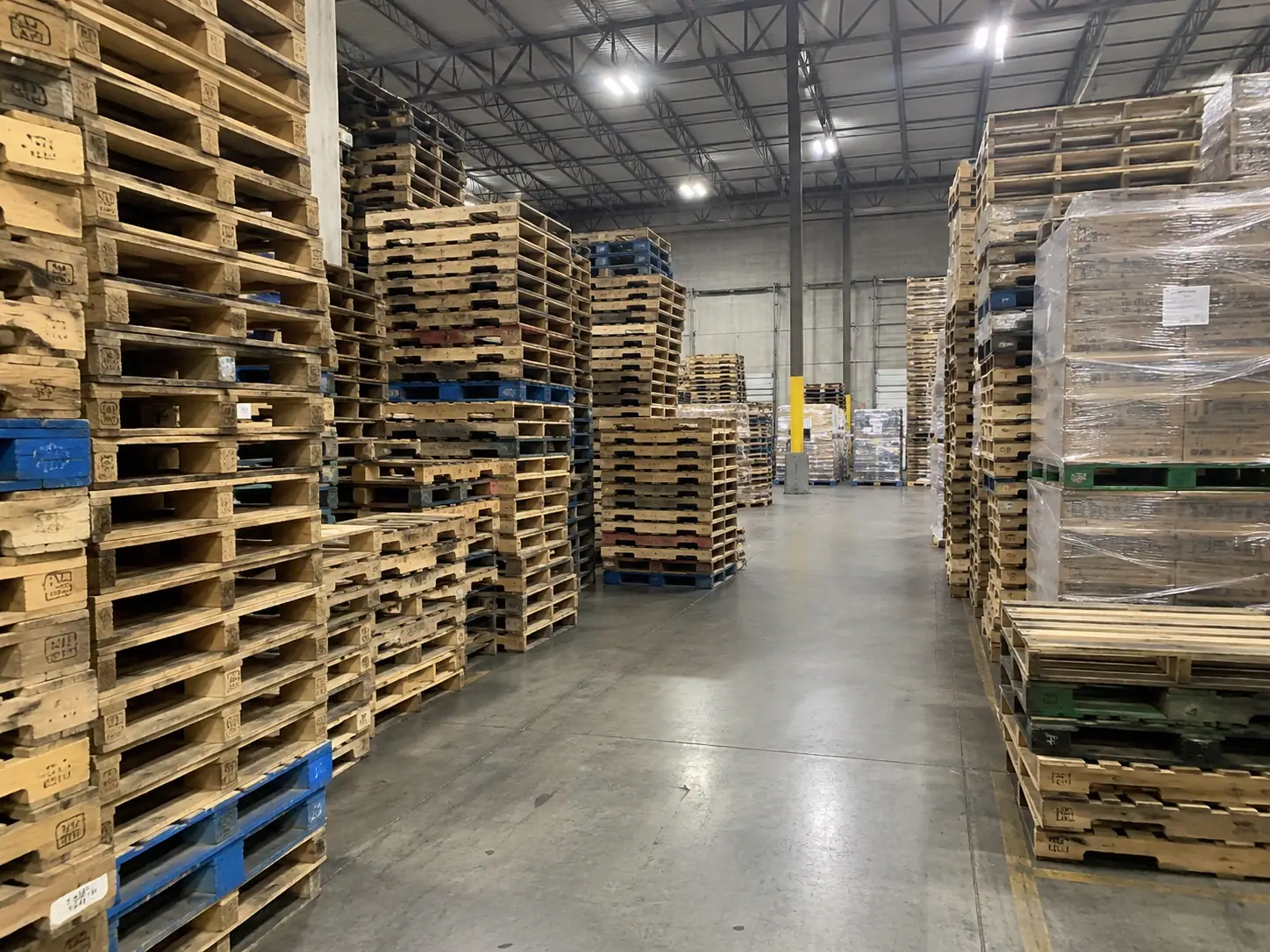
The sort aisle at half past seven. Graded stock on the left, waiting to be worked on the right.
When new is right
Five cases where we will recommend new over recycled
- 01Automated handling with tight tolerancesAS/RS, shuttle systems and high-speed conveyor lines specify height, bottom-board position and squareness to a few millimetres. Recycled stock cannot hold that consistently and jams are expensive.
- 02Engineered load ratingsIf a customer or an insurer requires a documented ISO 8611 rating, that rating has to come from a known, consistent build. Recycled variability makes it meaningless.
- 03Long internal service lifeA pallet that will do forty internal cycles a year for five years is cheaper new. The per-cycle cost is what matters, not the purchase price.
- 04Pharmaceutical and cleanroomWhere a documented material history is part of the qualification, a new pallet with mill paperwork is the only defensible option.
- 05Appearance-critical retailDisplay pallets the shopper sees. A recycled deck reads as tired even when it is structurally perfect.
Choosing lumber
Hardwood or SPF
| Mixed hardwood | SPF (spruce-pine-fir) | |
|---|---|---|
| Typical species | Oak, maple, poplar, gum | White spruce, lodgepole pine, balsam fir |
| Relative strength | Higher — better nail holding, stiffer deck | Lower, but adequate for most static loads |
| Weight, 48×40 | 50–60 lb | 35–42 lb |
| Moisture at build | Typically 15–20% if kiln dried | Often 19–28% green |
| Price index | Higher | Lower, and more volatile |
| Best for | Racking, repeated cycles, heavy loads | One-way shipping, weight-sensitive freight |
The uncomfortable comparison
New pallets are not automatically stronger
A new pallet built from green SPF with 5/16-inch deck boards is measurably weaker than a Grade A recycled hardwood GMA with 9/16-inch boards. The word 'new' describes the wood's history, not its performance.
When someone quotes you a new 48×40 at an unusually good price, ask for the deck board thickness and the species. Most of the cheapest new pallets on the market are competing on lumber cost, not on structure — and their load ratings reflect it.
We will publish the spec for anything we build: deck thickness, species group, stringer dimension, nail pattern and fastener count. If you cannot get that from a supplier, you cannot compare quotes.
Questions
New pallet questions
What is the minimum order for new pallets?
250 units for a standard footprint, same for custom. Below that, setup dominates and recycled stock is almost always the better buy.
How long is the lead time?
Two weeks for a first run, then days for repeats against a held spec. Prototypes for custom footprints ship in three to five business days.
Can new pallets be heat treated for export?
Yes, and we will mark them correctly. Note that kiln-dried and heat-treated are not the same thing — ISPM-15 explained covers the difference and why it gets shipments held.
Do you sell new pallets that are not GMA?
Yes, any footprint from 20×20 to 96×48. See custom pallet builds, and read the custom sizing guide before you commit to a non-standard size.
Build options
What a new pallet costs by construction
| Construction | Indicative price | Weight | Racked capacity | Best for |
|---|---|---|---|---|
| SPF, 5/16″ deck, 3 stringers | $14 – $16 | 33 – 38 lb | ≈ 1,200 lb | One-way, weight-sensitive lanes |
| SPF, 9/16″ deck, 3 stringers | $17 – $19 | 36 – 42 lb | ≈ 1,600 lb | General one-way freight |
| Mixed hardwood, 9/16″ deck | $19 – $22 | 50 – 58 lb | ≈ 2,500 lb | Internal returnable fleets |
| Hardwood, ¾″ deck, 4 stringers | $24 – $29 | 60 – 70 lb | ≈ 3,200 lb | Heavy or concentrated loads |
| Block construction, 9 feet | $26 – $34 | 55 – 68 lb | ≈ 2,800 lb | Automated handling, export |
| Any of the above, heat treated | +$1.10 – $2.20 | — | — | International shipments |
Reading a new pallet quote
The three numbers that make quotes comparable
Deck board thickness. The single largest driver of both price and performance. A 5/16-inch deck and a 9/16-inch deck are different products, and a quote that does not state it is not a quote you can compare.
Species group. Hardwood or SPF, and if hardwood, whether it is a mixed group or a specified one. Density gives you strength and nail retention and it also gives you weight, and there is no species that provides one without the other.
Fastener type and count. Helically threaded or stiff-stock nails hold dramatically better than smooth shank, which determines how long the unit stays square. Staples appear on some imported units and are the worst of both worlds.
Ask for all three in writing. Any manufacturer that cannot produce them immediately is not building to a specification, and the cheapest new pallet quote on a sheet is very often the one competing on lumber cost rather than on structure.
Lead times
Planning a new pallet order
- 01Prototype: three to five business daysA physical unit you can load, rack and abuse. Worth doing even for a standard footprint if the load is unusual.
- 02First production run: about two weeksFrom confirmed specification. Lumber procurement is the variable, particularly for specified species or thicknesses.
- 03Repeat orders: daysThe specification is held on file, so a reorder draws down against it. This is where the value of the setup work shows up.
- 04Heat treatment: add one dayA chamber cycle is roughly four hours including probe placement, ramp, hold and cool. Marking is done after the cycle, from the chart.
- 05Book seasonally sensitive volume earlyNew pallet lead times stretch in spring alongside everything else. If you need volume in April, agree it in the autumn.
Questions
More new pallet questions
Is a new pallet always dimensionally consistent?
Consistent within a run, yes. Between runs it depends on the lumber and the moisture at build — green SPF dries and moves after assembly, which is why some new pallets go out of square in their first year. Kiln-dried or heat-treated stock is materially more stable.
Can you build to an ISO 8611 rating?
We can build to a specification and have it tested through a partner laboratory. What we cannot do is certify a recycled unit, because the variability makes a certificate misleading.
Do you offer branded or marked pallets?
Stencilled marking, yes — company name, site code, or a returnable-fleet identifier. It is worth doing on any returnable population, because unmarked pallets migrate.
What is the minimum for a repeat order?
250 units on a held specification. Below that we would generally suggest recycled stock or a partial-load arrangement with another item.
Are new pallets better for food?
Not inherently. A new pallet has no known history, which sounds like an advantage and mostly means the same thing as an unknown one. What matters for food is dryness, odour and controlled sourcing, and a well-sorted recycled unit meets all three.
Send the load, not the part number.
Weight, dimensions, handling method and destination. We will tell you whether new is worth it — and quite often it is not.