Product 05
Crates, skids and bins for loads that refuse to sit flat.
Quote a crate or skid
Give us the quantity, the size and the ZIP. You'll get a written quote with the grade, the freight and the pickup window — not a sales call.
- Written quotes, usually inside one business day
- Loads from 100 pallets to full 53' trailers
- We buy as readily as we sell — tell us which way it flows
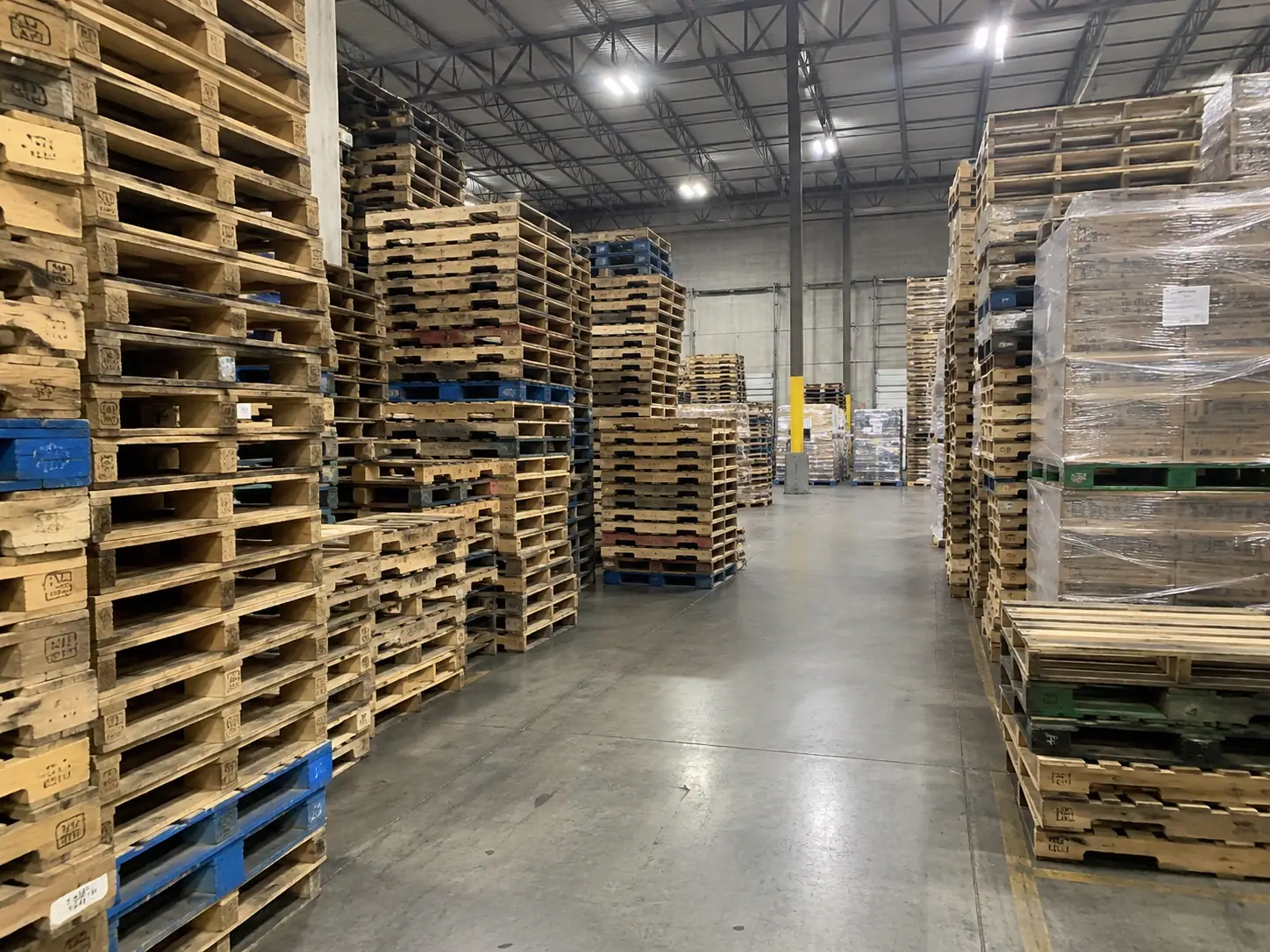
Inside the building
The sort aisle at half past seven. Graded stock on the left, waiting to be worked on the right.
The formats
What each one is actually for
- 01Two-runner skidNo bottom deck — just two or three runners under a deck. Cheaper and lighter than a pallet, slides on a floor, and cannot be handled by a pallet jack. Good for machinery and one-way heavy freight.
- 02Cleated plywood cratePlywood panels on a framed base with cleats. The standard for export machinery and anything that needs a documented, sealed enclosure.
- 03Slatted crateOpen board sides. Lighter, cheaper, ventilated. Used for produce, castings and anything that benefits from airflow or visual inspection.
- 04Collapsible bulk binA pallet base with removable or hinged walls. Returns flat, which is what makes it viable in a loop. Common in agriculture and automotive parts.
- 05Pallet with collarsThe modular answer: a standard pallet plus stacking collars and a lid. Height adjusts to the load; everything folds flat when empty.
Export crating
Where a crate earns its price.
An export crate is doing four jobs at once: carrying the load, protecting it from handling that you will never see, satisfying ISPM-15, and giving customs a surface to mark and seal.
Get the base wrong and the forklift at the destination port will put a tine through it. We build export bases with runners sized for the actual gross weight and skid clearance for the equipment at the far end, which is a question worth asking your consignee before you build anything.
- Heat treated and IPPC marked on two opposing sides
- Runner sizing calculated from gross weight, not from habit
- Cleat spacing to prevent panel racking in transit
- Desiccant, VCI lining and moisture barriers on request
- Documented build spec supplied with the shipment
Questions
Crate and skid questions
Can you build from our drawing?
Yes, or from a photo and a weight. For anything going overseas we would rather see the consignee's handling equipment than the drawing.
Do you use recovered lumber in crates?
For domestic crating, frequently — it is cheaper and structurally fine. For export crating, new heat-treated lumber, because the compliance chain has to be clean.
What is the largest thing you have crated?
A 14-foot machine base at just over 9,000 lb, on a purpose-built skid with cross-braced runners. The limit is usually the door, not the carpentry.
Do you offer on-site crating?
For large or delicate equipment that cannot travel to us, yes, by arrangement in central Ohio. Ask in the form and describe the item.
Choosing a format
Skid, crate or collared pallet
| Format | Handling | Reusable | Indicative cost | Best for |
|---|---|---|---|---|
| Two-runner skid | Forklift only, no pallet jack | Sometimes | $18 – $45 | Machinery, one-way heavy freight |
| Slatted crate | Forklift, sling | Rarely | $45 – $140 | Castings, produce, ventilated loads |
| Cleated plywood crate | Forklift, sling, crane | Rarely | $95 – $420 | Export machinery, sealed enclosures |
| Collapsible bulk bin | Forklift, pallet jack | Yes, folds flat | $85 – $240 | Agriculture, automotive parts |
| Pallet plus collars and lid | Forklift, pallet jack | Yes, folds flat | $60 – $150 | Modular, height-variable loads |
| Full export crate with base | Forklift, crane | No | $180 – $1,400+ | High-value machinery, sealed and marked |
Specifying a crate
What we need to quote properly
- 01A photograph with a tape measure in frameOne image of the item as it sits answers more than a specification sheet usually does — shape, mounting points, where the weight is.
- 02Gross weight, weighedRunner sizing is calculated from actual gross weight. Estimates run light far more often than they run heavy, and a runner that fails at the destination port is an expensive lesson.
- 03The handling equipment at the far endFork spacing and capacity at the destination. This is the question consignees are never asked and it decides skid clearance and runner position.
- 04Destination countryIt changes the treatment, the marking and sometimes the debarking requirement. It changes the answer more than the item does.
- 05Whether anything inside is fragile or hygroscopicDesiccant, VCI lining and moisture barriers are cheap at build and impossible afterwards.
Why crates fail
Four failures we have been asked to look at
The base was sized for the item, not the handling. A crate strong enough to hold the load and too light to survive a forklift tine finding it at the wrong angle at a foreign port. Runner sizing should assume rough handling, because it will get it.
Cleat spacing too wide. Plywood panels rack and bow in transit if the cleats are too far apart, and a bowed panel transmits load into the contents rather than around them.
No moisture management on a long ocean leg. Six weeks in a container across the tropics produces condensation. Desiccant and a barrier liner cost a few dollars and prevent a total loss.
Untreated dunnage inside a treated crate. The crate was compliant, the blocking timber inside it was yard offcuts, and the whole container was held. Segregate a treated dunnage stock and brief whoever loads.
Questions
More crate and skid questions
What is the difference between a skid and a pallet?
A skid has runners and no bottom deck. It is cheaper and lighter, slides on a floor, and cannot be handled by a pallet jack. For one-way heavy freight it is frequently the right answer and it is rarely offered.
Can you crate on our site?
For large or delicate equipment that cannot travel, yes, in central Ohio by arrangement. Describe the item in the message field and send a photograph.
Do you supply crate hardware — hinges, latches, corner protectors?
Yes, as part of a build. Reusable crates with latches and hinges are worth it for repeat shipments of the same item and are wasted on a one-way move.
How do you price an export crate?
Materials, build labour, treatment and marking, and any lining or desiccant. We quote it as a build with the specification attached, so you can compare it properly against another crating house.
Do crates need to be marked the same way as pallets?
Yes. Solid wood over 6 mm in a crate is wood packaging under ISPM-15 and needs treatment and the IPPC mark on two opposing sides. Plywood panels are exempt, but the frame is not.
Send a photo with a tape measure in it.
That single image answers most of what we need to quote a crate — dimensions, shape, how it sits and where the weight is.