Guide · not in the main menu
Custom pallet sizing: a guide that mostly argues against itself.
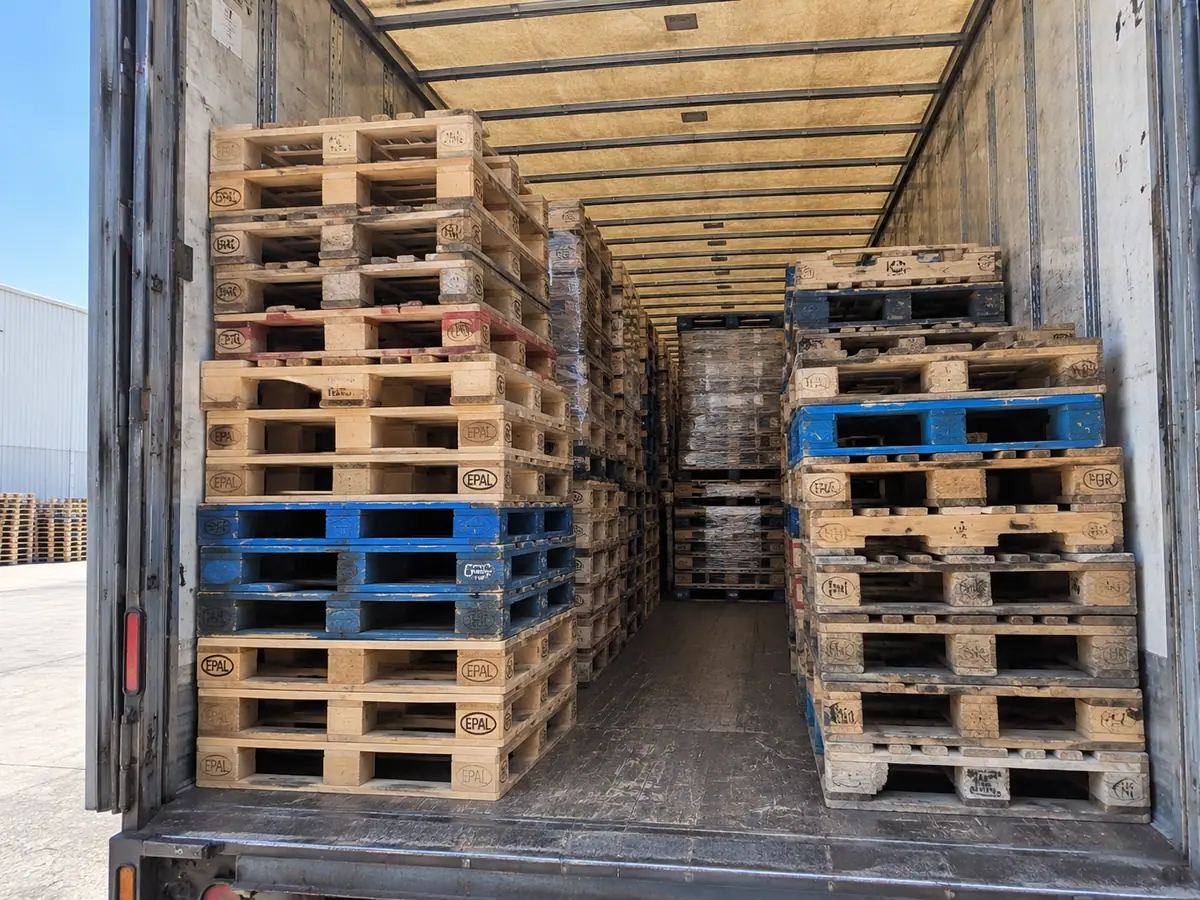
Have us look at the load
Describe the product, its weight and how it is handled. We will tell you whether a standard footprint will do — which, more often than not, it will.
- Written quotes, usually inside one business day
- Loads from 100 pallets to full 53' trailers
- We buy as readily as we sell — tell us which way it flows
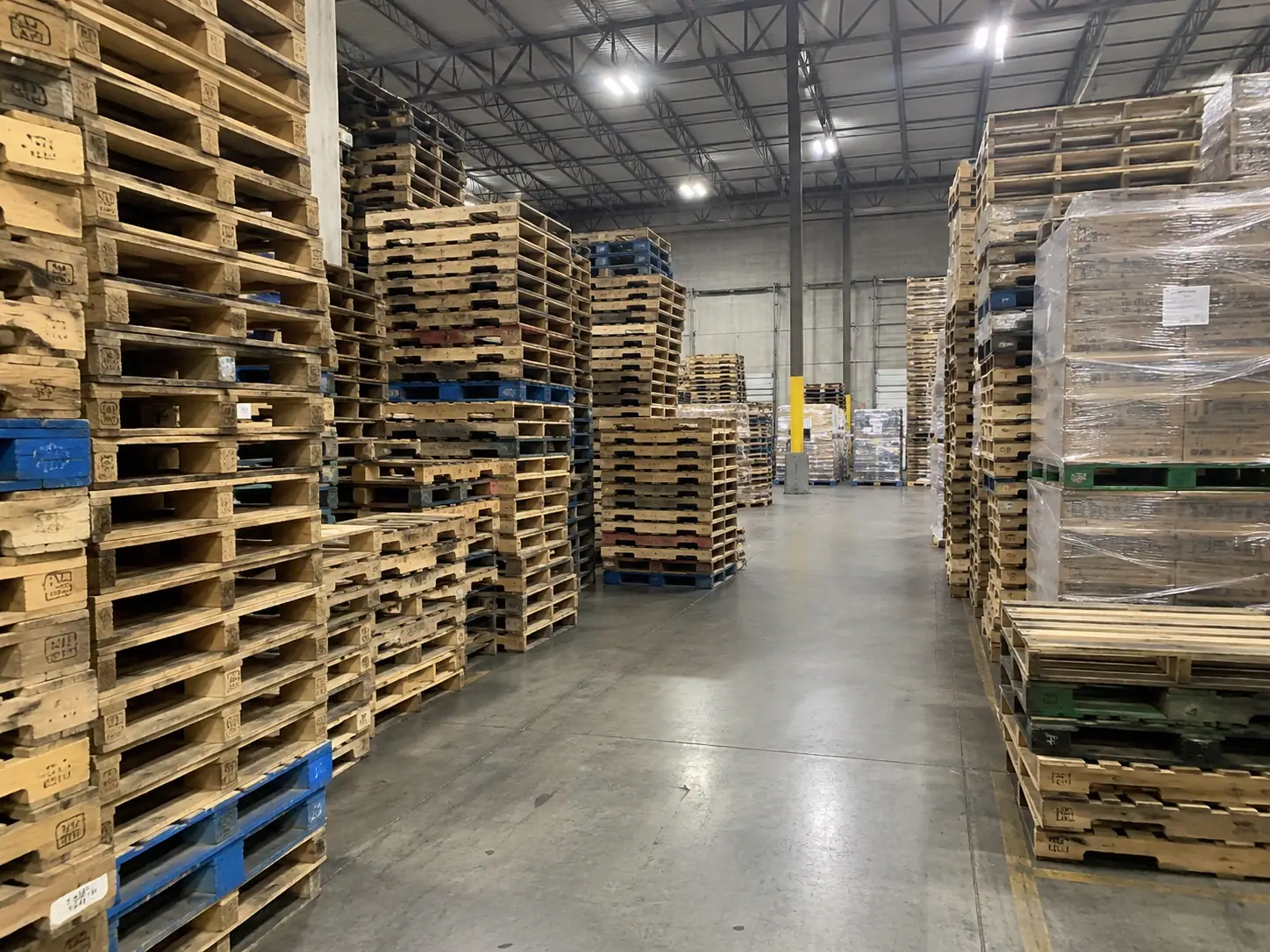
Inside the building
The sort aisle at half past seven. Graded stock on the left, waiting to be worked on the right.
The method
How to specify a pallet properly.
- Step 01
Measure the unit load, not the product
The dimension that matters is the outside of the assembled load — cases, slip sheets, corner boards and stretch wrap included. Measure it on a real pallet with a real load, not from a CAD drawing.
Add nothing for 'safety'. Overhang is worse than underhang.
- Step 02
Check the destination before the origin
Racking beam length, conveyor width, trailer door, and the receiver's pallet policy. A footprint that works in your building and jams at your customer's is a failure.
This is the step people skip.
- Step 03
Decide the load case
Static, dynamic or racked — and if racked, whether the pallet is edge-supported or fully supported. Racked, edge-supported is the demanding case and it drives stringer and deck dimensions.
See [load capacity explained](/resources/pallet-load-capacity).
- Step 04
Then choose members
Deck board thickness, board count and spacing, stringer dimension and species. This is where cost lives, and it is the last decision, not the first.
We will propose two specs: the cheap one and the durable one.
Rules of thumb
Numbers worth knowing before you draw anything
| Question | Rule of thumb | Why |
|---|---|---|
| How much overhang is acceptable? | None, ideally; 1″ maximum | A 1″ overhang costs roughly 30% of corrugated stack strength |
| How much underhang is acceptable? | Up to about 1″ each side | More than that and you are shipping air and loading the deck centre |
| Deck board thickness | 9/16″ hardwood typical; 5/8″–3/4″ for heavy loads | Deflection under a concentrated load |
| Deck board spacing | Gaps under 3.5″ for most cases | Small cases fall through wider gaps |
| Stringer dimension | 1⅜″ × 3½″ standard; 1⅝″ × 3½″ heavy | Racked span is the governing case |
| Fork opening height | 3½″ minimum | Below this, some jacks will not enter |
| Bottom deck coverage | ≥ 40% of footprint for racking | Beam contact area governs racked capacity |
| Maximum practical footprint | 96″ × 48″ | Beyond this you are building a skid or a crate |
The hidden costs
What a custom footprint costs you after year one.
The purchase price of a custom pallet is typically 15 to 30% above the equivalent standard size. That is the visible cost, and it is the smallest one.
The real costs arrive later: you cannot buy replacements at short notice when a load is damaged, you cannot sell the fleet at end of life for anything like GMA money, you cannot participate in any exchange or pool arrangement, and every new customer, carrier and third-party warehouse has to be told about your exception.
We build custom pallets and we are glad to. We would just rather you went into it having priced the whole decade rather than the first invoice.
- 15–30% price premium per unit, permanently
- No spot-market availability when you run short
- End-of-life value typically 40–60% of a GMA core
- Excluded from pooling and exchange arrangements
- Every 3PL and carrier needs briefing on the exception
- Minimum order quantities on every reorder
Custom 60 × 48
The alternatives
Four things to try before going custom
- 01Change the case sizeOften far cheaper than changing the pallet. A small adjustment to case dimensions can make a load tessellate onto a 48×40 with no overhang at all.
- 02Change the patternPinwheel, block-stack, column-stack, brick — the same cases arranged differently can fit a standard footprint. Ask a packaging engineer before a pallet supplier.
- 03Use a slip sheet or a top frameFor loads that are marginally too big, a top frame under the wrap can control the overhang without changing the platform.
- 04Use a standard size from a different regionA 1200 × 1000 mm or a 48 × 45 is non-standard for you but standard somewhere, which means it is still buyable. Better than a bespoke rectangle.
Questions
Custom sizing questions
What is the minimum order for a custom size?
250 units for a production run. Prototypes are built individually so you can load and abuse one before committing.
Can you reverse-engineer a pallet we already use?
Yes. Send us one, or send photographs with a tape measure across the deck and the stringer face. We will produce a spec sheet and quote against it.
Should a custom pallet be new or recycled?
Custom footprints are usually built new, because recycled cores in that size do not exist. Where the design allows, we build with recovered lumber, which brings both the price and the embodied carbon down substantially.
Can you test the design?
Load testing to ISO 8611 is available through a partner laboratory where a specification requires documented ratings. For most applications a loaded prototype and a week in your own operation tells you more.
Send a photo of the load on its current pallet.
With a tape measure in the shot. That one image plus a weight is enough for us to tell you whether you need a custom footprint at all.