Product 04
Plastic pallets: reconditioned, new, and honestly assessed.
Price plastic stock
Give us the quantity, the size and the ZIP. You'll get a written quote with the grade, the freight and the pickup window — not a sales call.
- Written quotes, usually inside one business day
- Loads from 100 pallets to full 53' trailers
- We buy as readily as we sell — tell us which way it flows
One stack
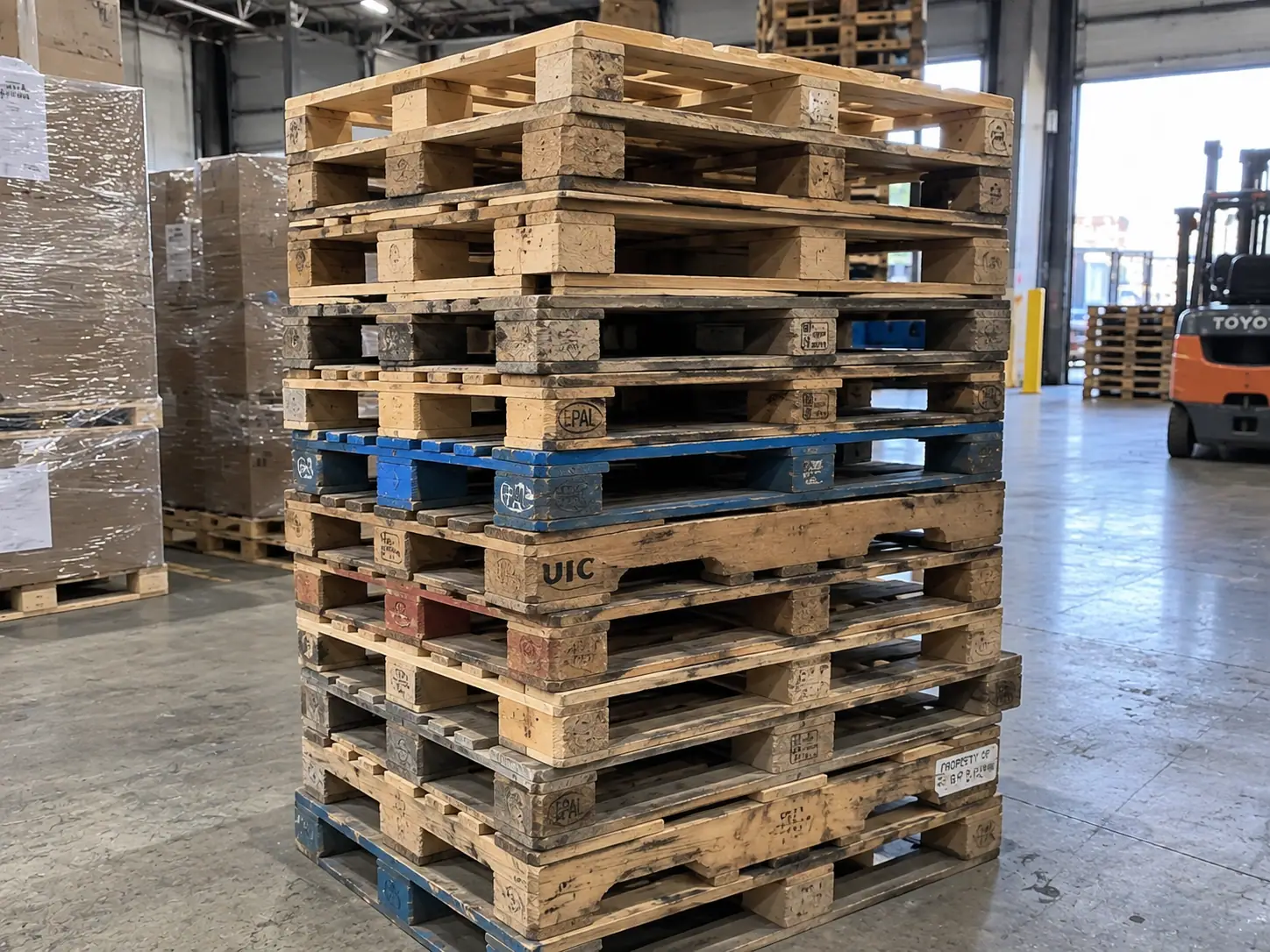
Fifteen high and square. A stack that leans is a stack somebody has to touch twice.
The comparison
Plastic against wood, without the sales pitch
| Recycled wood | New wood | Plastic (HDPE) | |
|---|---|---|---|
| Purchase price, 48×40 | $7.50 – $12.00 | $17 – $22 | $45 – $120 |
| Weight | 45–55 lb | 35–60 lb | 15–45 lb |
| Typical service life | 5–8 cycles | 10–25 cycles | 50–100+ cycles |
| Hygiene | Porous, cleanable to a point | Porous | Washable, non-absorbent |
| ISPM-15 | Required for export | Required for export | Exempt |
| Repairable | Yes, cheaply | Yes, cheaply | Rarely, and not economically |
| End of life | Mulch, fibre, energy | Mulch, fibre, energy | Regrind, if the resin is clean |
| Best for | Outbound and general freight | High-cycle internal use | Closed loops, hygiene, export |
The maths that decides it
Cost per cycle, not cost per pallet
A $60 plastic pallet that survives 80 internal cycles costs $0.75 a cycle. A $9 recycled wood pallet that survives six costs $1.50. On that arithmetic the plastic pallet is twice as cheap — provided it actually comes back eighty times.
The moment the pallet leaves your control, the arithmetic inverts violently. A plastic pallet that goes out on a one-way shipment and never returns cost you $60 to move one load. Loss rate, not durability, is the variable that decides this question, and it is the one most vendors do not want to discuss.
So the honest rule: closed loop with controlled returns, plastic is often right. Anything that leaves your building without a return mechanism, wood, every time.
Formats
What we stock and source
- 01NestableLight, stackable when empty at about a 4:1 ratio. Excellent for return logistics, weak in racking. Display and one-way-ish applications.
- 02RackableReinforced, often with steel rods through the rails. Genuine racking capability, typically 2,800 lb. The expensive end.
- 03Hygienic / open deckSmooth or open-grid decks for wash-down environments. Food processing, pharma, meat and dairy.
- 04ReconditionedUsed HDPE units, inspected, cleaned and sold at 40 to 60% of new. Where the resin is sound this is by far the best value in plastic.
Questions
Plastic pallet questions
Are plastic pallets actually more sustainable?
Only in a genuine closed loop. The embodied carbon of an HDPE pallet is several times that of a wood one, so it needs many cycles to break even. In a one-way application it is substantially worse, not better.
Do you take plastic pallets back?
Yes, on collection runs. Sound units are reconditioned and resold; broken units go to a resin recycler rather than into our wood stream. Mixing the two is how a diversion rate gets ruined.
Can plastic pallets be repaired?
Rarely economically. Welded repairs exist but a cracked HDPE deck usually means regrind. This is the main hidden cost against wood, which repairs for under $3.
What about fire code?
Idle plastic pallet storage is treated far more restrictively than wood under NFPA 13, with lower stack limits and stricter sprinkler requirements. Check with your fire protection engineer before switching a large fleet.
Format reference
Which plastic format does what
| Format | Typical price | Weight | Racked | Best for | Weakness |
|---|---|---|---|---|---|
| Nestable, light | $28 – $45 | 12 – 18 lb | Not rated | Display, one-way-ish, return logistics | No racking, low impact tolerance |
| Nestable, medium | $40 – $60 | 18 – 26 lb | Not rated | Closed loops with return leg | Still not rackable |
| Stackable, open deck | $55 – $80 | 25 – 35 lb | ≈ 1,500 lb | General closed-loop distribution | Moderate racking only |
| Rackable, steel reinforced | $85 – $130 | 35 – 48 lb | ≈ 2,800 lb | Racked closed loops | Cost; steel complicates recycling |
| Hygienic, smooth deck | $70 – $110 | 30 – 42 lb | ≈ 1,800 lb | Wash-down, food, pharma | Cost; slippery under some loads |
| Reconditioned HDPE | $22 – $55 | Varies | Varies | Best value in plastic where resin is sound | Availability is intermittent |
Before switching a fleet
Five checks that stop an expensive mistake
- 01Measure your loss rate firstCount out, count in, count what is left, for four weeks. Above about 4% loss per cycle, durability stops paying for itself and plastic is the wrong answer whatever the spec sheet says.
- 02Talk to a fire protection engineerIdle plastic pallet storage is treated far more restrictively than wood under NFPA 13. We have watched an operation switch for hygiene reasons and discover its storage area no longer complied.
- 03Check rackable versus nestable carefullyConfusing the two is a known cause of rack failures. Nestable units are not rated for racking and no amount of care changes that.
- 04Confirm your receivers will accept itSome will not, and some will not return it. A plastic pallet that goes out and stays out cost you sixty dollars to move one load.
- 05Plan the end of lifeClean single-resin units regrind. Steel-reinforced and mixed-resin units frequently do not, which is a real cost that rarely appears in the sales comparison.
The honest environmental picture
Plastic is better only in a genuine loop
An HDPE pallet carries roughly 90 to 130 kg CO₂e of embodied emissions. A recycled wood pallet carries about 1.2 kg. That is a difference of two orders of magnitude, and it means the plastic unit needs a very large number of cycles simply to draw level.
In a genuine closed loop with a low loss rate, it gets there and then keeps going, and the lifetime figure genuinely favours plastic. That is a real case and we will not argue against it.
In one-way use it never gets close. A plastic pallet that makes a single trip is one of the worst packaging decisions available, environmentally and financially, and it happens more often than the industry likes to discuss.
The convenient part is that the loss rate decides both the cost question and the carbon question simultaneously, so there is no trade-off to agonise over. Measure it and both answers appear at once.
Questions
More plastic pallet questions
Do you stock plastic or source it?
Both. Reconditioned HDPE we hold when we have it, which is intermittent. New units we source to specification, usually with a one to two week lead time.
Can plastic pallets be repaired?
Welded repairs exist and are rarely economic. A cracked HDPE deck usually means regrind, which is the main hidden cost against wood — wood repairs for under three dollars.
What about hybrid or composite pallets?
Some perform very well. The catch is end of life: composite materials frequently cannot be separated, which means neither the wood nor the plastic stream can take them. That belongs in the comparison and is usually missing from it.
Are plastic pallets always exempt from ISPM-15?
Yes — the standard covers solid wood packaging only. That exemption is a genuine advantage on high-frequency export lanes and it is worth pricing properly.
Do you take plastic pallets back?
On collection runs, yes, as a separate stream. Sound units are reconditioned and resold; broken ones go to a resin recycler rather than into our wood grinder.
Tell us the loop, not the pallet.
How many go out, how many come back, and how often. That answers the plastic question faster than any spec sheet.