Product 03
Heat-treated ISPM-15 pallets, stamped so the shipment does not stop at the border.
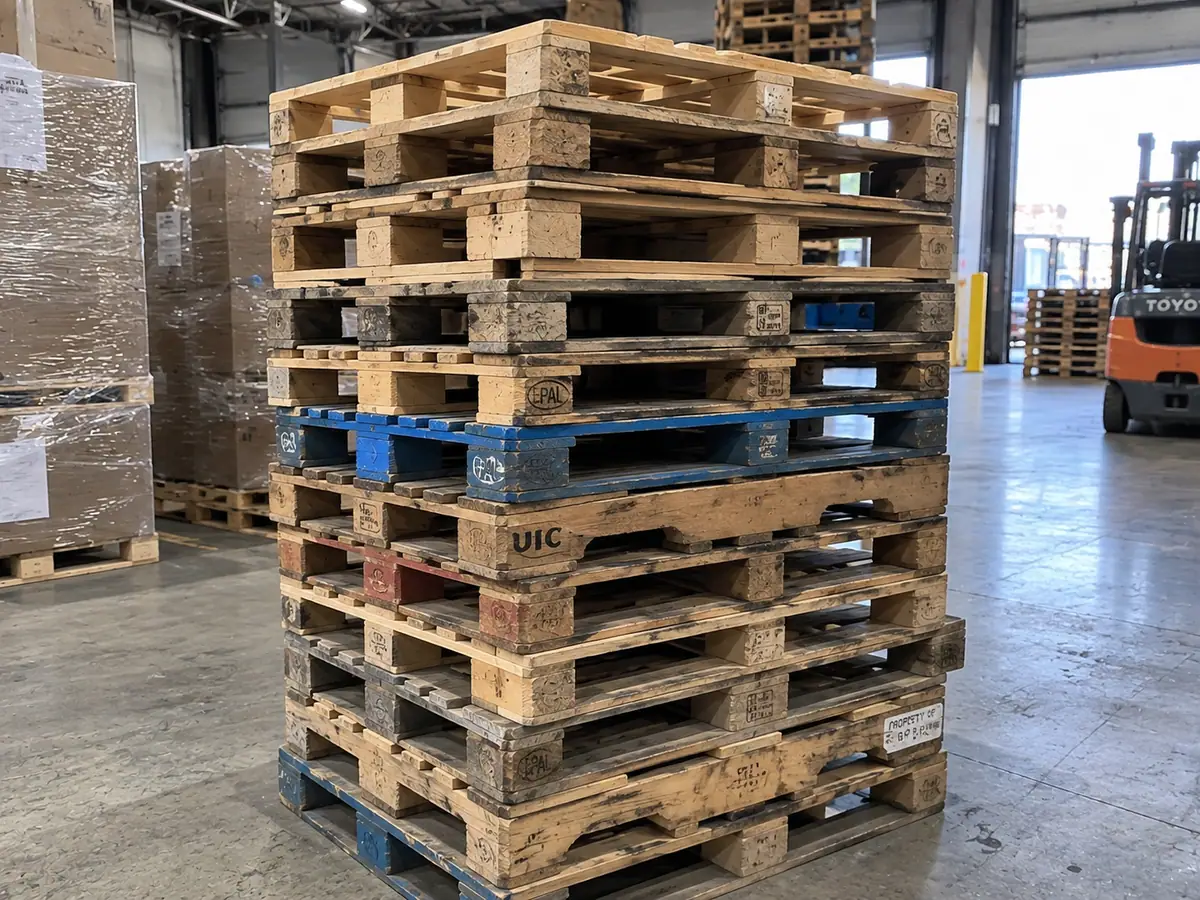
Order export-ready stock
Give us the quantity, the size and the ZIP. You'll get a written quote with the grade, the freight and the pickup window — not a sales call.
- Written quotes, usually inside one business day
- Loads from 100 pallets to full 53' trailers
- We buy as readily as we sell — tell us which way it flows
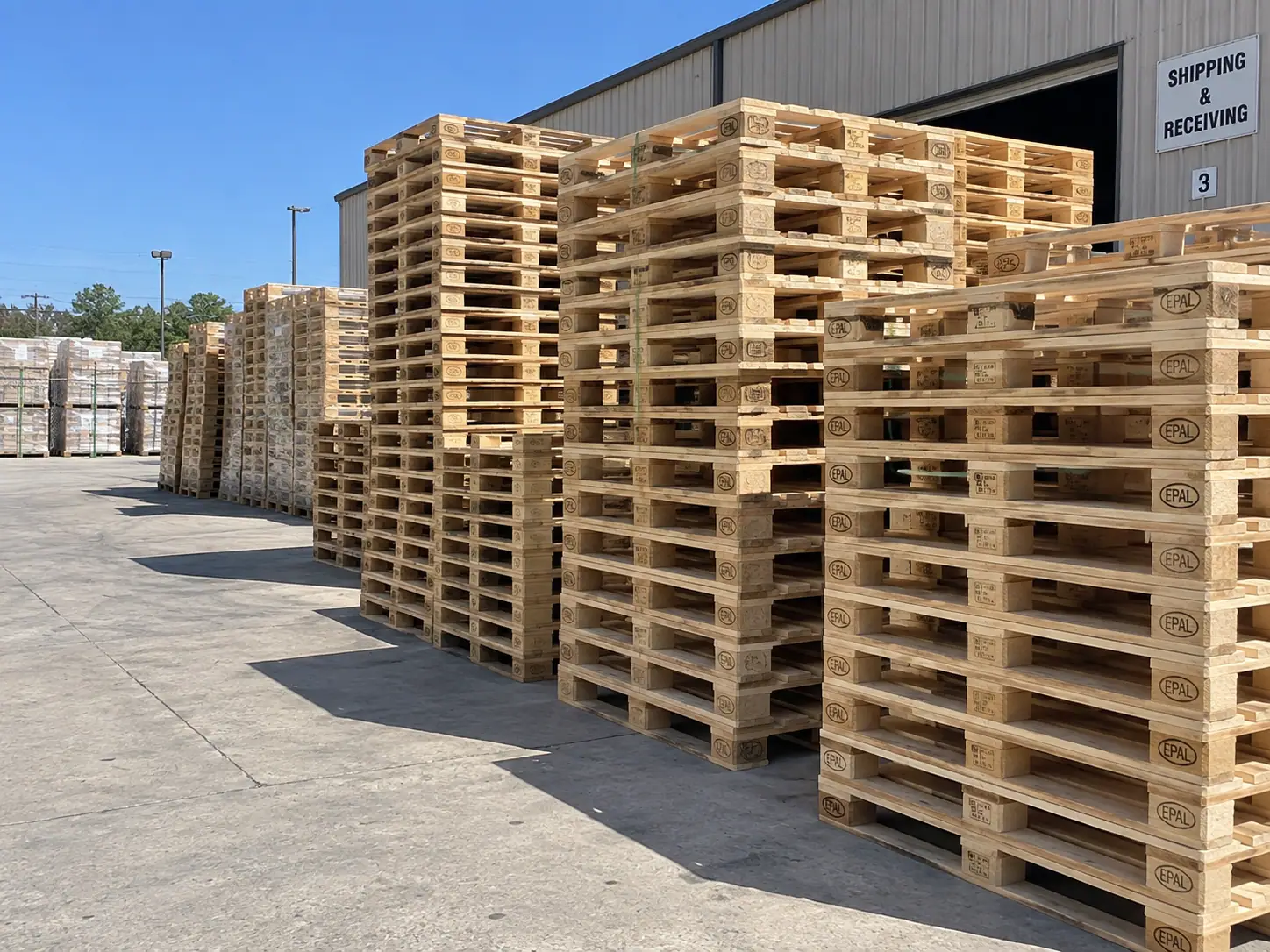
Outbound
Banded, counted and staged against the door. Stacks of fifteen, double-banded, the way a forklift expects them.
Reading the stamp
What each part of the mark means.
A valid mark carries four elements: the IPPC wheat symbol, a two-letter ISO country code, a unique facility registration number issued by the national plant protection organisation, and the treatment code — HT for heat treatment, DH for dielectric heating, MB for methyl bromide.
In the United States the mark also usually carries the certifying agency's logo. The mark must appear on at least two opposing sides of the unit, be legible, and be permanent — stencilled or branded, never on a sticker.
MB-marked material is a different animal. Methyl bromide is being phased out globally, many countries no longer accept it, and we do not process it through our recycling stream at all.
- IPPC wheat symbol — never a plain text stamp
- ISO country code, e.g. US
- Facility registration number issued nationally
- Treatment code: HT, DH or MB
- Marked on at least two opposing sides, legible and permanent
Where it goes wrong
Four ways a compliant pallet becomes non-compliant
- 01Repaired with untreated lumberThe single most common failure. Any replacement component on a marked pallet must itself be heat treated, and the unit re-marked. A repair yard that does not track this will quietly break your compliance.
- 02The mark is painted or filmed overStretch wrap over the stamp, a shipping label across it, or a coat of yard paint. If an inspector cannot read it, it does not exist.
- 03Kiln dried mistaken for heat treatedKD and HT are different processes with different temperature requirements. A KD stamp is not an ISPM-15 mark and will not clear.
- 04Bark left onSome destinations require debarked wood in addition to treatment. Residual bark on a stringer edge is enough to trigger an inspection hold.
Practicalities
What we can supply
| Type | Availability | Marking | Typical use |
|---|---|---|---|
| Recycled 48×40 GMA, HT | Held in stock | Existing valid mark, verified | General export freight |
| New 48×40 GMA, HT | Built to order, 250+ | Our facility mark applied | Regulated and high-value exports |
| Euro 1200 × 800, HT | 3–7 days | EPAL or generic HT | European lanes |
| Custom crates and skids, HT | Built to order | Our facility mark applied | Machinery, oversize, one-way |
| Treatment of your own units | By arrangement | Re-marked after treatment | Existing fleets going international |
Questions
ISPM-15 questions
Do I need heat treated pallets for domestic shipping?
No. ISPM-15 applies to international movements of solid wood packaging. Shipping Columbus to Cleveland, it is irrelevant, and paying for it is money wasted.
Does Canada or Mexico require it?
Wood packaging moving between the United States, Canada and Mexico has historically been exempt under a regional arrangement, but requirements change and depend on the commodity. Confirm with your broker for each lane rather than relying on precedent.
Can plastic pallets avoid the whole problem?
Yes — ISPM-15 covers solid wood only, so plastic pallets are outside its scope entirely. For high-frequency export lanes that is sometimes the cheaper answer over the life of the fleet.
What happens if a shipment is held?
Typically re-export, treatment at the port at your cost, or destruction — plus demurrage while it is resolved. The cost of getting this wrong is measured in thousands, which is why we are pedantic about it.
Destination requirements
Where the rules differ, in practice
| Destination | ISPM-15 | Debarking | Notes |
|---|---|---|---|
| European Union | Required | Commonly required | Marks checked routinely at major ports |
| United Kingdom | Required | Commonly required | Separate from EU requirements since 2021 |
| China | Required | Required | Strict enforcement; MB frequently refused |
| Japan | Required | Required | Very strict inspection regime |
| Australia / New Zealand | Required | Required | Among the strictest biosecurity regimes anywhere |
| Brazil | Required | Required | MB accepted in some cases, but declining |
| Canada / Mexico | Check per lane | Check per lane | Regional arrangements exist and change |
| Domestic United States | Not required | Not required | Paying for treatment here is money wasted |
The treatment cycle
What happens inside the chamber.
- Step 01
Load and probe
A fixed stacking pattern, with temperature probes drilled into the members expected to heat last — usually a stringer in the centre of the load, not a deck board on the outside.
20 – 30 minutes.
- Step 02
Ramp
Chamber to temperature. The core lags substantially behind the air, which is the entire reason probe placement matters more than chamber setting.
90 – 150 minutes.
- Step 03
Hold
Core at or above 56 °C, continuously, everywhere in the load, for at least thirty minutes. The chart records it and the chart is the evidence.
30 minutes minimum.
- Step 04
Cool, mark and file
Chart printed and filed against the batch. Mark applied — wheat symbol, country code, our facility number, treatment code — on at least two opposing sides.
45 – 60 minutes.
Compliance in the supply chain
The four questions to ask everyone who touches your export pallets
Your supplier: is the mark yours, or inherited from a previous treatment? Both are valid, but an inherited mark means the compliance chain runs through somebody you have never met.
Your repair yard: do you segregate ISPM-15 stock, repair it only with treated lumber and re-mark afterwards? This is the most common failure point in the entire system and it is invisible until an inspector finds it.
Your warehouse: where do labels go? A shipping label applied across the mark makes a compliant pallet non-compliant, and it is done by a machine that has no opinion about customs.
Whoever loads your containers: is the dunnage treated? Blocking and bracing timber is covered by the rule and it is forgotten constantly, because it is offcuts rather than packaging in most people's mental model.
Questions
More ISPM-15 questions
How long does treatment last?
Indefinitely, as long as the wood is not replaced. Treatment is a heat history rather than a coating — it does not wear off. What invalidates it is adding untreated material.
Can I heat treat pallets myself?
Only if your facility is registered under the national scheme and marks with its own registration number. Applying an IPPC mark without registration is fraud rather than a shortcut, and the numbers are traceable.
Does heat treatment sterilise the pallet?
No, and nobody should claim it does. It kills wood-boring insects and larvae. It is a phytosanitary treatment, not a hygiene one, and food-sector requirements are a separate conversation.
What if my pallet has an old, faded mark?
If an inspector cannot read it, it does not exist. Faded, painted-over and abraded marks are functionally absent. We re-mark treated stock where the original has degraded.
Do plywood or presswood pallets need treatment?
No. Processed wood products — plywood, OSB, particleboard, moulded presswood — are outside the scope because the manufacturing process already does the job. Solid wood over 6 mm is what the rule covers.
Tell us the destination country.
It changes the answer more than the pallet does. Give us the lane and the commodity and we will tell you what actually needs to be stamped.