Comparison
Grade A vs Grade B: one question decides it.
Order a specific grade
Give us the quantity, the size and the ZIP. You'll get a written quote with the grade, the freight and the pickup window — not a sales call.
- Written quotes, usually inside one business day
- Loads from 100 pallets to full 53' trailers
- We buy as readily as we sell — tell us which way it flows
Outbound
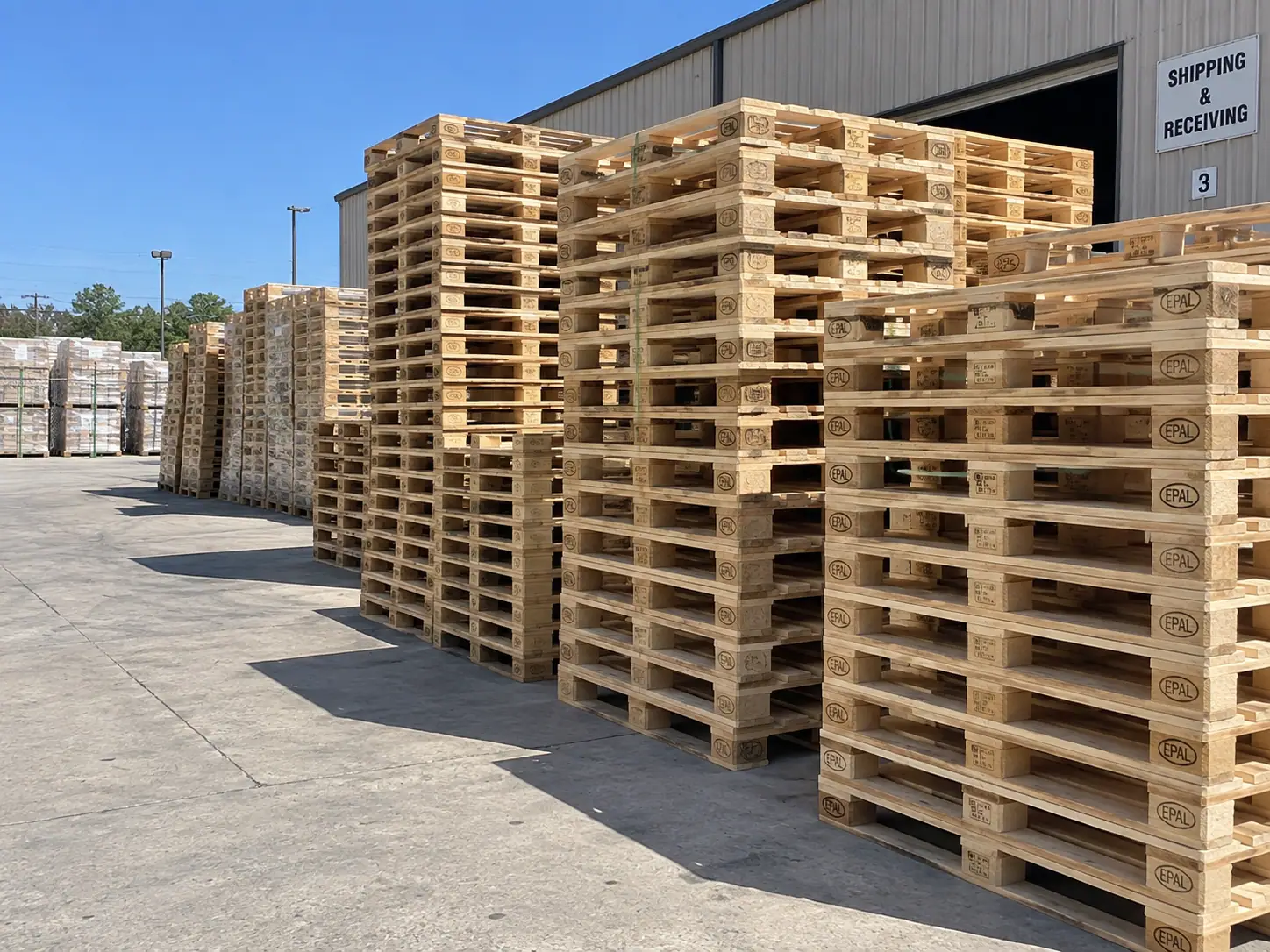
Banded, counted and staged against the door. Stacks of fifteen, double-banded, the way a forklift expects them.
The difference
Where the two grades genuinely diverge
| Grade A (#1) | Grade B (#2) | Does it matter to you? | |
|---|---|---|---|
| Replaced deck boards | 0, or full-length only | Up to 2 | Only under concentrated loads |
| Stringer repairs | None permitted | One companion permitted | Critical in racking |
| Racked capacity | ≈ 2,100 lb | ≈ 1,500 lb | Critical in racking |
| Dynamic capacity | ≈ 3,000 lb | ≈ 2,200 lb | Matters on a forklift |
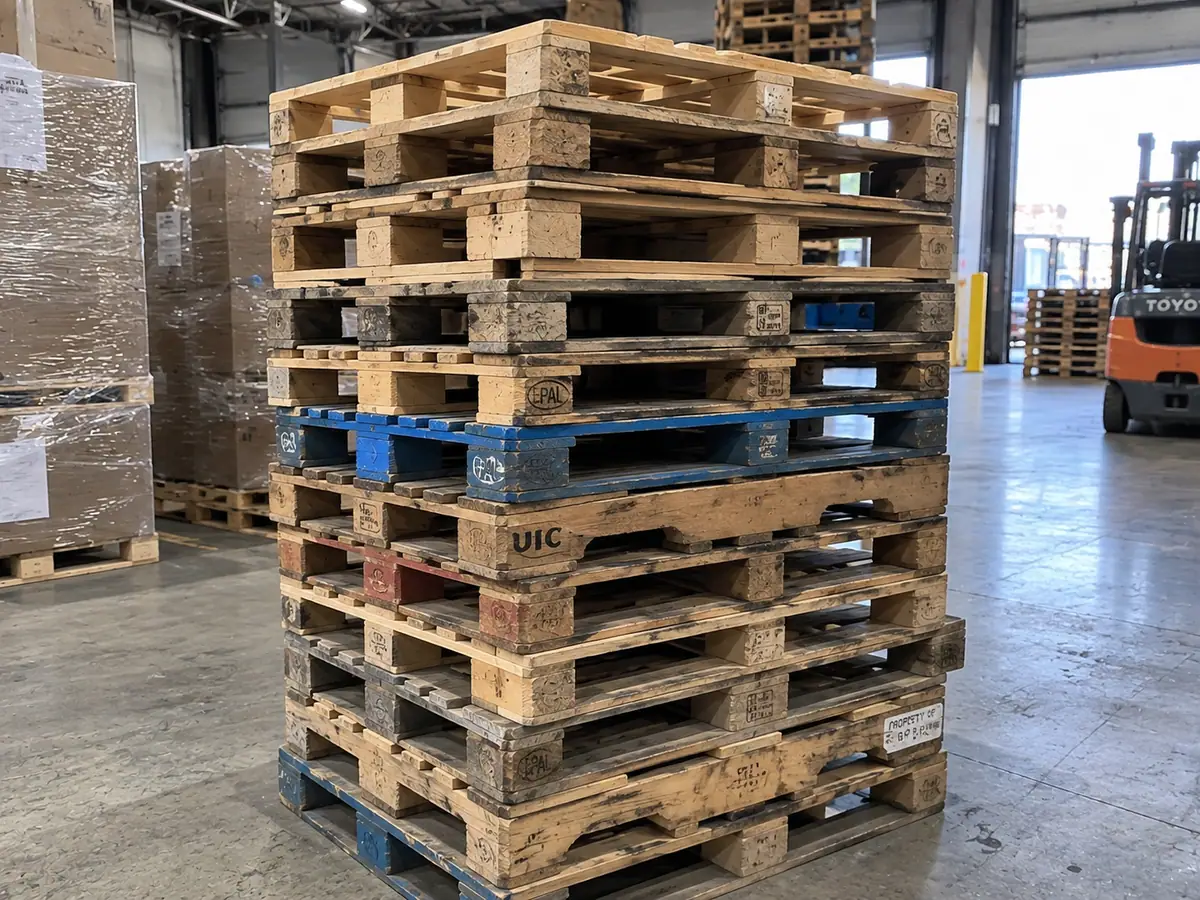
| Appearance | Uniform | Mixed colour, visible repairs | Only if a customer sees it |
| Expected remaining life | 3–5 further cycles | 1–3 further cycles | Decisive for returnable fleets |
| Price, 48×40 | $7.50 – $12.00 | $5.00 – $8.50 | Always |
| Availability | Good | Excellent | Rarely binding |
The arithmetic
Cost per cycle, again.
A Grade A unit at $9.50 that survives four more cycles costs $2.38 a cycle. A Grade B unit at $6.50 that survives two costs $3.25. On a returnable fleet, the more expensive pallet is the cheaper one — comfortably.
Invert the assumption and the answer inverts with it. On a one-way shipment, the pallet does exactly one cycle regardless of grade. $6.50 beats $9.50 and nothing else about the comparison matters.
So the decision rule is not about quality at all. It is about whether the pallet comes back. Everything else follows from that single question.
- Returnable, racked or internal fleet → Grade A, essentially always
- One-way outbound to a customer → Grade B or remanufactured
- Food, pharma or automated handling → Grade A regardless of direction
- Mixed operations → buy both, and label the stacks so they do not get mixed
48 × 40 · both grades
Common mistakes
Four ways operations get this wrong
- 01Buying A for everythingThe safe-looking decision that quietly costs a large operation tens of thousands a year on outbound loads that never come back.
- 02Buying B for rackingThe dangerous one. A companion-repaired stringer under a racked load is exactly the failure mode that drops product from height.
- 03Mixing the two in one stackOnce mixed, they cannot be separated without handling every unit. Label the stacks, separate the storage, and brief the forklift drivers.
- 04Comparing quotes without comparing definitionsAnother yard's Grade A may permit stringer repairs. A cheaper Grade A quote is often a Grade B by our definition. Ask the question directly.
Questions
A vs B questions
Can I buy an A/B mix?
Yes, and it is priced between the two. It works well if you know the ratio and your application tolerates the lower end. It works badly if you are racking, because you cannot tell which is which without inspecting every unit.
Does Grade B mean damaged?
No. Grade B means repaired or cosmetically used, but structurally sound and fully serviceable. Damaged units do not get a grade — they get dismantled or ground. See pallet recycling.
Will a Grade B pallet pass a customer's inspection?
Usually, unless the customer specifies otherwise. Big-box retailers and food distributors frequently do specify, and their receiving teams do check. Ask your customer before you save the money.
Can Grade B be upgraded?
A Grade B unit that dropped a grade only because of deck boards can be repaired to Grade A. One that dropped because of a stringer repair cannot — the repair is permanent. See repair standards.
Tell us the application, not the grade.
Describe where the pallet goes and whether it comes back. We will tell you which grade to buy, including the times it is the cheaper one.