Cost guide · 9 min read
Reducing pallet costs: where the money actually leaks.
Last reviewed January 2026 · Written by the RePallet USA yard team
Ask us about anything on this page
These guides are written by the people who grade the pallets. If something here does not match your situation, tell us in the message field.
- Written quotes, usually inside one business day
- Loads from 100 pallets to full 53' trailers
- We buy as readily as we sell — tell us which way it flows
Intake
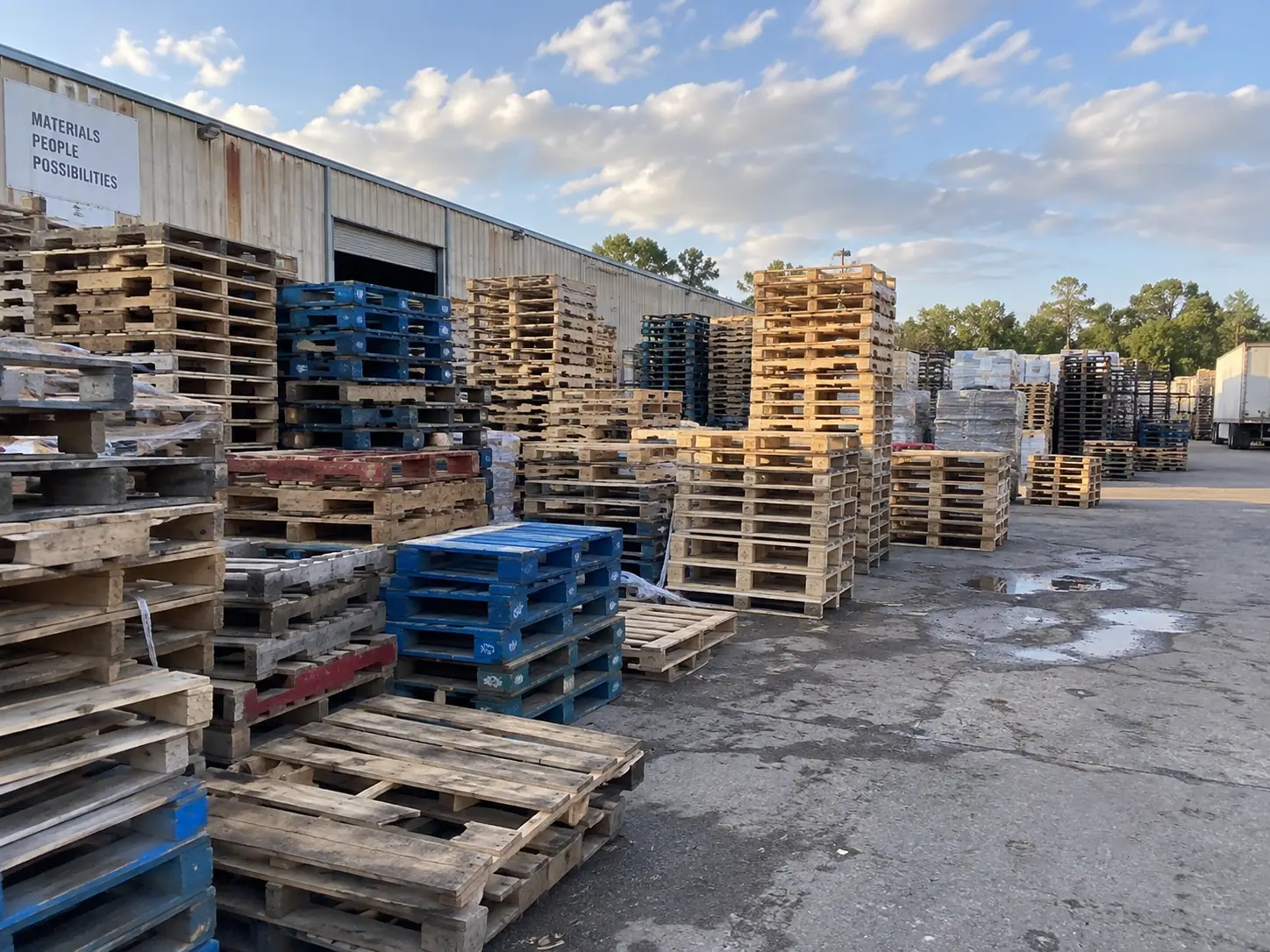
Mixed cores straight off a collection run. Every one of these gets a grader's four-way decision before it goes anywhere.
Ranked by return
The five leaks, largest first
- 011. Emergency purchasesRunning short on a Friday and buying whatever anyone will deliver, at whatever price. At most sites this is the single largest avoidable cost, and a held buffer eliminates it entirely. Fixing it costs nothing but an agreement.
- 022. Loss ratePallets that leave and never come back. Most operations have never measured this. Count out and count in for one month; if the gap is over 5% per cycle on a returnable fleet, that is your biggest number and no unit price will touch it.
- 033. FreightTypically 20 to 35% of delivered cost, and entirely a function of distance. A yard 40 miles away at $8.50 delivered beats one 300 miles away at $7.25. Always compare delivered, never FOB.
- 044. Double handlingEmpties moved to make space, then moved again to load out. Every touch is forklift minutes nobody budgeted. A fixed collection slot and a defined staging area removes most of it.
- 055. Grade mismatchBuying Grade A for one-way outbound, or Grade B for racking. The first wastes money, the second causes damage. Both are common and both are free to fix.
Worked example
A mid-sized distributor, 40,000 pallets a year
| Line | Before | After | Change |
|---|---|---|---|
| Base purchases, 36,000 @ $9.20 | $331,200 | $331,200 | — |
| Emergency purchases, 4,000 @ $14.50 → 0 | $58,000 | $0 | −$58,000 |
| Buffer stock, 4,000 @ $9.20 | — | $36,800 | +$36,800 |
| Removal of damaged units | $14,400 | $4,800 | −$9,600 |
| Core sales credit | $0 | −$21,000 | −$21,000 |
| Repair programme | $0 | $16,800 | +$16,800 |
| Replacement purchases avoided | — | −$41,400 | −$41,400 |
| Total | $403,600 | $327,200 | −19% |
The thing to notice
The unit price never moved
In the example above, the base purchase price is identical before and after. Every dollar of the 19% came from eliminating emergencies, capturing core value, repairing instead of replacing, and cutting removal volume.
This is the general pattern. Unit price is the most visible number and the most negotiated, and it is usually the one with the least room in it — pallet margins are thin and a supplier who drops 25% is going to find it back somewhere, usually in the grade.
The costs that actually have room in them are operational, which means they are yours to fix rather than your supplier's. That is inconvenient but it is also good news: they do not require anyone else's agreement.
Questions
Cost questions
How do I measure loss rate?
Count pallets out and pallets in for one month, adjusting for stock on hand. The gap divided by outbound units is your loss rate per cycle. Almost nobody does this and almost everybody is surprised.
Is a buffer worth the working capital?
Almost always. A buffer of two weeks' usage costs you the carrying cost of that stock and saves the spread between contract and spot pricing, which in a tight spring can be 40%.
Should we switch to a pooling arrangement?
Depends entirely on your flow pattern. Pooling converts a capital cost into a per-trip cost and shifts the loss risk. Sometimes better, sometimes far worse. See pooling vs buying.
Where should we start?
Add up twelve months of pallet purchases, removal invoices and freight. Most organisations have never seen those three numbers on one page, and the exercise usually identifies the answer on its own.
We will build the number for you.
Send twelve months of purchase and removal invoices and we will assemble the real total cost — free, and with no obligation to do anything about it.