Size library
The 48″ × 40″ GMA pallet: the most consequential rectangle in American logistics.
Price 48" × 40" stock
Give us the quantity, the size and the ZIP. You'll get a written quote with the grade, the freight and the pickup window — not a sales call.
- Written quotes, usually inside one business day
- Loads from 100 pallets to full 53' trailers
- We buy as readily as we sell — tell us which way it flows
Intake
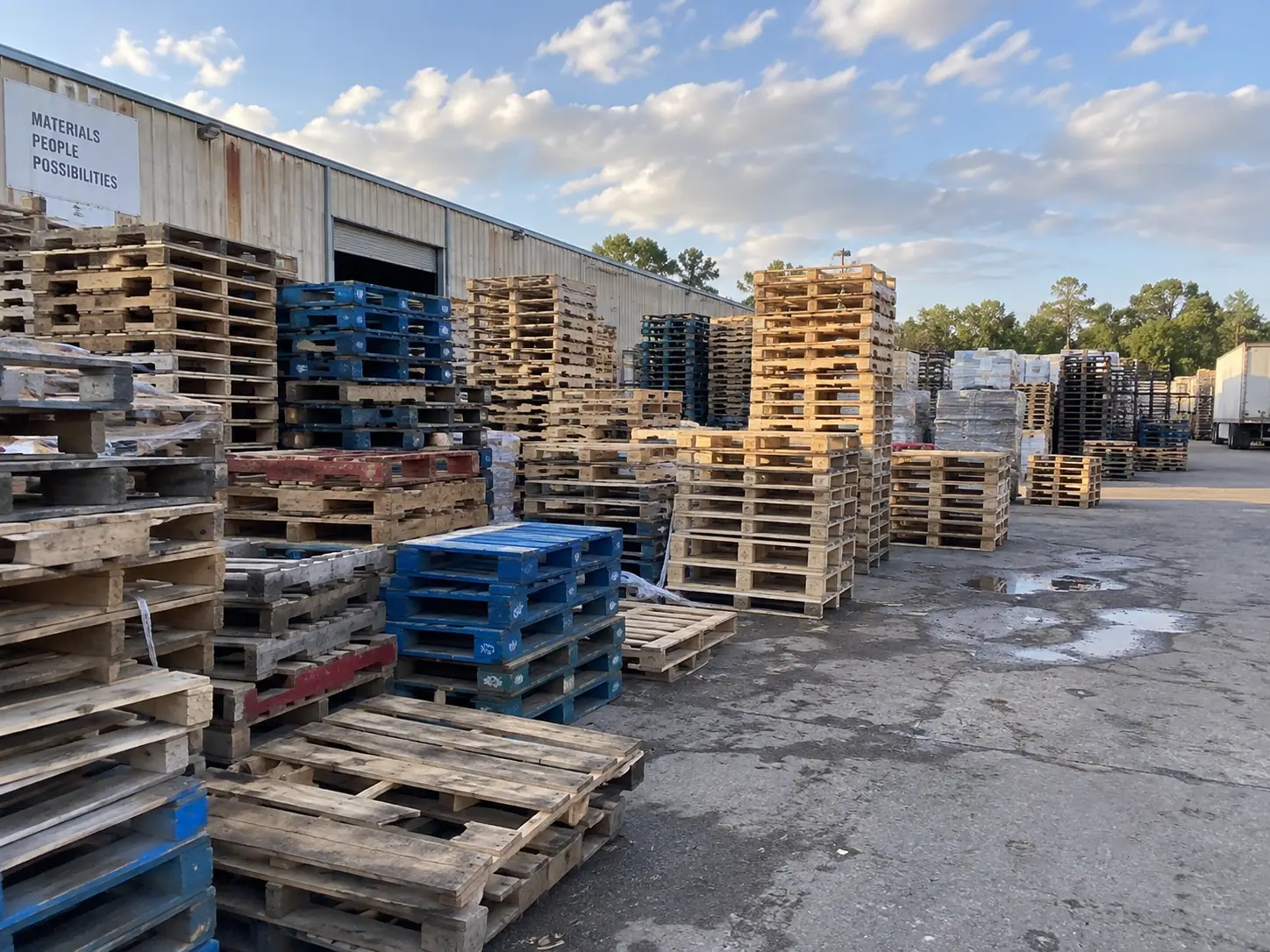
Mixed cores straight off a collection run. Every one of these gets a grader's four-way decision before it goes anywhere.
Drawn to scale
48" × 40" — 1219 × 1016 mm
6,000 lb
Static load
3,000 lb
Dynamic load
2,100 lb
Racked load
45 lb
Unit weight
5.5″
Overall height
7/3
Deck boards, top / bottom
48" × 40" · 7 top boards · 3 stringers
Why this size
Forty-eight by forty is not an accident
The footprint came out of the Grocery Manufacturers Association in the 1960s, and it was chosen for one dominant reason: it fits an American trailer. Two 48-inch dimensions side by side is 96 inches, and a standard dry van interior is 98 to 100 inches wide. Two pallets across, turned, with a couple of inches of clearance for the driver's sanity.
Everything else follows from that. Grocery case sizes, racking beam lengths, the width of a standard warehouse aisle, the dimensions of a shrink-wrap turntable — all of it settled around a rectangle that was originally chosen to fit a truck.
The practical consequence for you is liquidity. A 48×40 can be bought at short notice in almost any American city, sold at the end of its life for real money, and returned into a pool. No other footprint has that.
Loading
How many fit
| Equipment | Floor count | Two high | Three high |
|---|---|---|---|
| 53′ dry van | 26 units | ≈ 330 units | Not typical — height |
| 48′ dry van | 24 units | ≈ 300 units | — |
| 40′ container | 20 units | ≈ 240 units | — |
| 20′ container | 10 units | ≈ 120 units | — |
| Standard rack bay | 2–3 units per level | — | By beam length |
Questions
48 × 40 questions
Is a GMA pallet the same as a standard pallet?
In North America, in casual conversation, yes. Strictly, GMA describes a specification — the deck layout, board count and notch pattern — not just the footprint. A 48×40 with five deck boards and no notches is 48×40, but it is not a GMA pallet.
Which dimension is the length?
The 48-inch dimension runs with the stringers and is conventionally quoted first. This matters for racking: the stringers are the load-bearing members, so a pallet loaded across the beams the wrong way is dramatically weaker.
How much does one weigh?
45 to 55 lb for a recycled hardwood unit, 35 to 42 lb for a new SPF unit, and 50 to 60 lb for new hardwood. On a full trailer of 330 units that is a spread of about 3,000 lb, which matters if you gross out.
What does one cost right now?
In central Ohio through 2025, $7.50 to $12.00 recycled Grade A, $5.00 to $8.50 Grade B and $17 to $22 new. Ask through the form for this week's actual number.
The build, member by member
What a GMA specification actually says
| Member | Specification | Count | Notes |
|---|---|---|---|
| Top deck boards | 9/16″ × 3½″ – 5½″ × 40″ | 7 | Lead boards are usually the widest |
| Bottom deck boards | 9/16″ × 5½″ × 40″ | 3 | Coverage governs racked capacity |
| Stringers | 1⅜″ × 3½″ × 48″ | 3 | The load-bearing members |
| Notches | 9″ long × 1½″ deep | 4 (2 per outer stringer) | Partial four-way access |
| Fasteners | Helically threaded or stiff-stock | 78 – 90 | Holding power decides service life |
| Overall height | 5½″ | — | The dimension automation cares about |
| Deck opening | 3½″ minimum | — | Below this some jacks will not enter |
| Species | Mixed northern hardwood | — | Oak, maple, poplar, gum, ash |
Common variants
Five things sold as 48×40 that are not GMA
- 01Five-board deckTwo fewer top boards, wider gaps, less deck coverage. Frequently a remanufactured unit and perfectly serviceable at Grade B ratings — but not a GMA.
- 02Two-way (unnotched)No fork notches, so entry only from the 40-inch ends. Cheaper and a nuisance if your operation assumes four-way access.
- 03Light deck (5/16″)Thinner top boards. Measurably weaker under concentrated loads and a common feature of very cheap new pallets.
- 04Block construction, 48×40Nine blocks rather than three stringers. Genuinely four-way, better dimensional consistency, more expensive and much harder to repair.
- 05Softwood buildSPF rather than hardwood. Lighter, cheaper, worse nail retention, and it will not last as long in a returnable fleet.
Buying advice
How to specify a GMA order so it arrives right
Say GMA and say the grade. 'Forty-eight by forty' describes a rectangle. 'Grade A recycled 48×40 GMA' describes a product.
Ask whether their Grade A permits a repaired stringer. The single most informative question in the trade, and it explains most of the price difference between two apparently identical quotes.
State whether it racks. It changes which units come off the stack, and it is the difference between a specification and a preference.
Give a delivered ZIP rather than asking for a unit price. Freight is 20 to 35% of the delivered cost of a pallet and comparing FOB prices between suppliers at different distances compares nothing.
Say if appearance matters. Display grade is a separate sort and nobody supplies it unless asked.
Questions
More 48 × 40 questions
Is the GMA specification a formal standard?
It is a widely-followed convention originating with the Grocery Manufacturers Association rather than a legally binding standard. There is no certifying body, which is precisely why buyers should compare written criteria rather than the letters A and B.
Why 5½ inches tall?
Two 9/16-inch deck boards plus a 3½-inch stringer plus a 9/16-inch bottom board is roughly 5⅜, and the convention rounded. It matters because automated storage systems plan clearances around it, and a unit at 5¾ inches will not fit.
How many fit in a 40-foot container?
Twenty on the floor, about 240 stacked two high. Our load planner works out mixed orientations for any equipment.
What does a GMA weigh empty?
45 to 55 lb recycled hardwood, 50 to 60 lb new hardwood, 35 to 42 lb new SPF. On a 330-unit trailer that is a spread of about 6,600 lb, which matters if you gross out.
Can a GMA be repaired back to specification?
Deck boards, yes — a full-length replacement of matched thickness restores it. Stringers, structurally yes with a companion, but in our grading that drops it to B, because racked loads test stringer repairs first.
Trailer maths
How many of these fit where.
53′ dry van
30
on the floor
≈ 60 stacked two high
48′ dry van
28
on the floor
≈ 56 stacked two high
40′ container
18
on the floor
≈ 36 stacked two high
20′ container
8
on the floor
≈ 16 stacked two high