The dimension library
Pallet sizes, drawn to scale and argued about properly.
Need a size we have not listed?
Put the dimensions in the message field. If it exists, we can usually find it; if it does not, we can build it.
- Written quotes, usually inside one business day
- Loads from 100 pallets to full 53' trailers
- We buy as readily as we sell — tell us which way it flows
Segregation
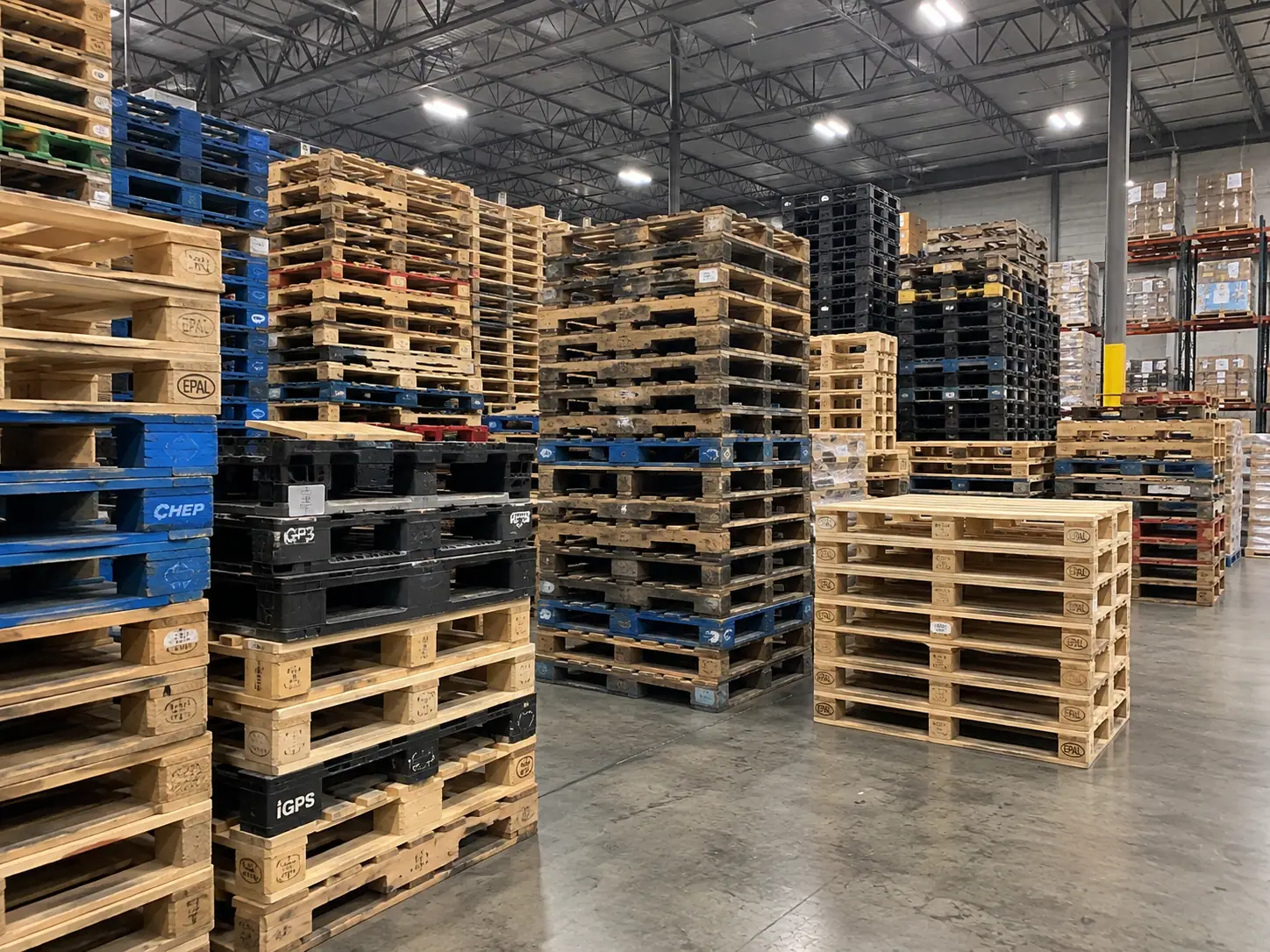
Sorted by type, not by convenience. Pooled units go back to the pool; plastic runs a separate stream entirely.
That said, the constraint is often real. Product that does not tessellate onto a 40-inch width, racking inherited from an acquisition, drums that need a square, a customer’s automated system that will only accept one thing — these are the situations where the size question actually matters, and where getting it wrong is expensive for a decade.
This page holds everything we know about the trade-offs. The interactive explorer below draws each footprint from its real dimensions and calculates how many fit in the equipment you actually use. Below that, the full comparison table, the international standards, and the questions we get asked most.
If you are considering a non-standard footprint, read the custom sizing guide first. It is the most expensive decision on this page.
Interactive
Pick a footprint. Watch it draw itself.
North American
48" × 40"
1219 × 1016 mm · 5.5″ tall · 45 lb
Roughly a third of every new pallet built in North America. Fits two-across in a 53-foot trailer with room to breathe.
- Static load
- 6,000 lb
- Dynamic load
- 3,000 lb
- Racked load
- 2,100 lb
- Top deck boards
- 7
- Stringers
- 3
- Bottom boards
- 3
Typically carries grocery, cpg, beverage, general freight.
How many fit
60 pallets — 30 on the floor, 2 high, loaded turned.
Floor count only. Real loads depend on product overhang, load height and whether the receiver will take a stacked pallet.
The full table
All twenty-two footprints.
| Size | Millimetres | Family | Static | Dynamic | Racked | Weight | Typical use |
|---|---|---|---|---|---|---|---|
| [48" × 40"](/pallet-sizes/48x40-gma) | 1219 × 1016 | North American | 6,000 lb | 3,000 lb | 2,100 lb | 45 lb | Grocery, CPG, beverage, general freight |
| [42" × 42"](/pallet-sizes/42x42) | 1067 × 1067 | North American | 6,000 lb | 3,000 lb | 2,000 lb | 48 lb | Telecom, paint, 55-gallon drums |
| [48" × 48"](/pallet-sizes/48x48) | 1219 × 1219 | North American | 7,000 lb | 3,500 lb | 2,400 lb | 56 lb | Four-drum loads, chemicals, wide industrial parts |
| [36" × 36"](/pallet-sizes/36x36) | 914 × 914 | Retail & display | 4,500 lb | 2,200 lb | 1,500 lb | 34 lb | Beverage, club store displays, floor-ready retail |
| [1200 × 800 mm](/pallet-sizes/euro-1200x800) | 1200 × 800 | International | 8,800 lb | 3,300 lb | 2,200 lb | 55 lb | European export, automotive, pharmaceutical |
| [48" × 45"](/pallet-sizes/48x45-automotive) | 1219 × 1143 | Industry-specific | 6,500 lb | 3,200 lb | 2,200 lb | 50 lb | Tier-1 and Tier-2 automotive suppliers |
| 48" × 42" | 1219 × 1067 | Industry-specific | 6,000 lb | 3,000 lb | 2,100 lb | 47 lb | Chemicals, paint, converted paper |
| 40" × 48" | 1016 × 1219 | North American | 6,000 lb | 3,000 lb | 2,000 lb | 45 lb | Racking systems built for 40-inch stringer runs |
| 48" × 36" | 1219 × 914 | Industry-specific | 5,500 lb | 2,800 lb | 1,900 lb | 42 lb | Beverage, shingles, dense building product |
| 40" × 40" | 1016 × 1016 | North American | 5,200 lb | 2,600 lb | 1,800 lb | 40 lb | Dairy, cheese, mixed food distribution |
| 44" × 44" | 1118 × 1118 | Industry-specific | 6,500 lb | 3,200 lb | 2,200 lb | 50 lb | Drums, chemicals, petroleum products |
| 36" × 48" | 914 × 1219 | Retail & display | 5,500 lb | 2,800 lb | 1,900 lb | 42 lb | Retail display, seasonal goods |
| 45" × 45" | 1143 × 1143 | Industry-specific | 6,000 lb | 3,000 lb | 2,000 lb | 48 lb | Automotive, appliance |
| 24" × 40" | 610 × 1016 | Retail & display | 3,000 lb | 1,500 lb | 1,000 lb | 24 lb | In-store displays, small-format retail |
| 20" × 48" | 508 × 1219 | Retail & display | 2,400 lb | 1,200 lb | 800 lb | 20 lb | Aisle displays, promotional builds |
| 1200 × 1000 mm | 1200 × 1000 | International | 8,800 lb | 3,300 lb | 2,200 lb | 62 lb | European chemical and industrial export |
| 1140 × 1140 mm | 1140 × 1140 | International | 8,800 lb | 4,400 lb | 2,200 lb | 66 lb | Australia and New Zealand export lanes |
| 1100 × 1100 mm | 1100 × 1100 | International | 8,800 lb | 3,300 lb | 2,200 lb | 58 lb | Japan, Korea and much of Southeast Asia |
| 35" × 45.5" | 889 × 1156 | Industry-specific | 5,000 lb | 2,500 lb | 1,700 lb | 40 lb | Defence contractors, air freight prep |
| 48" × 20" | 1219 × 508 | Retail & display | 2,400 lb | 1,200 lb | 800 lb | 22 lb | Narrow product, tubing, extrusions |
| 60" × 48" | 1524 × 1219 | Industry-specific | 9,000 lb | 4,500 lb | 3,000 lb | 78 lb | Machinery, glass, oversized crates |
| 32" × 30" | 813 × 762 | Retail & display | 3,200 lb | 1,600 lb | 1,100 lb | 26 lb | Bakery, produce, small-format distribution |
Six pages worth reading
The footprints that matter most.
48″ × 40″ GMA
The North American standard, and why it is 48 by 40.
OpenFootprint0242″ × 42″
Square, for drums and anything round.
OpenFootprint0348″ × 48″
Four drums, and a heavier build to carry them.
OpenFootprint0436″ × 36″
The retail display footprint the shopper sees.
OpenFootprint05Euro 1200 × 800
Block construction and a stamp with teeth.
OpenFootprint0648″ × 45″ automotive
Written into supplier manuals, scarce as cores.
OpenInternational standards
ISO recognises six. The world uses about forty.
ISO 6780 recognises six pallet footprints, which is a polite fiction. In practice each major economy standardised around whatever fitted its trucks and rail wagons in the 1960s, and those decisions have proved almost impossible to unwind.
The practical consequence for exporters: your pallet almost certainly does not fit the destination’s racking. Most international shipments therefore either transfer product at the port, or use a one-way pallet sized for the destination rather than the origin.
| Region | Standard | Millimetres | Inches |
|---|---|---|---|
| North America | GMA 48 × 40 | 1219 × 1016 | 48.0 × 40.0 |
| Europe | EPAL EUR 1 | 1200 × 800 | 47.24 × 31.50 |
| Europe (industrial) | EUR 2 / ISO | 1200 × 1000 | 47.24 × 39.37 |
| Asia | T11 / Asian | 1100 × 1100 | 43.30 × 43.30 |
| Australia | Australian standard | 1165 × 1165 | 45.87 × 45.87 |
| ISO 6780 | Also recognised | 1067 × 1067 | 42.00 × 42.00 |
Questions
Sizing, answered.
What is the standard pallet size?
In North America, 48 inches by 40 inches — the GMA footprint, 1219 × 1016 mm. It accounts for roughly a third of pallets in circulation, and considerably more of the used market. In Europe the equivalent is the 1200 × 800 mm Euro pallet.
Which number is the length?
Convention puts the stringer dimension first. A 48 × 40 pallet has 48-inch stringers running under a 40-inch-wide deck. This matters structurally: the stringers are the load-bearing members, so racking a pallet the wrong way round can halve its effective capacity. More in load capacity explained.
How tall is a standard pallet?
5½ inches for a GMA stringer pallet, 144 mm (about 5⅔ inches) for a Euro block pallet. Overall loaded height is usually the constraint that matters — most warehouses plan around 48 to 60 inches of product on top.
How many pallets fit on a 53-foot trailer?
Twenty-six 48 × 40 pallets on the floor, or about 330 stacked two high in stacks of 15. Weight rarely limits a load of empty pallets; cube always does. The explorer above computes this for any footprint.
Can I mix pallet sizes in one operation?
You can, and many operations do, but every mixed footprint adds a sorting step, a racking exception and a purchasing line. Our honest advice is to consolidate to one primary size and treat anything else as a deliberate exception with a named reason.
Is a bigger pallet always better value?
No. Bigger pallets cost more, weigh more, and frequently waste trailer cube because they tessellate badly. The right footprint is the smallest one your product genuinely fits on without overhang.
A note on overhang
A note on underhang