Service 03 — Removal
Pallet pickup and removal, on a schedule you can forget about.
Set up a pickup
Give us the quantity, the size and the ZIP. You'll get a written quote with the grade, the freight and the pickup window — not a sales call.
- Written quotes, usually inside one business day
- Loads from 100 pallets to full 53' trailers
- We buy as readily as we sell — tell us which way it flows
Loaded
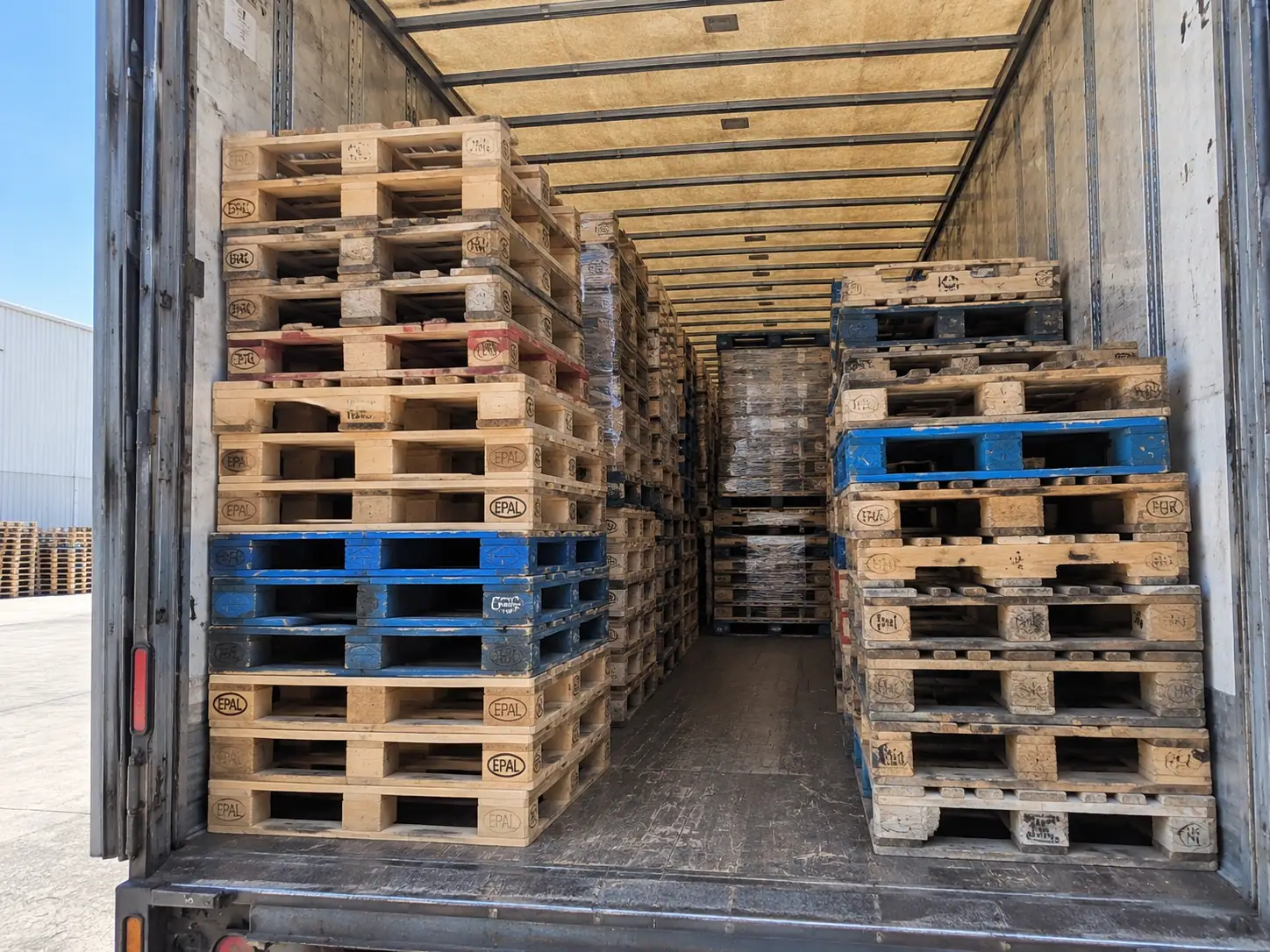
About 330 units, two high, roughly 15,000 lb in a trailer rated for three times that. Pallet loads cube out long before they gross out.
Why docks call us
The four ways a pallet pile turns into a real cost
- 01Fire codeIdle pallet storage is specifically regulated in NFPA 13 and most local codes, with limits on stack height and separation distance from buildings. An inspector who finds a wall of empties against a loading door will write it up.
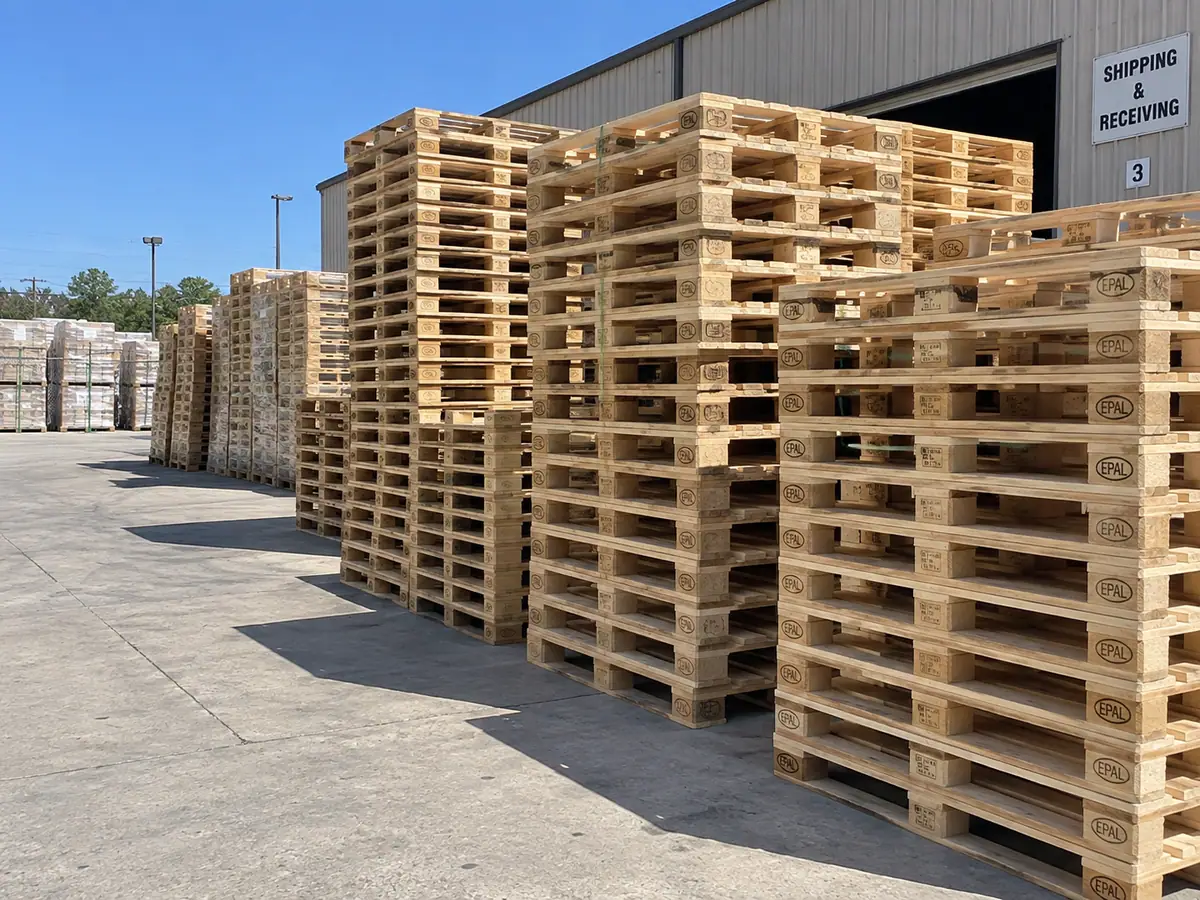
- 02Floor spaceA stack of 15 GMA pallets occupies about 13 square feet and roughly 7 feet of height. Forty stacks is a truck bay you are not using for anything productive.
- 03Forklift trafficPallet piles grow into aisles. Aisles that narrow are where near-misses happen, and near-misses are the leading indicator that safety teams actually watch.
- 04Pest and moistureWet wood outdoors invites both. Once a stack starts to go, its resale value drops to zero and its removal cost goes up.
How the schedule works
Pick the rhythm; we will hold the slot.
Most customers settle into a fixed weekly or biweekly slot — the same day, the same window, the same driver. That predictability is what lets us keep the price low, because the truck is already routed past you.
For seasonal operations, and for anyone whose volume swings with a promotion calendar, we run a trailer-drop arrangement instead: we leave an empty 53-foot trailer on your yard, you fill it at your own pace, and we swap it when you tell us it is ready.
- Standing weekly or biweekly slots with a named driver
- On-call pickups, usually inside three business days
- Trailer drops for seasonal or high-volume sites
- One-off clean-outs, including yards that have been accumulating for years
- Signed count ticket on every collection
What happens next
Where the wood actually goes
58%
Returned to service
Reused as-is or after repair with recovered boards.
27%
Dismantled for lumber
Good boards become repair stock for other pallets.
14%
Ground to fibre
Landscape mulch, animal bedding and boiler fuel.
0.6%
Landfill
Contaminated and treated wood we cannot legally process.
The paperwork
Documentation your sustainability team will actually accept
Waste diversion claims fall apart under audit when the only evidence is an invoice that says 'pallet removal'. Ours does not: every collection produces a weight ticket, and every month you get a statement showing tonnage collected, tonnage returned to service, tonnage converted to fibre and tonnage landfilled.
For customers reporting against GRI 306 or a corporate zero-waste target, that statement is the audit trail. We are happy to walk your auditor through the methodology directly — it is all published anyway.
Questions
Removal questions
How quickly can you come out?
For a scheduled customer, your slot. For a new site in central Ohio, usually within three business days, and same-week almost always. Emergencies — a failed inspection, a shutdown — we will do what we can, and we will tell you honestly if we cannot.
Do we have to sort the pile?
No, but it changes the price. An unsorted pile is a removal job; a sorted stack of whole 48×40 cores is a purchase. If you have the labour to separate them, selling them is worth real money.
Will you take plastic pallets, crates and other debris?
Plastic pallets yes — we recondition or recycle those separately. General debris, no; we are a wood recycler, not a waste hauler, and mixing the streams is what wrecks a diversion rate.
What does it cost?
Between roughly $95 and $180 per trailer load in central Ohio for material with no resale value, and less or nothing where the load contains sellable cores. Distance is the main variable.
What it costs
Removal pricing, and how it compares
| Option | Typical cost | What happens to the wood | Documentation |
|---|---|---|---|
| RePallet collection, sellable load | We pay you $1.50 – $6.00/unit | Graded, repaired, returned to service | Count ticket, weight ticket, monthly statement |
| RePallet collection, mixed load | Roughly net zero | Sorted; good units resold, rest ground | Count ticket, weight ticket, monthly statement |
| RePallet removal, no resale value | $95 – $180 per trailer | Ground to mulch, bedding and boiler fibre | Weight ticket, monthly statement |
| General waste hauler | $400 – $900 per roll-off | Usually landfill | Disposal ticket only |
| Landfill direct | Tipping fee plus your own freight | Landfill | Tipping receipt |
| Burning on site | Not lawful in most jurisdictions | — | — |
Setting up a schedule
Getting the frequency right
- 01Count what you actually generateFor two weeks, tally empties coming off the dock. Most sites guess high by a factor of two, because the pile is visible and the flow is not.
- 02Divide by trailer capacityA 53-foot trailer takes about 330 stacked 48×40 units. If you generate 200 a week, that is a collection every eleven working days — call it biweekly.
- 03Decide where the pile livesA marked area away from the building, on firm ground, ideally under cover. Piles that have no designated home migrate into aisles.
- 04Name one ownerPallet programmes fall between shipping, facilities and procurement. Name a person or it will drift within a quarter.
- 05Choose live load or trailer dropAbove about a trailer a fortnight, a dropped trailer is better for everyone: you fill at your own pace and nobody waits on a dock door.
Access
The practical constraints that decide whether we can come at all
Turning room. A 53-foot trailer needs meaningful space to turn. If your only approach is a tight yard or a residential street, tell us at quote stage and we will send a smaller vehicle or plan a different approach. A wasted trip costs both of us.
Ground conditions. Firm ground, particularly after rain. We have had trailers sink on unpaved yards, and recovering one is a bad afternoon for everybody.
Overhead clearance. Canopies, cables and low bridges on the approach. Worth a two-minute walk before the first collection.
Hours. Our drivers run fixed routes, so a site that can only receive between 10:00 and 11:00 is harder to schedule than one with a wide window. Where the window is genuinely tight, a trailer drop solves it entirely.
Who signs. Somebody has to agree and sign the count. If your dock is unstaffed at the collection window, agree in advance how the count is verified.
Questions
More removal questions
Do you handle emergency clear-outs?
We will try. A failed fire inspection or an imminent shutdown gets priority where we have capacity, and we will tell you honestly and immediately if we cannot help rather than leaving you hoping.
What about pallets stored outside for years?
Almost always a removal rather than a purchase — long weather exposure takes the grade out of anything. We can still divert essentially all of it from landfill through the grinder, which is usually the point.
Can you remove from multiple sites on one agreement?
Yes, and it is usually cheaper per site because the route is shared. Send the list of addresses and approximate volumes and we will build a schedule.
Do you take other packaging waste?
Plastic pallets and collars yes, on a separate stream. General waste, film, banding and cardboard no — we are a wood recycler rather than a waste hauler, and mixing the streams is exactly what destroys a diversion rate.
How is the diversion figure calculated for our site?
From weight, not counts. Your collections are weighed at our inbound scale and the monthly statement reconciles tonnage in against tonnage by outcome. Method is on the zero-waste promise page.
Get the pile off your floor before the inspector does.
Tell us where you are, roughly how many pallets you generate a week, and what shape they are in. We will come back with a schedule and a number.
Keep reading
Pallet Pickup & Removal is delivered from our yard at 7240 S Access Rd, Columbus, OH 43217, Monday to Friday 7:00 AM to 5:00 PM and Saturday mornings.