Product 01
Recycled wood pallets, graded the way we would want them graded.
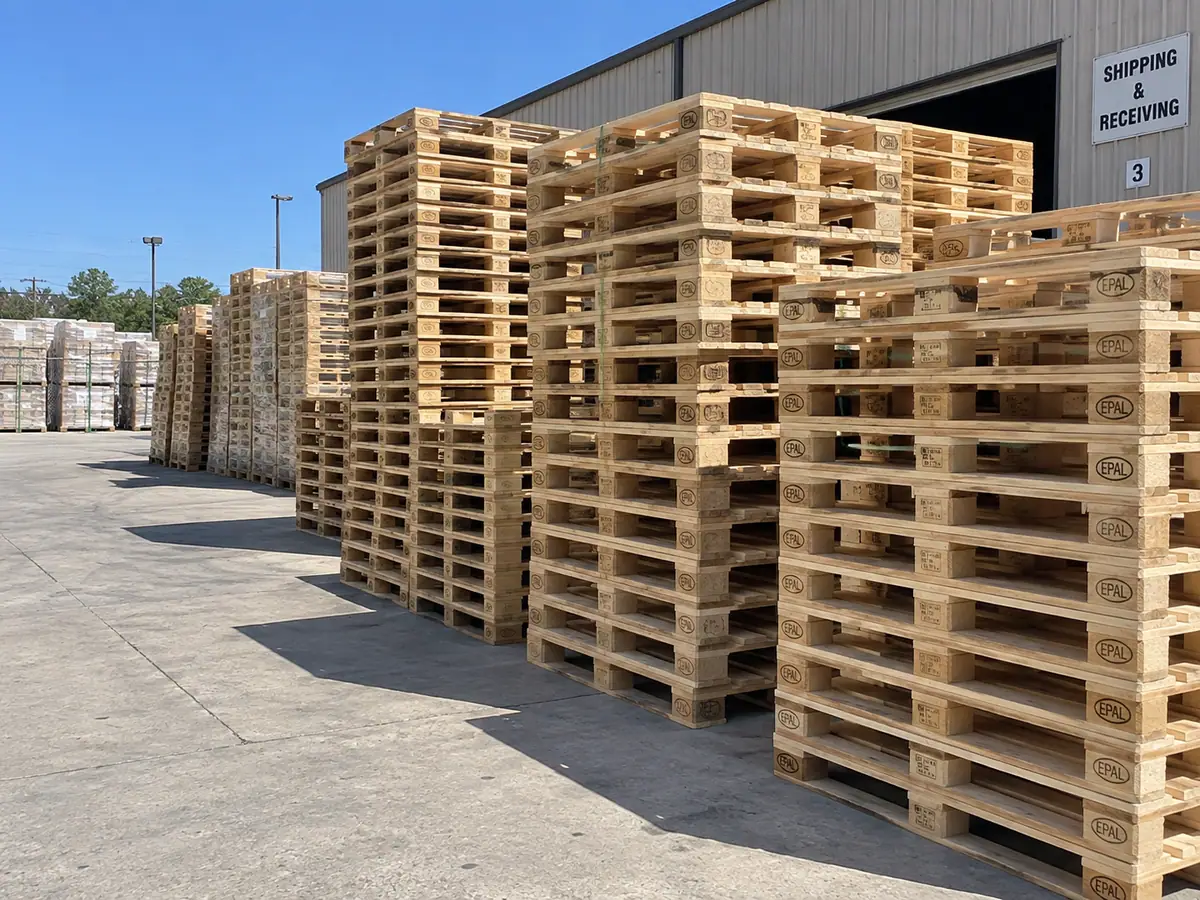
Price recycled stock
Give us the quantity, the size and the ZIP. You'll get a written quote with the grade, the freight and the pickup window — not a sales call.
- Written quotes, usually inside one business day
- Loads from 100 pallets to full 53' trailers
- We buy as readily as we sell — tell us which way it flows
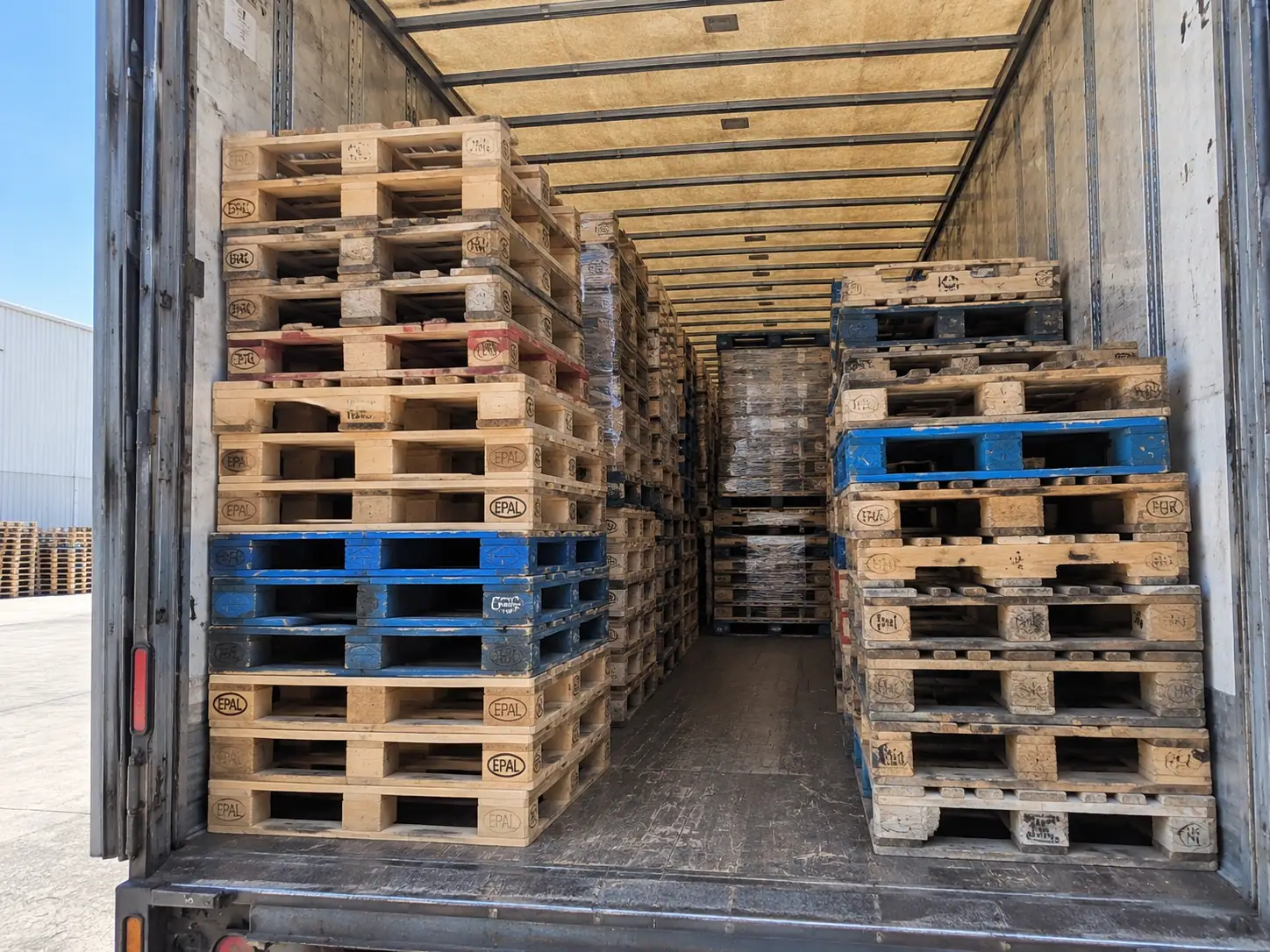
Loaded
About 330 units, two high, roughly 15,000 lb in a trailer rated for three times that. Pallet loads cube out long before they gross out.
The specification
What each grade actually means
| Grade A (#1) | Grade B (#2) | Remanufactured | |
|---|---|---|---|
| Deck boards | All present, no breaks, full length | Up to 2 replaced, no splits over 2″ | Rebuilt deck, usually 5 boards |
| Stringers | No cracks, no plugs | Repaired with companion permitted | Recovered, cut to length |
| Appearance | Uniform colour, no heavy staining | Mixed colour acceptable | Visibly mixed |
| Moisture | Under 19% | Under 19% | Under 19% |
| Racked load | ≈ 2,100 lb | ≈ 1,500 lb | ≈ 1,200 lb |
| Typical price | $7.50 – $12.00 | $5.00 – $8.50 | $4.50 – $7.00 |
| Best for | Racking, food, automated handling | One-way shipping, floor stacking | Expendable outbound loads |
Why used wood is often better wood
A pallet that has already survived three years has proved something.
New softwood pallets are frequently built from lumber at 25 to 30% moisture content. As that dries in service, boards cup, nails loosen and the unit loses squareness — most of the failures in a new pallet's first year come from drying, not from load.
A recycled hardwood pallet has already done its drying, in service, under load. What survives to be regraded is by definition the stock that did not warp, split or loosen. There is a selection effect working in your favour, and it is the reason experienced buyers often prefer a Grade A recycled unit to a budget new one.
The trade-off is variability: species, board thickness and nail patterns are mixed. If your handling equipment cares about that, say so and we will sort tighter, or point you at new pallets.
- Mostly oak and mixed northern hardwood, already seasoned
- Moisture under 19% at dispatch, checked on the sort deck
- Squareness verified against a jig before banding
- Nails set, loose boards re-secured, banding residue removed
- Stacked 15 high and double-banded as standard
Grade A · 48 × 40 GMA
Footprints we hold in recycled stock
48 × 40
48 × 48
42 × 42
36 × 36
Euro
48 × 45
48 × 36
40 × 40
Questions
Recycled pallet questions
How do I know the grade is real?
Pull ten units off a stack at random and check them against the table above. If they do not match, we replace the load. That offer is the only meaningful guarantee anyone in this industry can give you.
Are recycled pallets clean enough for food handling?
Grade A stock collected from food-sector sources, yes — and we can tell you the collection source. What we will not do is sell you a pallet that spent its previous life under a drum of solvent and call it food-grade. See food and beverage.
Can recycled pallets be heat treated?
Yes. Recycled units can be heat-treated and marked for export, provided they are structurally sound first. Read ISPM-15 explained before ordering.
What is the environmental case, in numbers?
Roughly 15.4 kg CO₂e and 24 board feet of lumber avoided per 48×40 unit against buying new. Run your own volumes through the Reclaim Index.
Full specification
The 48×40 GMA, member by member
| Member | Nominal | Tolerance | Reject if |
|---|---|---|---|
| Overall footprint | 48″ × 40″ | ± ½″ | More than ½″ under on either axis |
| Overall height | 5½″ | ± ¼″ | Over 5¾″ — jams automated handling |
| Top deck boards | 7 full length | — | Any short, spliced or butted board |
| Top board thickness | 9/16″ hardwood | ± 1/16″ | Under ½″ on any board |
| Top board width | 3½″ – 5½″ | — | Under 3″ on a lead board |
| Bottom deck boards | 3 full length | — | Missing or split through |
| Stringers | 1⅜″ × 3½″ × 48″ | — | Any crack, plug or repair (Grade A) |
| Fork notches | 9″ × 1½″, four-way | ± ¼″ | Broken through to the bottom deck |
| Squareness | Diagonals equal | ± ¼″ | More than ¼″ difference |
| Fasteners | Helical or stiff-stock | — | Any protruding above the deck |
| Moisture content | Under 19% | — | Above 19% at any of three points |
| Unit weight | 45 – 55 lb | — | Over 60 lb suggests moisture |
Storage and handling
Keeping a grade you paid for
- 01Indoors, or under a roof with open sidesRain protection plus airflow. A tarp is worse than no cover — it traps warm humid air against the wood and creates exactly the conditions mould wants.
- 02Never directly on the groundTwo lengths of scrap timber underneath stop moisture wicking up from concrete or dirt. It costs nothing and it is the most commonly skipped step.
- 03Deck boards horizontalStack so water runs off rather than pooling in the gaps between boards.
- 04First in, first outRotate. The stack in the corner that has been there since March is the one that will fail a grade check.
- 05Fifteen high, bandedWhat a standard forklift handles safely, and what keeps a stack square. Twenty-high stacks look efficient and are a safety conversation.
Where they come from
The provenance question, answered properly
Every recycled pallet had a previous life, and for some buyers that matters a great deal. We can tell you the collection region and the source sector for any load, because both are recorded at the inbound scale.
What we will not tell you is the source company, and that is deliberate — our collection customers are entitled to the same discretion you would want. Sector and region is enough for any hazard analysis we have ever seen.
We do not sell food-sector customers stock collected from chemical or petroleum sites. That segregation happens at the sort deck, on the nose as much as the eye, and it is the single most important thing we do for food and pharmaceutical accounts.
For programme customers a Pallet Passport makes the provenance explicit per shipment, with the collection routes and repair counts for that specific load.
Questions
More recycled stock questions
What species will I actually get?
Mixed northern hardwood — oak, maple, poplar, gum and ash, typically three or four species across the members of a single unit. We sort by grade rather than species and we say so rather than implying consistency we cannot deliver. Detail in species matters.
How many times has this pallet been used?
Unknowable for any individual unit, and anyone who tells you otherwise is guessing. What we can tell you is that a well-built hardwood GMA typically survives five to eight service cycles with two or three repairs along the way, and that a Grade A unit has demonstrably not warped, split or loosened yet.
Can I get a consistent appearance across a load?
Ask for display grade, which adds an appearance sort — uniform deck colour, no visible top-deck repairs, no stencils — for about a dollar a unit. Standard Grade A is a structural sort and says nothing about colour.
Do you offer a sample before a first order?
Better than a sample: come and pull ten units at random off a stack in our yard and grade them yourself. Most of our long-term customers did exactly that before their first order.
What is your return policy on a load that misses grade?
Tell us within five business days with photographs of the units in question and we replace the shortfall or credit it, your choice. We do not argue about it — the occasional replaced load costs less than a reputation for arguing.
The stock is in the yard today.
Tell us the footprint, the grade and the count, and we will confirm availability and a delivered price.