Industry
Pallets for retail and distribution, where the customer can see them.
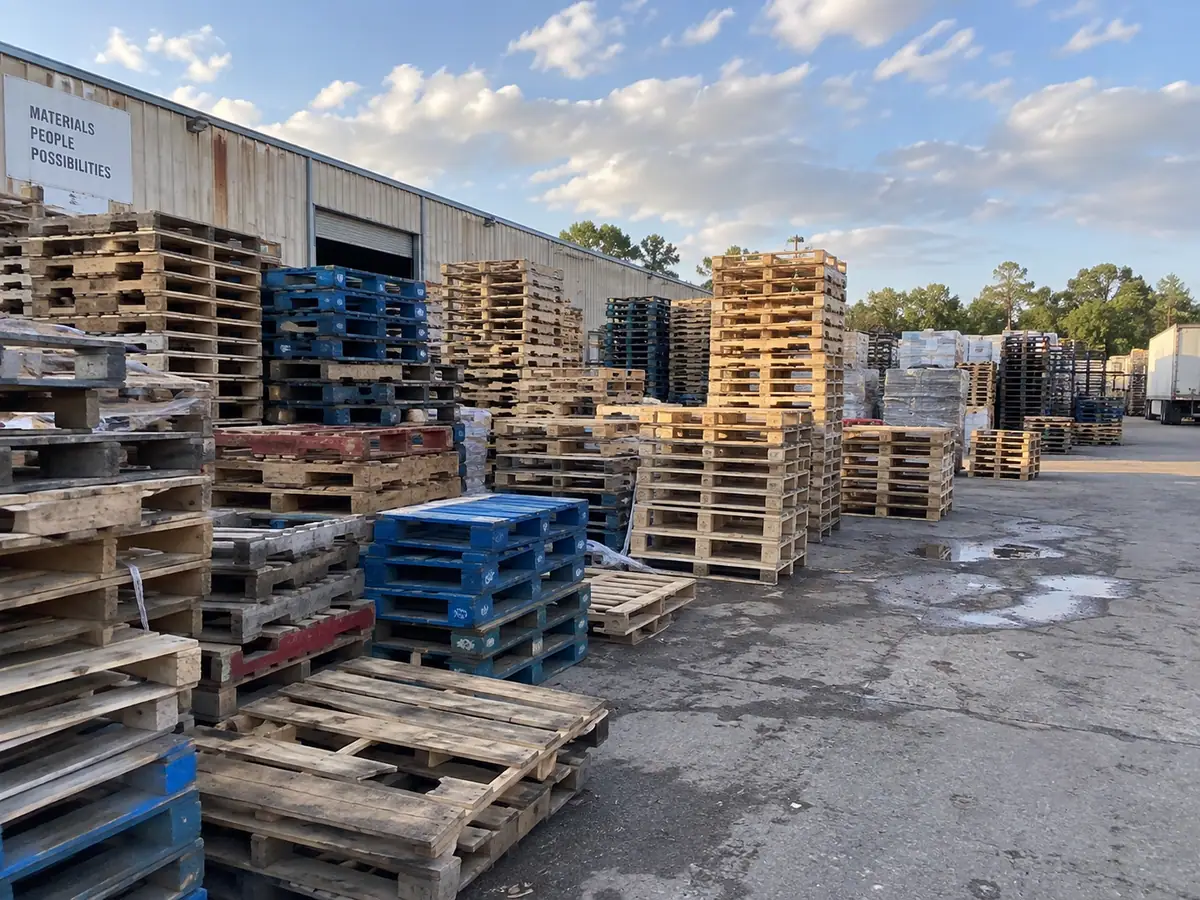
Talk to us about retail & distribution
Give us the quantity, the size and the ZIP. You'll get a written quote with the grade, the freight and the pickup window — not a sales call.
- Written quotes, usually inside one business day
- Loads from 100 pallets to full 53' trailers
- We buy as readily as we sell — tell us which way it flows
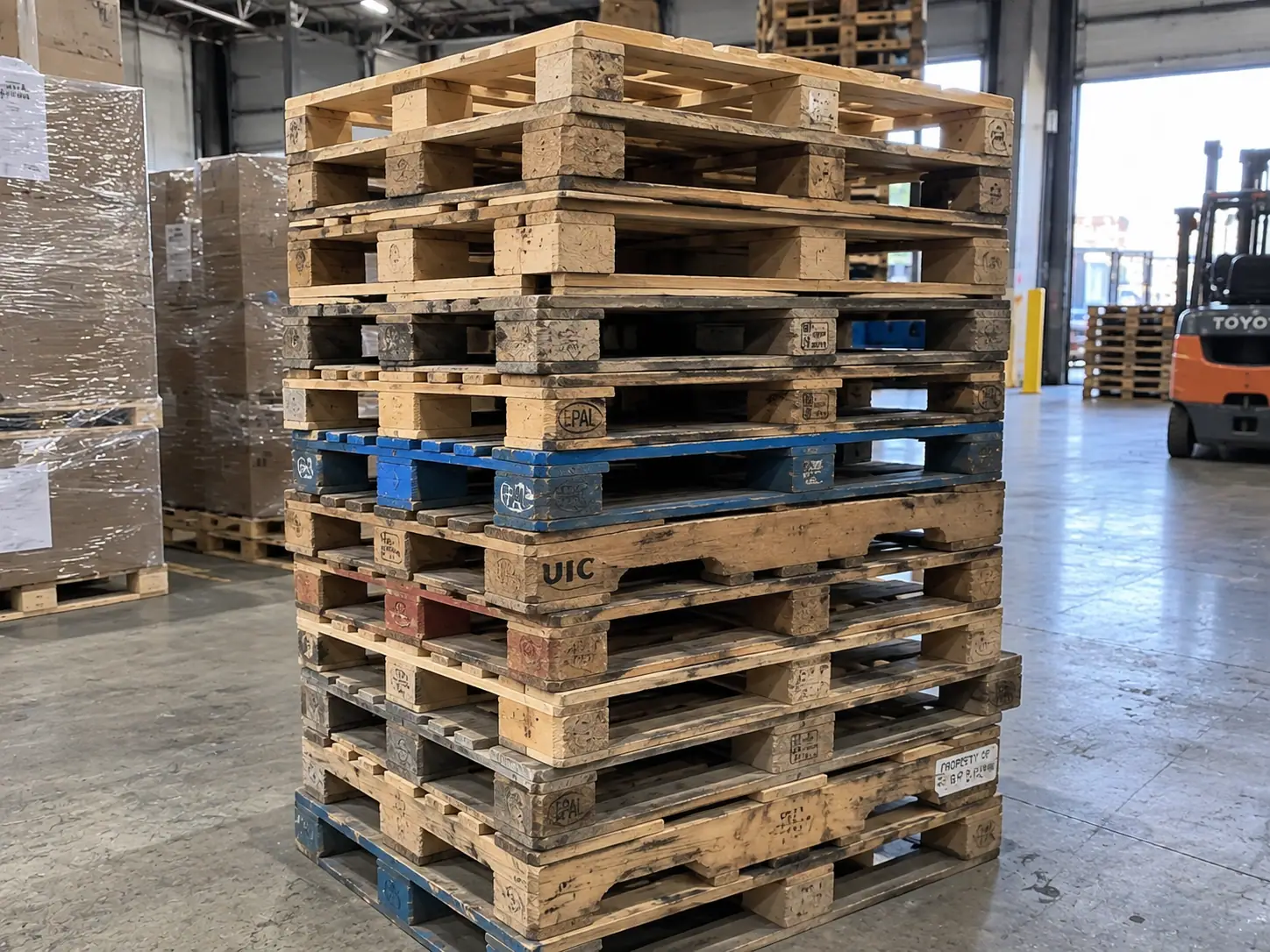
One stack
Fifteen high and square. A stack that leans is a stack somebody has to touch twice.
Retail formats
The sizes the shop floor actually wants
| Format | Footprint | Fits | Typical use |
|---|---|---|---|
| Full GMA | 48" × 40" | Standard rack bay | Backroom and DC movement |
| Beverage square | 36" × 36" | Promotional aisle | Floor displays, club store |
| Half pallet | 24" × 40" | Half a rack position | In-store displays, small format |
| Quarter / narrow | 20" × 48" | Against a shelf run | Aisle-end promotions |
| Display long | 36" × 48" | Down an aisle | Seasonal builds |
Display grade
What we sort for, beyond structure.
A standard Grade A sort is structural: full members, sound stringers, correct footprint, dry wood. It says nothing about whether the deck is three different colours or carries a previous owner's stencil.
Display grade adds an appearance pass. It costs roughly a dollar a unit more and it is the difference between a merchandiser accepting a build and a store manager pulling it. If your pallets end up in front of shoppers, ask for it by name — nobody supplies it by default.
- Uniform deck colour across the top boards
- No visible top-deck repairs or replacement boards
- No stencils, paint marks or heavy staining
- Consistent board width for a clean edge line
- Available in 48×40, 36×36 and half formats
36 × 36 display grade
Questions
Retail questions
Can you meet a retailer's pallet specification?
Usually. Send us the spec document — most of the big grocery and club specifications are variations on GMA Grade A with an appearance clause, and we grade to the stricter of the two.
Do you supply for seasonal peaks?
Yes, on booked volume. Retail peaks are predictable and the spot market in October is not, so book it. Same logic as agriculture.
What happens to pallets at the store end?
In most chains they accumulate in a backroom until someone hauls them. That is a collection opportunity — see pallet pickup and removal — and often a revenue one.
Do you build custom display bases?
Yes, to a planogram. See custom builds. Retail display bases are one of the few genuinely good reasons to go non-standard.
Retail compliance
What the big receiving standards typically require
| Requirement | Typical wording | What to buy | How it is checked |
|---|---|---|---|
| Footprint | 48″ × 40″ ± ½″ | GMA standard | Tape at receiving |
| Construction | Four-way notched stringer | GMA specification | Visual |
| Condition | No broken or missing boards | Grade A | Visual at unload |
| Repairs | Often no visible stringer repairs | Grade A, strict | Visual — the one people fail |
| Protruding fasteners | None | Any grade, checked | Visual and by hand |
| Moisture / mould | No visible mould | Under 19% at dispatch | Visual |
| Appearance | Sometimes specified for display | Display grade | Merchandiser judgement |
| Overhang | No product beyond deck edge | Correct footprint for the load | Visual, and it fails loads |
Display programmes
Getting a floor-ready build right
- 01Ask for display grade by nameStandard Grade A is a structural sort and says nothing about appearance. Display grade adds a uniform-colour, no-visible-repairs pass for about a dollar a unit.
- 02Match the format to the aisleA 48-inch pallet in a promotional aisle blocks cart traffic. 36×36 and half-pallet formats exist for exactly this reason.
- 03Consider the weight for manual handlingDisplay pallets get moved by hand more often than anything else in the pallet world. A 36×36 at 34 lb is manageable; a full GMA at 55 lb is not.
- 04Specify no protruding fasteners explicitlyA shopper will touch this pallet. It is the one place where a nail head is a customer-facing problem rather than an operational one.
- 05Plan the backroom exitDisplay pallets accumulate in store backrooms with no process for them. For a chain of any size that is recoverable material and usually revenue-positive.
Distribution centres
Where the volume actually sits
A large distribution centre is the highest pallet-turnover environment there is: everything arrives on one, is broken down, and leaves on another. The economics are dominated by throughput rather than by unit price.
Consistency is the operational requirement. Automated sortation, conveyor transfer and high-bay racking all assume dimensional predictability, and a mixed-quality pallet population produces jams that cost far more than the pallet saving.
Empties are a revenue stream, not a waste stream. A DC generating several trailers of empties a week is generating material with real value, and a surprising number of them are paying somebody to take it away.
Seasonal peaks are predictable and rarely planned for. Retail distribution peaks in the autumn on a calendar everybody knows a year in advance, and still buys spot in October.
Questions
More retail questions
Can you meet a specific retailer's pallet specification?
Send us the document. Most are variations on GMA Grade A with an appearance clause, and we grade to the stricter of theirs and ours. Where a clause is unusually expensive for no functional benefit we will say so.
What happens if a load is rejected at a retailer's dock?
Photograph the units and the rejection paperwork and tell us within five business days. If the pallets missed our published grade we replace them; if they met grade and the receiver applied a different standard, we will help you argue it.
Do you collect from individual stores?
Store-level collection is awkward — small quantities, tight access, frequently no dock. For a regional cluster it works and is usually revenue-positive. For a single store it rarely does.
Are half pallets worth the extra cost per unit?
Per square foot they cost more. Per display they frequently cost less, because a full pallet of a promotional item is often more stock than one store sells in the window, and product sitting for six weeks looks unwanted.
How do we handle pooled pallets in a retail chain?
Segregate and return them. They belong to the pool operator, selling them is a legal problem, and a legitimate recycler will pull them out and tell you how many. See pooling vs buying.