Service 08 — Programs
Managed pallet programs: one counterparty, one invoice, one honest number.
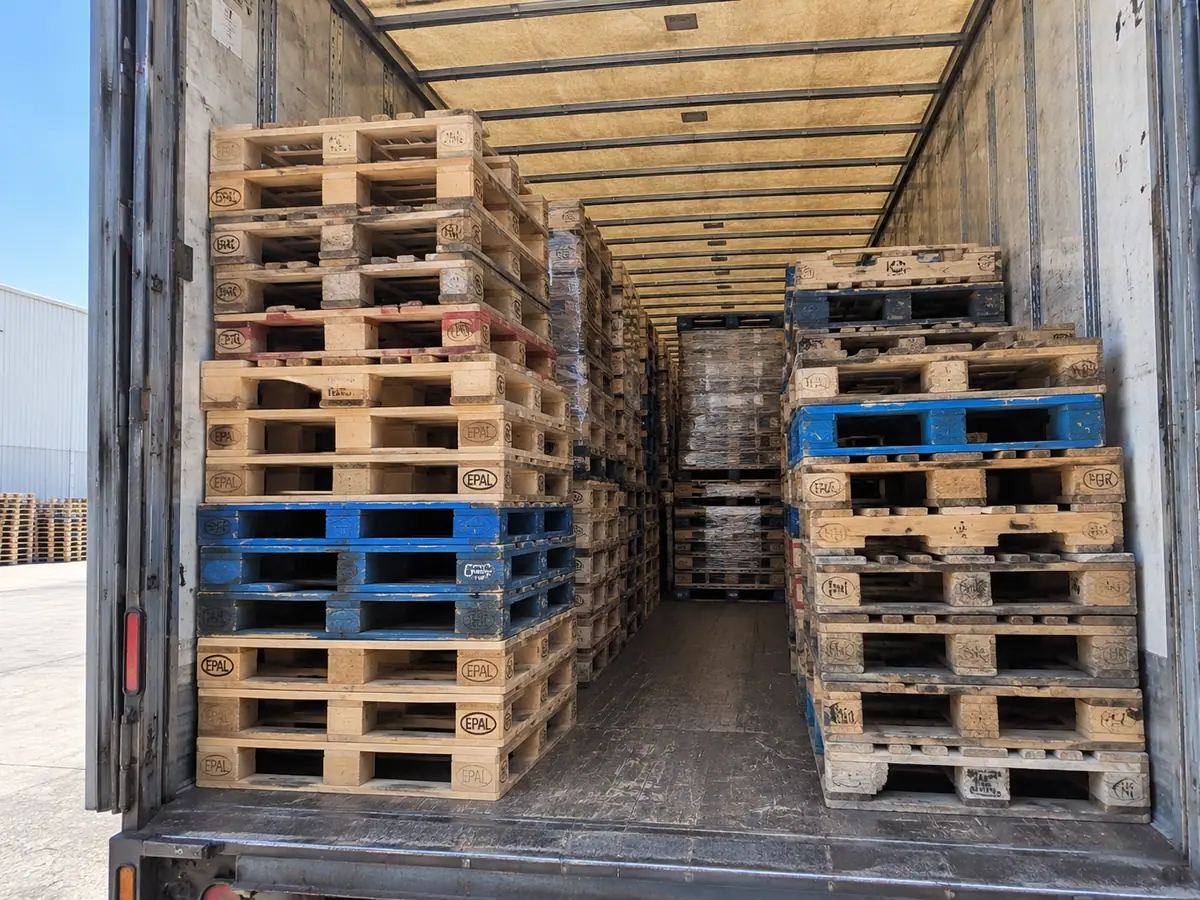
Design a program
Give us the quantity, the size and the ZIP. You'll get a written quote with the grade, the freight and the pickup window — not a sales call.
- Written quotes, usually inside one business day
- Loads from 100 pallets to full 53' trailers
- We buy as readily as we sell — tell us which way it flows
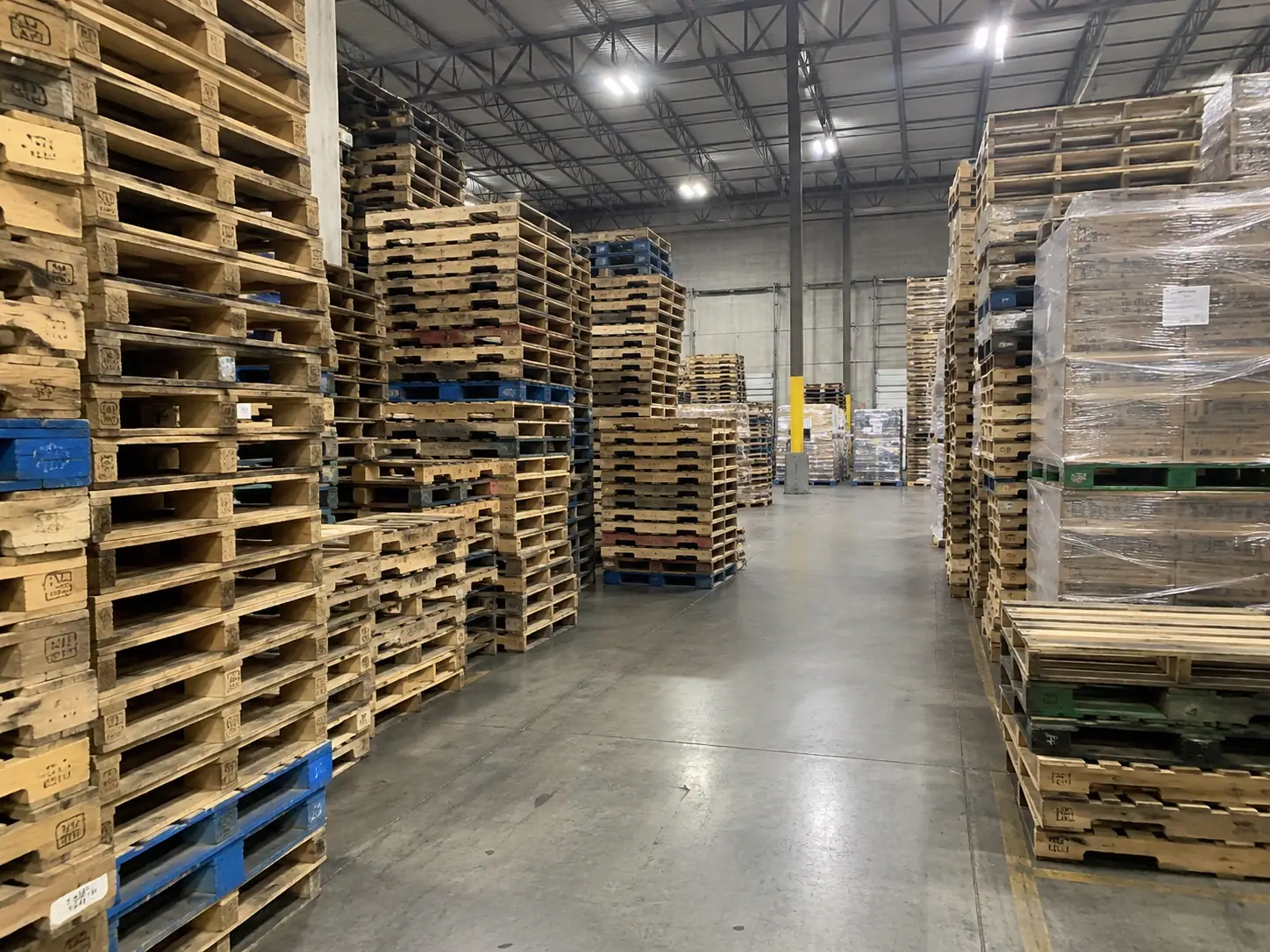
Inside the building
The sort aisle at half past seven. Graded stock on the left, waiting to be worked on the right.
Where the money actually goes
The four costs nobody puts in the pallet budget
Emergency buying. Running short on a Friday afternoon and paying spot prices for whatever anyone will deliver is, at most sites, the single largest avoidable pallet cost. A buffer arrangement removes it entirely.
Double handling. Empties get moved to make space, then moved again to load them out. Every touch is a forklift minute nobody budgeted.
Grade drift. Buying 'whatever is cheap' means your fleet quality wanders, which shows up months later as product damage and racking incidents rather than as a pallet cost.
Reporting labour. Someone in your organisation is assembling diversion figures from invoices by hand. That is a real salary line.
A program addresses all four. The unit price barely moves — and any vendor promising to save you 30% on unit price is either cutting grade or pricing to win the first year.
What a program includes
The moving parts
- 01Committed supplyAn agreed monthly volume by footprint and grade, priced for the term, with a buffer we hold in our yard against your call-offs.
- 02Scheduled collectionFixed pickup slots for empties and damaged units, usually on the same runs that deliver your stock.
- 03Repair loopDamaged units repaired with recovered lumber and returned to your fleet rather than replaced with new purchases.
- 04Monthly reportingUnits in, units out, tonnage diverted by outcome, repair rate, and the cost per cycle rather than per pallet.
- 05One invoicePurchases, credits for cores, removal fees and freight consolidated into a single monthly document that reconciles.
- 06A named contactThe same person every time, who knows your dock hours and your footprint. Not a ticket queue.
What customers see
Typical first-year outcomes
12–24%
Lower total pallet cost
Across the first twelve months of a program.
0
Emergency spot purchases
The buffer removes the Friday afternoon problem.
~40%
Of damaged units repaired
Rather than replaced with new purchases.
1
Invoice a month
Reconciled against one signed ticket per collection.
We were buying pallets from three vendors and paying a fourth to haul the broken ones away. Nobody had ever put those four invoices on the same page.
Questions
Program questions
What volume do we need to justify a program?
Roughly 1,500 pallets a month in either direction, or a site generating more than a trailer of empties a fortnight. Below that the coordination overhead outweighs the savings and we will tell you to keep buying transactionally.
Is this the same as pallet pooling?
No, and the distinction matters. In a pool you rent a pallet and pay per trip; in our program you own the fleet and we manage it. Different cost structures, different risks. We compare them honestly in pooling vs buying.
What contract term?
Twelve months is standard so that pricing can be committed, with a 60-day exit either way. We are not interested in holding a customer who wants to leave.
Who owns the pallets?
You do, throughout. We hold buffer stock on your behalf and it is identified as yours in our yard records.
Implementation
Two to three weeks, mostly spent counting.
- Step 01
Week one — measure
Twelve months of purchase, removal and freight invoices on one page. A physical count of what is on site. A two-week tally of what leaves and what comes back.
This step alone usually identifies the answer.
- Step 02
Week one — walk the site
Where empties accumulate, how many times each is touched, where damaged units go, and whether anything is stored outdoors. Photographs beat descriptions.
Half a day with somebody who knows the building.
- Step 03
Week two — design
Committed volume by footprint and grade, buffer size, collection frequency, repair thresholds, and the reporting format your team actually needs.
One meeting and a document.
- Step 04
Week two — price the term
Fixed pricing for twelve months on committed volume, with the buffer priced separately. You see the whole cost model, not just a unit rate.
60-day exit either way, from day one.
- Step 05
Week three — start
First scheduled collection, first buffer release, first count ticket. The reporting starts immediately rather than after a settling-in period.
Named contact from this point on.
What is in the agreement
Scope, plainly
| Element | What it means | Typical figure |
|---|---|---|
| Committed volume | Monthly units by footprint and grade, priced for the term | Agreed from your measured usage |
| Buffer stock | Held in our yard, identified as yours, released on call-off | Two to four weeks of usage |
| Collection schedule | Fixed slot, named driver, signed count each time | Weekly or biweekly |
| Repair loop | Damaged units repaired with recovered lumber and returned | ≈ 40% of damaged units |
| Core purchase | We buy whole cores back at agreed rates | $1.50 – $6.00 per unit |
| Reporting | Monthly diversion and cost statement, annual roll-up | Issued by the 10th |
| Named contact | One person who knows your dock hours and your footprint | Not a ticket queue |
| Term | Twelve months so pricing can be committed | 60-day exit either way |
Governance
What a programme needs from you
One owner. Pallet programmes fall between shipping, facilities and procurement, and unowned programmes drift within a quarter. It does not need to be a senior person; it needs to be a named person.
A quarterly fifteen minutes. Read the statements, check the variance, look at whether the repair rate is moving. Discrepancies surface in that review or they do not surface at all.
Honesty about changes. A new customer, a new racking configuration, a seasonal contract — tell us before it lands rather than after. Most of the failures we have seen in managed programmes were foreseeable and simply not mentioned.
Willingness to be told no. Part of what you are buying is a supplier who says 'that grade is wrong for that application' rather than shipping what was ordered. That only works if the advice is welcome.
Questions
More programme questions
What if our volume changes significantly mid-term?
We re-price. Committed volume works both ways: if you grow, the buffer and schedule grow with you; if you shrink materially, holding you to a number that no longer reflects reality would just produce an unhappy customer and an early exit.
Can a programme cover multiple sites?
Yes, and multi-site is usually where the biggest savings are, because sites within a region share routes and because a central view exposes wildly different practice between locations.
Do you require exclusivity?
No. Several programme customers keep a second supplier for specific footprints or specific plants, and that is entirely sensible. What we ask for is the committed volume, not all of your volume.
What does it cost to set up?
Nothing. The measurement work and the cost model are free, including if you look at the numbers and decide to do nothing. We would rather have the relationship than the fee.
How do you handle price changes during the term?
Committed volume is priced for the term. Volume above the commitment is at prevailing rates. If lumber or diesel move violently we will talk to you about it rather than issuing a surprise, and in 2021 we honoured fixed prices at a loss for four quarters rather than reopening them.
Start by finding out what pallets actually cost you.
Send us twelve months of purchase and removal invoices and we will build the real number, free, whether or not you go any further with us.
Keep reading
Managed Pallet Programs is delivered from our yard at 7240 S Access Rd, Columbus, OH 43217, Monday to Friday 7:00 AM to 5:00 PM and Saturday mornings.