Inside the yard
One trailer, nine stations, about four hours.
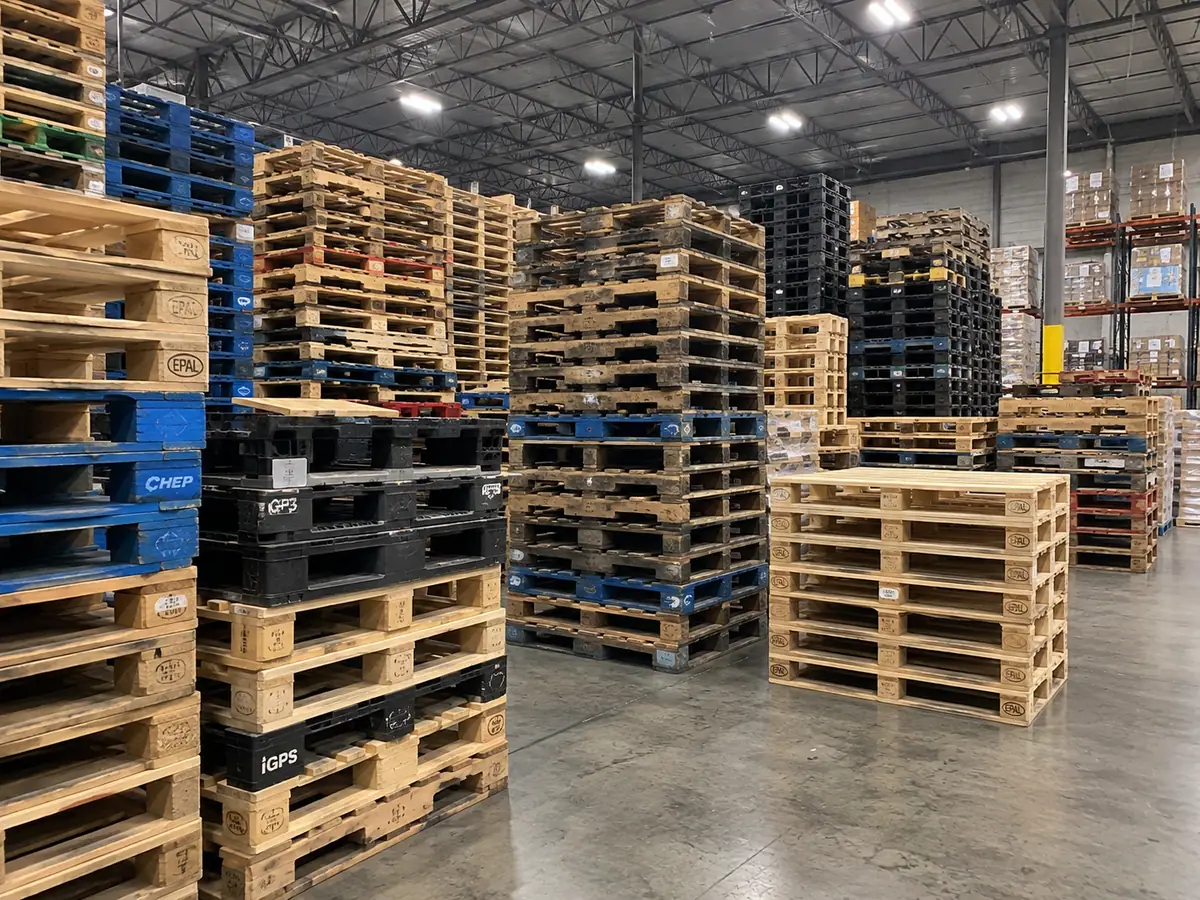
Want to see it in person?
We give yard tours to customers and to anyone auditing a diversion claim. Put 'yard tour' in the message and pick a morning.
- Written quotes, usually inside one business day
- Loads from 100 pallets to full 53' trailers
- We buy as readily as we sell — tell us which way it flows
The last four per cent
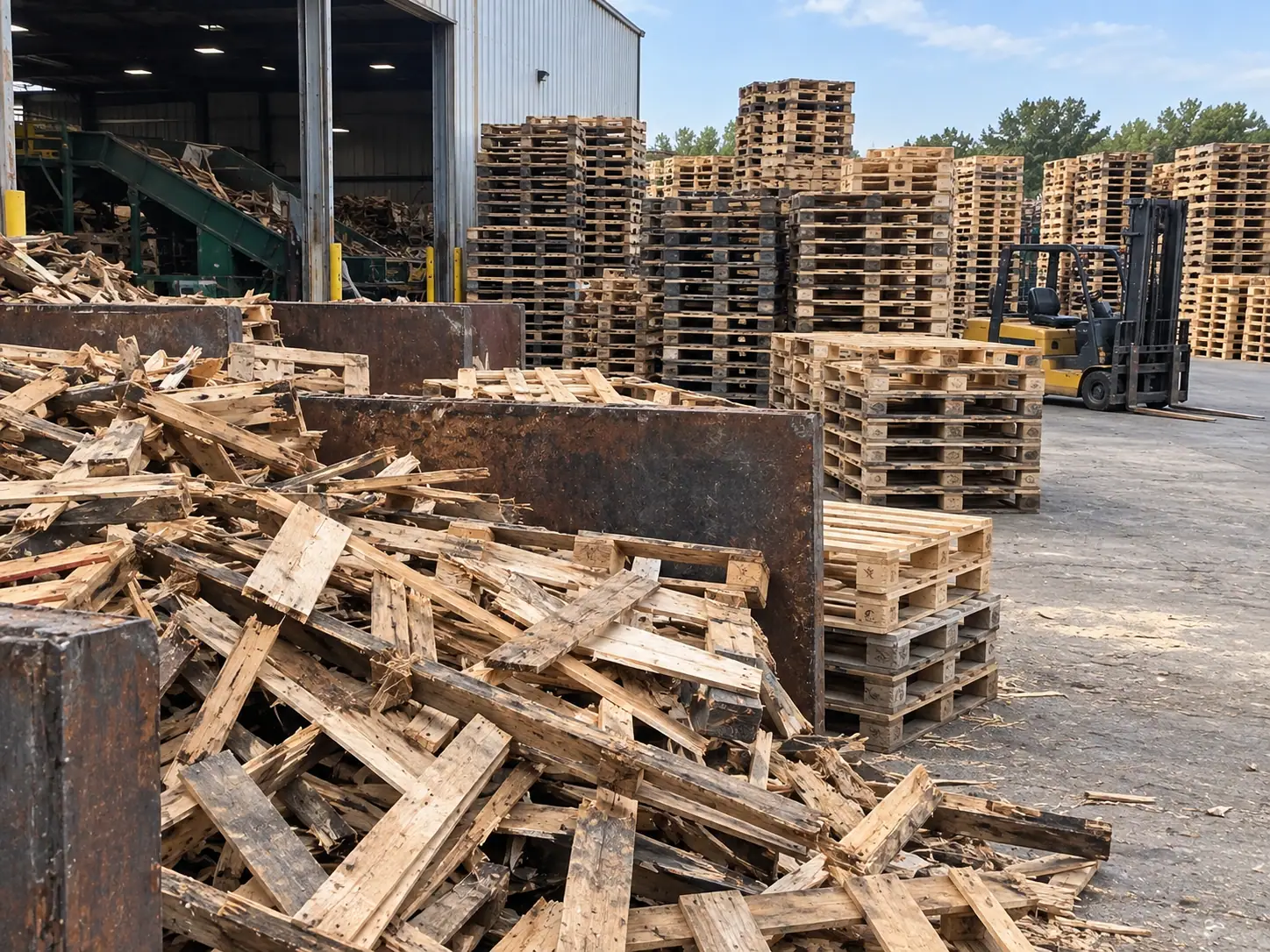
Everything the sort deck rejected, on its way to the grinder. It leaves as mulch, bedding and boiler fibre — not as landfill.
Station by station
The nine places a pallet stops.
- 016 minutes
Inbound scale and visual
The trailer crosses the scale before anything is unloaded. Gross weight in, tare weight out, and the difference is the number every downstream figure is built on. While it weighs, a yard lead walks the load and flags anything obviously wrong: standing water, a chemical smell, MB stamps, or a footprint mix that will slow the sort deck down.
About one load in forty gets turned away at this point, almost always for moisture or contamination.
- 0225 minutes
Unload and stage
Two forklifts pull the load into staging lanes organised by footprint, not by customer. A 53-foot trailer of stacked GMA is roughly 330 units and takes about twenty-five minutes to strip if the stacks are square and banded. Loose, unbanded loads take twice that, which is why we ask you to band.
Loose loads add roughly $0.35 per unit in handling. It is the cheapest thing you can fix.
- 032.5 seconds per unit
The sort deck
Every pallet passes a grader. They look at four things in a fixed order: stringer integrity, deck board count and breaks, footprint accuracy, and moisture and staining. The unit goes into one of four lanes — reuse, repair, dismantle, grind — and that decision is not revisited downstream.
A good grader makes this call in under three seconds and is right well over 95% of the time. It takes about eight months to train.
- 0440 seconds per unit
Cleaning and squaring
Reuse-lane units get protruding nails set, loose boards re-nailed, banding and film residue removed, and a squareness check against a jig. Anything more than a quarter-inch out of square goes back to the repair lane, because out-of-square pallets are what jam racking.
This is the station that separates a graded pallet from a used one.
- 053–7 minutes per unit
The repair line
Broken members come off with a pallet buster and a pry bar. Replacements come from the recovered-lumber rack next to the station — full-length boards of matched nominal thickness, never short splices. Cracked stringers get a companion glued and nailed along the full face, or the unit is kicked to dismantling.
Roughly 40% of repair-lane units are repaired with lumber recovered from other pallets on the same day.
- 0690 seconds per unit
Dismantling
Units beyond economic repair go through a dismantler that separates deck boards from stringers with minimal splitting. Good boards go to the recovered-lumber rack; stringers get cut down for shorter footprints. What comes off here is the raw material for station 05, which is the loop that makes the economics work.
27% of intake by weight leaves this station as lumber rather than as a pallet.
- 07Batch
Remill and rebuild
Recovered stringers get docked to length and resawn where needed, then fed to the build line alongside recovered deck boards. This is where remanufactured pallets are born — orphan footprints converted into 48×40 GMA units that anyone will buy.
A remanufactured GMA is typically a five-board deck rather than seven, and grades as B.
- 08Continuous
Grinding, magnets and screening
Everything left goes through a horizontal grinder. The output crosses a magnetic separator that pulls nails and banding, then a screening deck that splits the stream into landscape mulch, animal bedding and boiler fibre by particle size. Coloured mulch gets dyed on a second pass.
Ferrous recovery runs about 0.4% of intake weight and goes to a scrap processor.
- 0920 minutes
Outbound and the ticket
Graded stock is banded in stacks of 15 and loaded. The count sheet, grade certificate and — for program customers — the Pallet Passport are generated from the same records that started at the inbound scale. Every number on that document traces back to a weight, not an estimate.
The scale ticket at station 01 and the outbound records are what an auditor actually wants.
The bit that surprises people
Station 06 feeds station 05.
Most visitors assume the repair line runs on purchased lumber. It does not, and that single fact is what makes recycled pallets both cheap and genuinely low-carbon.
Pallets that are too far gone to repair are dismantled, and their sound boards become the replacement stock for pallets that can be saved. The wood never leaves the loop. A 48×40 GMA repaired here in March is very likely carrying a board that was cut in 2016 and spent nine years on a different pallet.
It also means our repair capacity is constrained by our dismantling volume rather than by lumber prices — which is why our repair pricing has been far more stable than the new-pallet market since 2021.
Rebuilt with recovered boards
Throughput
What the yard handles on a normal day.
| Measure | Per day | Per year | Note |
|---|---|---|---|
| Pallets received | ≈ 6,400 | ≈ 1.6 million | Across roughly 19 inbound trailers |
| Pallets shipped graded | ≈ 3,700 | ≈ 925,000 | Reuse plus repaired stock |
| Units dismantled | ≈ 1,700 | ≈ 425,000 | The source of all repair lumber |
| Wood ground | ≈ 42 tons | ≈ 10,500 tons | Mulch, bedding and boiler fibre |
| Ferrous recovered | ≈ 0.7 tons | ≈ 175 tons | Nails and banding to scrap |
| Landfilled | ≈ 0.5 tons | ≈ 125 tons | Treated and contaminated wood only |
Why four hours matters
What we still get wrong
Keep reading
- Pallet recycling serviceThe commercial side of this pageRead
- Zero-waste promiseHow the 99.4% is measuredRead
- Pallet gradesThe standard station 03 grades againstRead
- Mulch & wood fibreWhat comes off station 08Read
- Pallet PassportThe document station 09 producesRead
- The yard & crewWho works these stationsRead
This page is not linked from the main menu — it lives underneath pallet recycling for people who want the mechanics rather than the pitch.