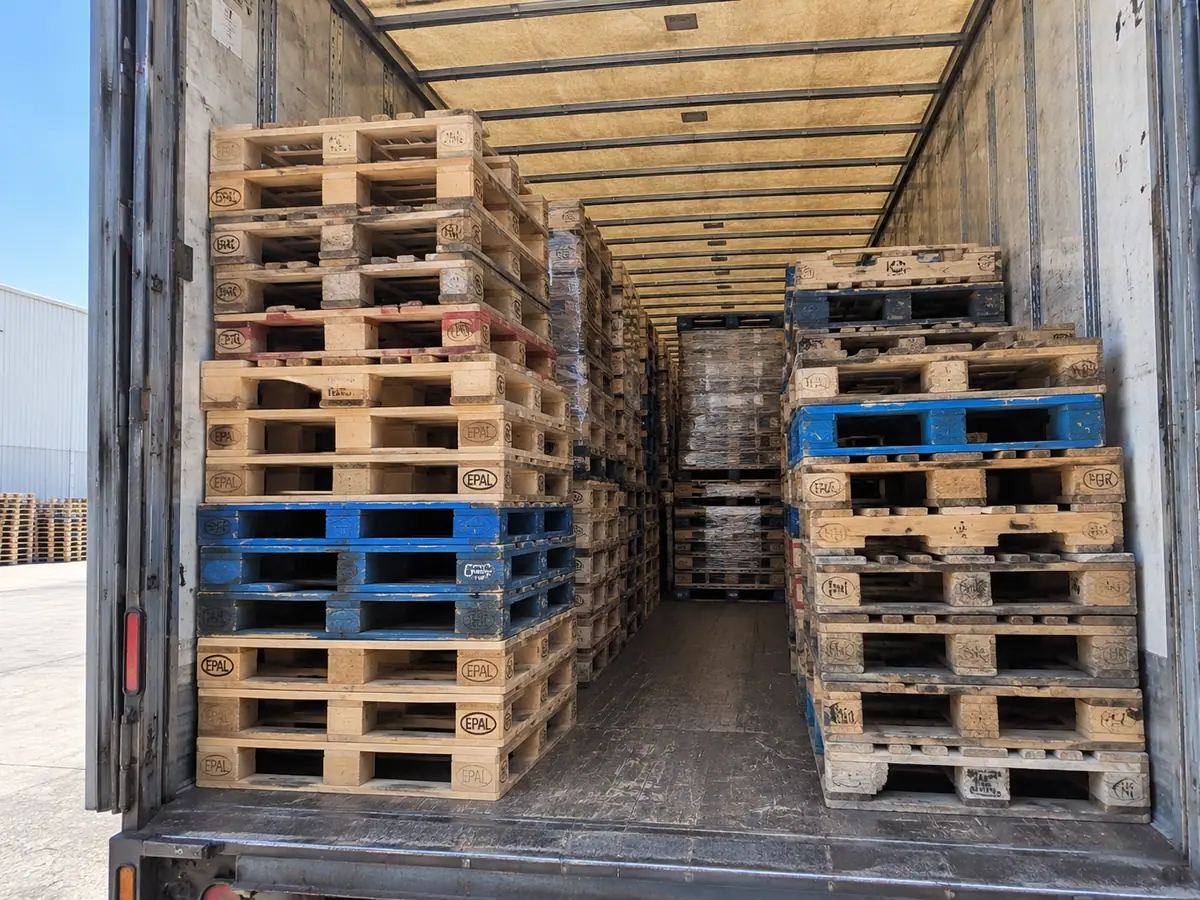

Search for a pallet load calculator and you will find a dozen. Nearly all of them do the same thing: divide the trailer length by the pallet length, divide the width by the width, multiply, done.
That is not how anybody who has actually loaded a trailer does it, and it systematically understates what fits.
Where the missing pallets are
A 53-foot trailer has about 630 inches of usable length. A 48-inch pallet divides into that thirteen times with six inches left over — wasted.
Turn the last column and the 40-inch dimension fits in that space instead, and you gain a whole column of pallets. Experienced loaders do this instinctively and call it pinwheeling.
So we wrote something that tries every possible split — nought straight columns then all turned, one straight then the rest turned, and so on in both directions — and keeps whichever produces the highest count.
What it found
The honest finding is that for the two most common footprints, mixing gains nothing — 48×40 and 42×42 already fit cleanly. The gains show up on rectangular non-standard sizes, which is exactly where nobody has a rule of thumb.
Which is a slightly deflating result for a tool we spent a week on, and it is the result, so it is what we published.
| Footprint | Single orientation | Mixed | Gain | Worth |
|---|---|---|---|---|
| 48″ × 40″ | 26 | 26 | 0 | Already optimal |
| 42″ × 42″ | 28 | 28 | 0 | Square, so no gain possible |
| 48″ × 48″ | 24 | 24 | 0 | Square |
| 36″ × 36″ | 32 | 32 | 0 | Square |
| 48″ × 36″ | 32 | 34 | +2 | ≈ 6% more per load |
| 40″ × 40″ | 30 | 30 | 0 | Square |
| 24″ × 40″ half | 60 | 62 | +2 | Small but free |
| 60″ × 48″ | 18 | 20 | +2 | ≈ 11% more per load |
What it deliberately does not do
- Product overhang. If your load hangs over the deck, plan on the load dimension rather than the pallet dimension.
- Weight distribution. Axle loading is a real constraint and a floor plan says nothing about it.
- Load height. Whether you can stack two high depends on mast height at both ends and on the receiver's policy.
- Whether the receiver will take a stacked pallet. Frequently the binding constraint and never a geometric one.
Why it is not gated
Because a calculator behind an email wall is a lead form wearing a costume. If the arithmetic is useful it is useful whether or not you ever buy from us.
It also runs entirely in your browser — nothing you type into it is sent anywhere, including to us. The only thing on this site that transmits data is the quote form, and that one is obvious about it.
It sits alongside five other tools now: a grade selector, a total cost model, an ISPM-15 stamp decoder, the Reclaim Index and the Passport builder. All of them show their assumptions, which is the part that keeps us honest.