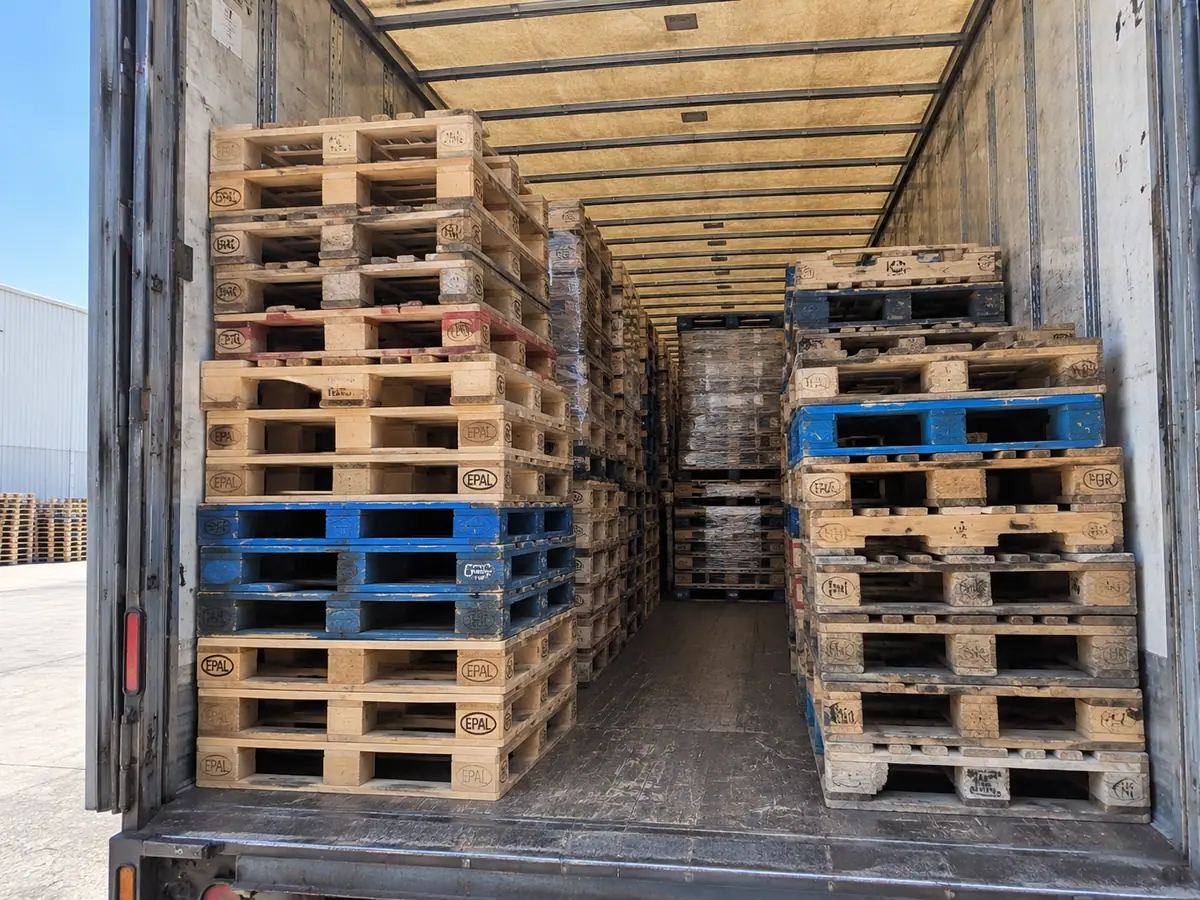
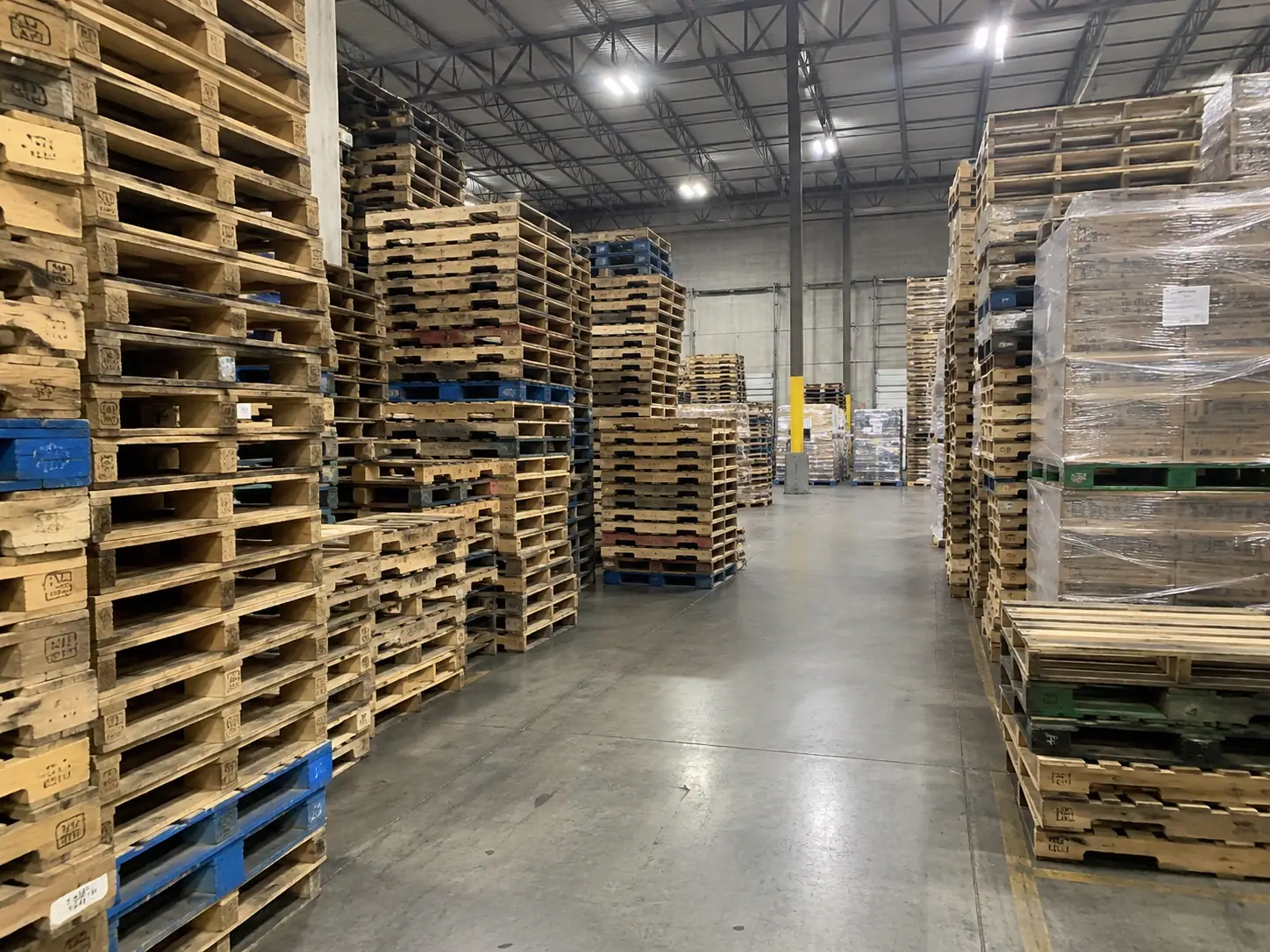
There is nothing natural about forty-eight inches by forty inches. It is not a round number in any system, it does not correspond to any product dimension, and it makes no sense in metric.
It is, however, the single most important dimension in American distribution, and the reason is almost entirely about the inside width of a truck.
Pallets before pallets
The pallet as we know it is a twentieth-century object, and specifically a Second World War one. Forklifts existed from the 1910s, and skids — platforms with runners and no bottom deck — were in use in industrial settings well before that. What was missing was standardisation.
Military logistics in the 1940s made the case forcefully. Moving enormous volumes of material through ports and depots with mechanical handling required platforms that were interchangeable, and interchangeable means standard. The four-way pallet and the pallet jack emerged from that pressure.
What did not emerge was agreement on a size. Through the 1950s, American industry used a bewildering variety of footprints, largely determined by whatever a given company's product happened to be.
The trailer decided it
The 48×40 footprint came out of the Grocery Manufacturers Association in the 1960s, and the dominant consideration was the interior width of an American trailer.
Standard dry van interior width is 98 to 100 inches. Two 48-inch dimensions side by side is 96 inches, leaving a couple of inches of clearance for the driver's sanity and for the fact that nothing in a warehouse is ever perfectly square.
Forty inches was the other dimension because it worked with the case sizes the grocery trade was already using, and because 48 by 40 gives a sensible aspect ratio for a hand-stacked load. That is genuinely the whole derivation. A rectangle chosen to fit a truck.
Then everything else moved to fit it
This is the part that makes the footprint so durable. Once enough of the grocery trade standardised on 48×40, the rest of the supply chain optimised around it.
Rack beam lengths settled at multiples that take two or three GMA pallets. Warehouse aisle widths were set by the turning radius of a forklift carrying one. Case dimensions across enormous product categories were adjusted to tessellate on a 40-inch width. Shrink-wrap turntables, pallet jacks, dock levellers, AS/RS shuttle dimensions — all of it assumes the footprint.
The result is a lock-in of extraordinary depth. Changing the standard now would not mean changing pallets; it would mean changing several billion dollars of fixed assets that were sized around them.
| Region | Standard | Millimetres | What decided it |
|---|---|---|---|
| North America | 48 × 40 GMA | 1219 × 1016 | Trailer interior width |
| Europe | EPAL 1200 × 800 | 1200 × 800 | Rail wagon and truck dimensions |
| Europe (industrial) | 1200 × 1000 | 1200 × 1000 | Chemical and industrial handling |
| Australia | 1165 × 1165 | 1165 × 1165 | Rail wagon width |
| Japan / much of Asia | 1100 × 1100 | 1100 × 1100 | Container and domestic vehicle fit |
What GMA actually specifies
A point worth making, because the terms get used loosely: GMA describes a specification, not just a footprint. Seven top deck boards, three bottom boards, three stringers, four-way notched, with defined board thicknesses and a nail pattern.
A 48×40 unit with five deck boards and no notches is 48 by 40 inches. It is not a GMA pallet, it will not carry a GMA pallet's load, and calling it one is one of the more common pieces of sloppiness in the trade.
When you order, specify both. Footprint and construction.
Why it still matters commercially
Liquidity. A 48×40 GMA can be bought at short notice in nearly any American city, sold at the end of its life for real money, and returned into a pooling network. No other footprint in North America has all three of those properties.
That is the practical argument against a custom footprint, and it is why we push back when customers ask for one. You are not just choosing a rectangle. You are choosing whether to be inside or outside sixty years of accumulated infrastructure.