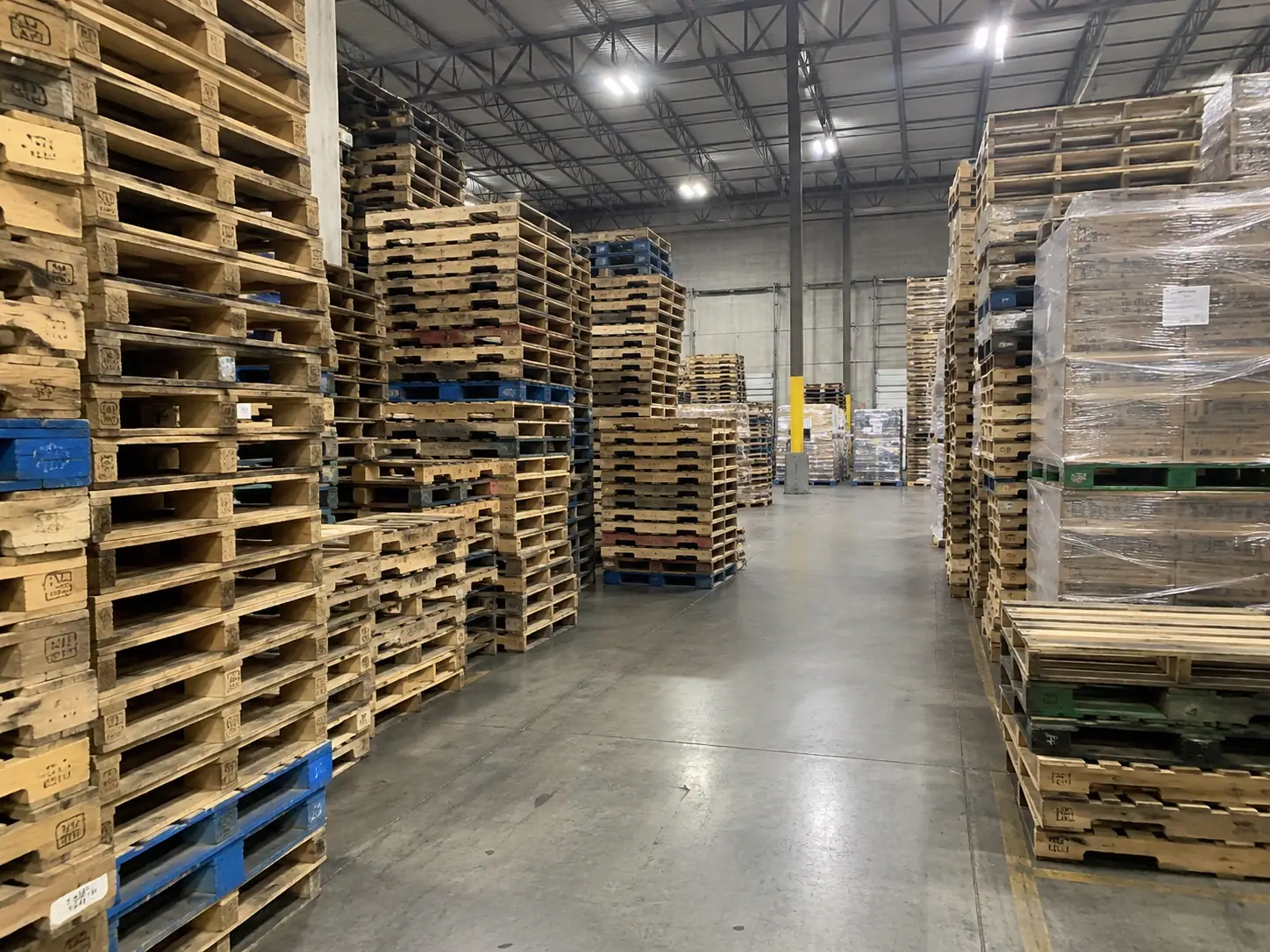
Ask about pallet construction in North America and the answer is stringers. It has been stringers since the 1960s and by volume it still is, comfortably.
But look at where growth is happening — automotive, pharmaceutical, automated warehousing, anything with an international leg — and the direction is consistently toward blocks.
The construction difference
A stringer pallet has three continuous boards running its length, carrying the load. Fork access from the sides requires cutting notches into those stringers, which weakens them precisely where they are working hardest.
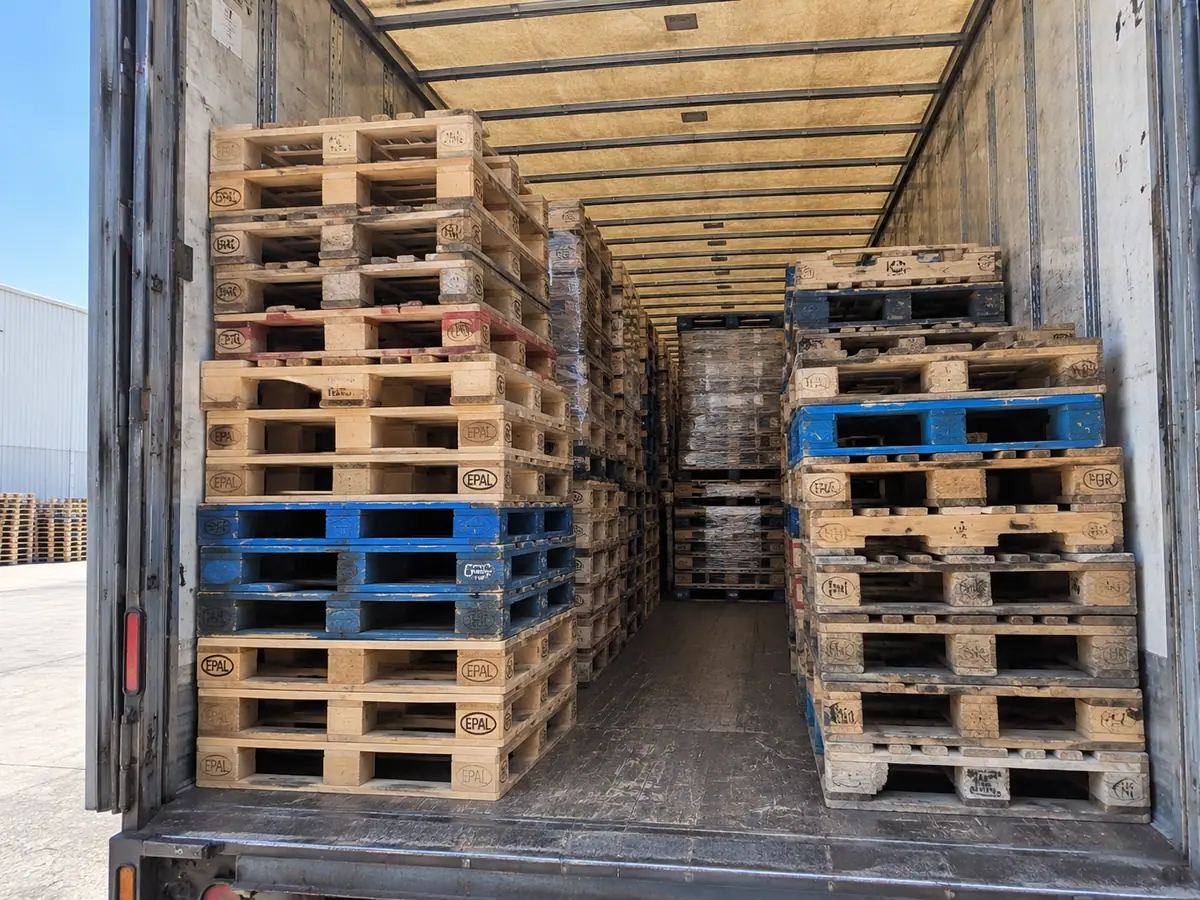
A block pallet has nine wooden blocks and three bottom runners. There are no continuous stringers to notch, so entry from all four sides is unrestricted and equivalent. That is not a marginal advantage in an operation where equipment approaches from whatever direction is convenient.
The trade-off is cost and complexity: more components, more fasteners, more assembly, and a considerably more difficult repair.
| Stringer | Block | |
|---|---|---|
| Four-way access | Partial, via notches | Full, all four sides equivalent |
| Dimensional consistency | Good | Better — blocks set the geometry |
| Repair cost | $1.75 – $3.75 | Higher; block replacement is a bigger job |
| Weight, 48×40 equivalent | 45–55 lb | 50–65 lb |
| Cost, new | $17 – $22 | $24 – $34 |
| Recycled availability, US | Excellent | Limited |
| Dominant in | North American general distribution | Europe, automotive, pharma, AS/RS |
Why automation favours blocks
Blocks set the geometry. In a stringer pallet the overall height depends on deck board thickness plus stringer depth plus bottom board thickness, all of which vary. In a block pallet the height is essentially the block dimension, which is machined and consistent.
Squareness behaves similarly. A block pallet's geometry is defined by nine rigid components rather than by how well three long boards were aligned during assembly.
For a shuttle system working to a few millimetres, that consistency is worth paying for, and it is the reason the pallets in most new automated facilities are blocks whatever the rest of the operation runs.
What is holding the shift back
Repair. A cracked block is a much bigger job than a broken deck board, and the recycled repair infrastructure in North America is built entirely around stringer construction. This is the largest brake and it is a real one.
Recycled availability. There is a deep, liquid market in used 48×40 stringer pallets in every American city. There is not one in block pallets, so buying block means buying new or importing, which changes the economics substantially.
Sixty years of infrastructure. Racking, conveyors, jacks and dock equipment across the continent were sized around stringer pallets. Not incompatible, but not optimised either.
Our position
We repair and supply both, and we are honest that our block capability is narrower. We can repair block pallets structurally; we cannot restore EPAL certification, because that requires a licensed repairer inside the scheme, and we say so before we touch one.
For general North American distribution we still recommend stringers, and will for a long time. Liquidity is worth more than four-way access to an operation that ships out and never sees the pallet again.
For automated handling, for automotive, and for anything crossing to Europe regularly, blocks are increasingly the right answer and pretending otherwise would not serve anyone.