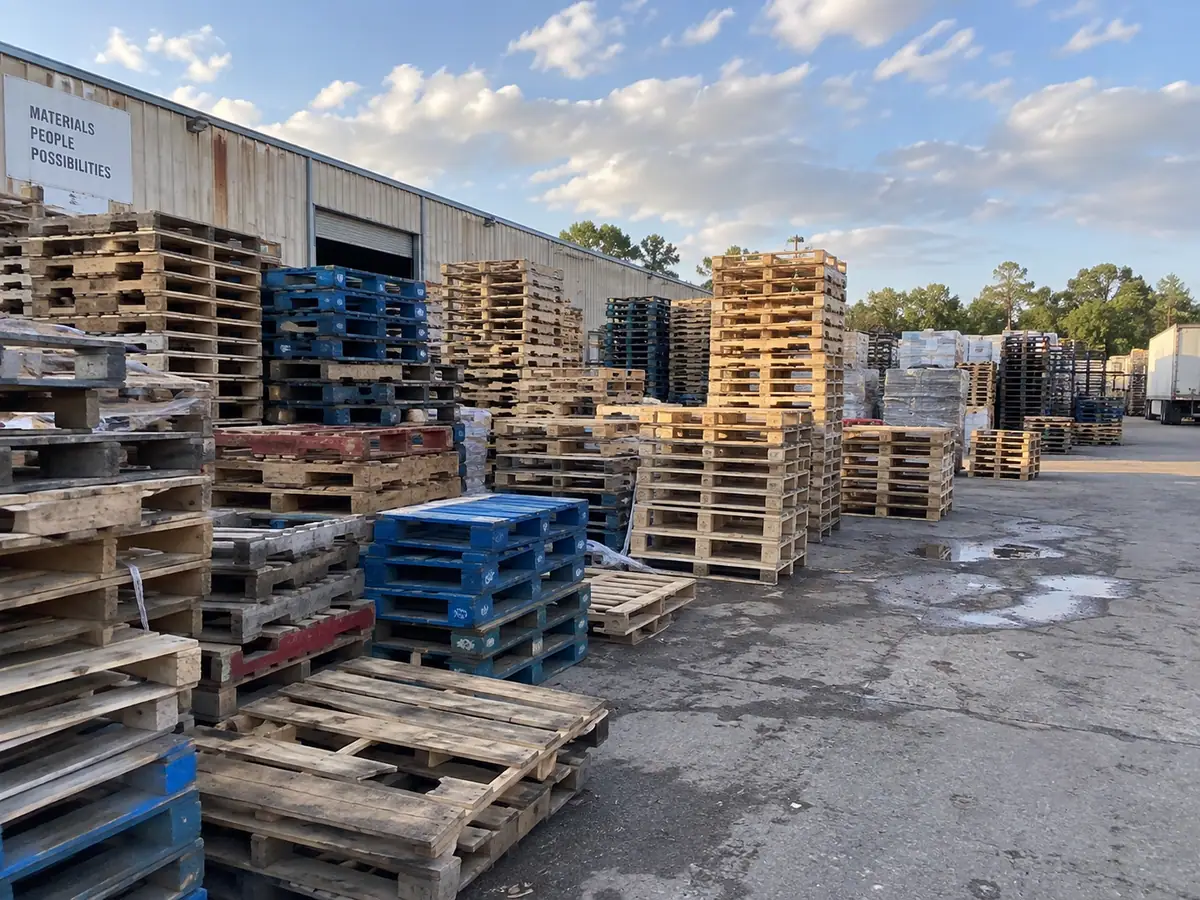
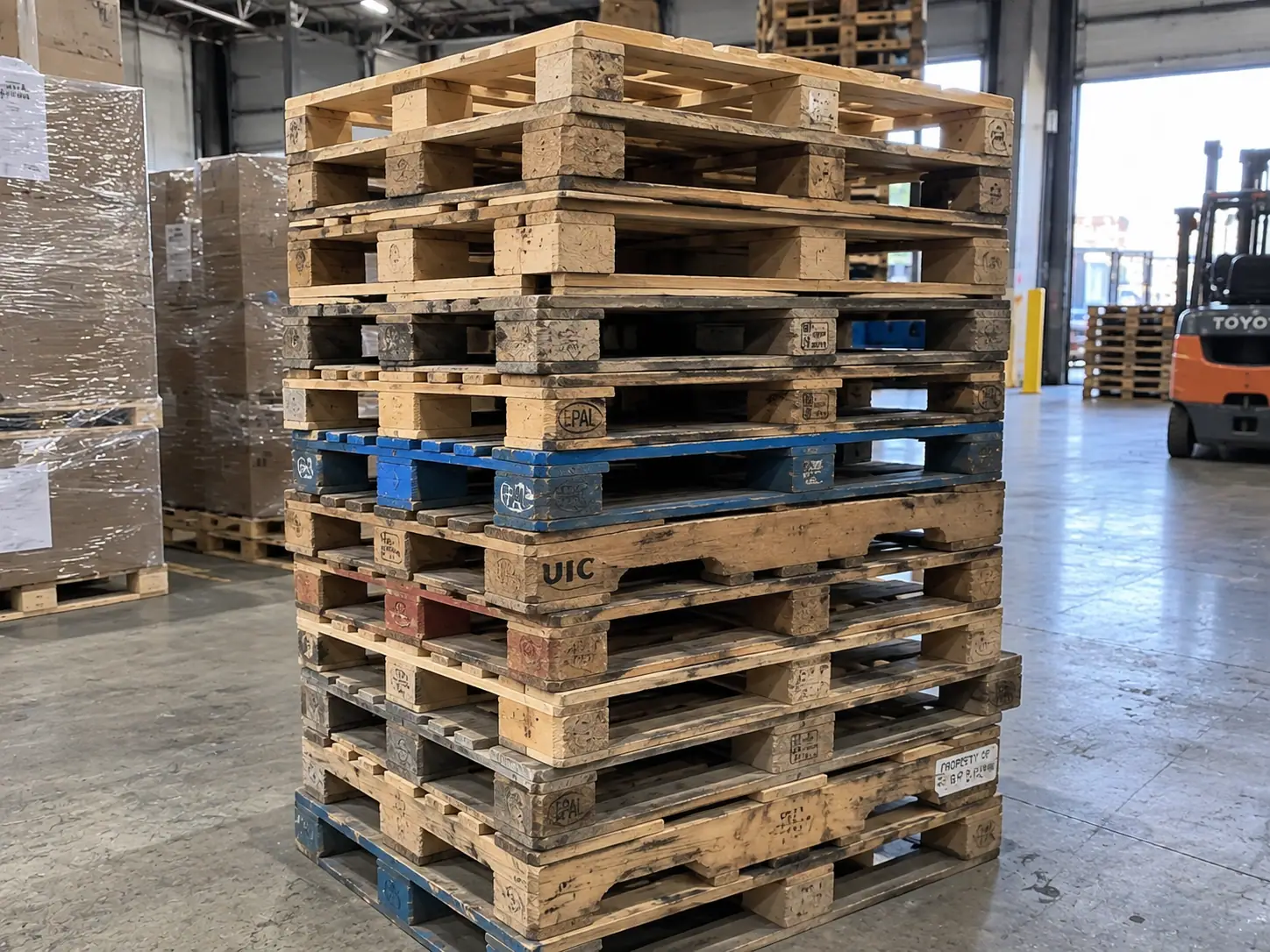
Our published landfill diversion rate is 99.4% by weight. The remaining six-tenths of a per cent — around 125 tons a year — goes to permitted disposal.
We could stop mentioning it. Most of the industry does. Here is what it consists of and why we think leaving it out would make the other 99.4% worth less.
The four categories
- Methyl bromide treated wood. MB-stamped units, fumigated rather than heat treated. The treatment is being phased out globally and we exclude the material from our stream entirely regardless of condition.
- Pressure-treated and painted lumber. CCA and similar treatments are exactly what you do not want ground into landscape mulch. Paint is a contamination question rather than a toxicity one, but it fails the same test.
- Chemically or biologically contaminated units. Pallets that carried a spill, or that arrive with residue, staining or an odour that indicates something we cannot identify.
- Composites with inseparable binders. Presswood and moulded units where the non-wood content cannot be separated from the fibre.
Why not just grind it
Because the output goes onto flower beds, playgrounds and trails, into animal bedding, and into boilers. Every one of those destinations has a reason to care what is in the feedstock.
Grinding treated wood would raise our diversion figure by about half a percentage point and lower the quality of every product we make. It would also be, in the case of CCA-treated material in a landscape product, straightforwardly wrong.
So it gets segregated at the sort deck — station 03, first thing in the morning, by someone whose job includes knowing what an MB stamp looks like — and routed to a permitted facility.
| Category | Approx. share of the 0.6% | How it is identified |
|---|---|---|
| Methyl bromide treated | ≈ 20% | MB code on the IPPC mark |
| Pressure-treated / painted | ≈ 35% | Visual — colour, surface, weight |
| Contaminated | ≈ 40% | Staining, residue, odour |
| Composite / inseparable | ≈ 5% | Material identification at the deck |
Why a claimed 100% should worry you
There are three ways to report 100% landfill diversion. You can refuse to accept difficult material, which moves the problem to whoever does accept it. You can count energy recovery as diversion without saying so, which some frameworks permit and many do not. Or you can not measure carefully enough to notice.
None of those is fraud. All of them make the number mean something different from what a reader assumes it means.
We count boiler fibre as a product because it displaces another fuel, and we report it separately at 2.0% so that anyone whose framework excludes energy recovery can subtract it. That kind of separation is what makes a figure usable rather than impressive.
Can we get it lower
Honestly, not much, and not without changing what we accept.
The contaminated share is the largest and it is essentially a function of what our collection customers hand us. We could reduce it by refusing loads from chemical and industrial sites, and that would improve our number while making the overall system worse.
There is some room in the composite category as identification improves, and MB-treated material should decline naturally as the phase-out continues. Neither moves the headline much.
So the honest position is that 99.4% is close to the ceiling for a yard that takes difficult material, and we would rather sit there and say so than sit at 100% by being fussier about what comes through the gate.