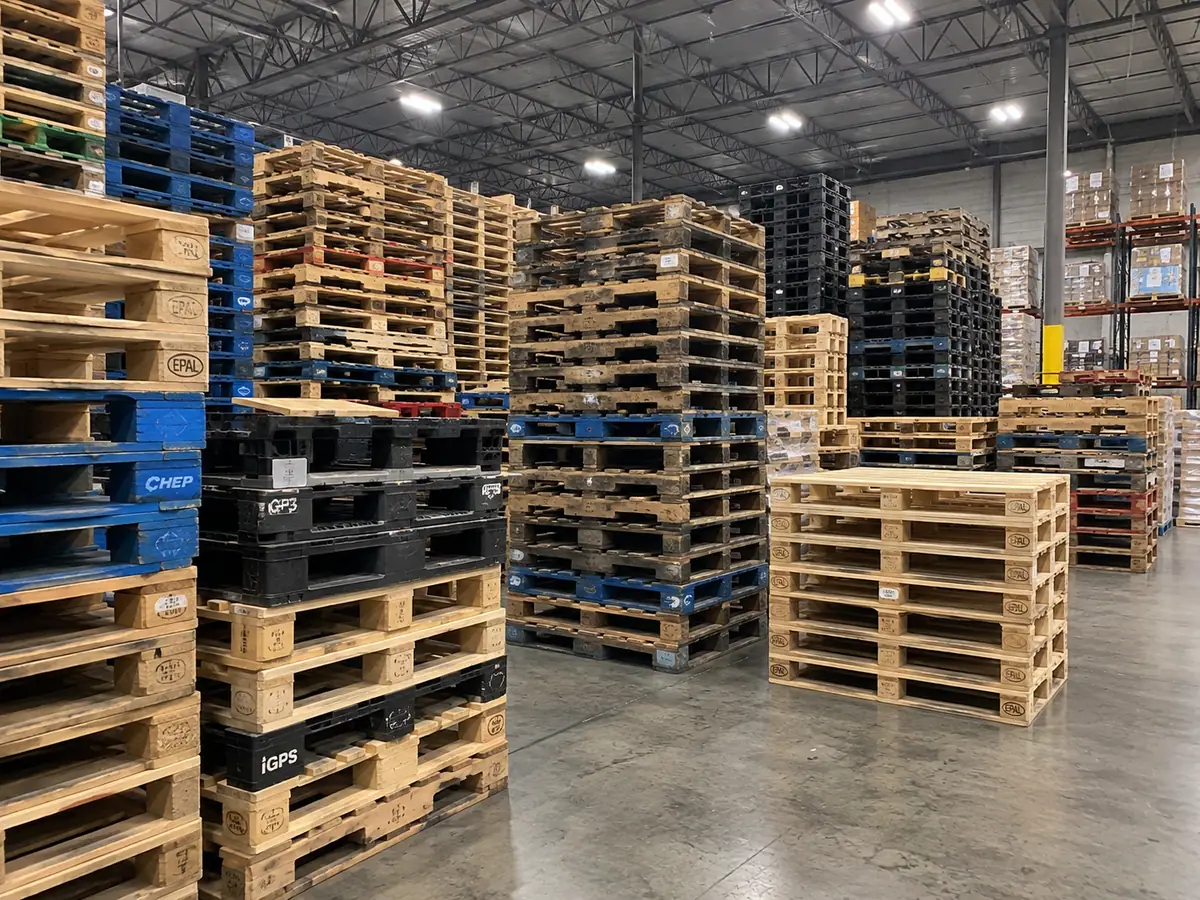
Walk any distribution centre and you will see loads where the bottom layer of cases hangs an inch or so past the pallet deck on two sides. It looks like nothing.
It is commonly cited as costing around thirty per cent of the compression strength of the corrugated stack, and it is one of the more consequential inches in logistics.
Why it matters so much
A corrugated case carries essentially all of its compression load through its four vertical corners. The panels contribute very little; the corners do the work.
When a case hangs over the pallet edge, the outer corners have nothing beneath them. The case is now carrying the stack above it on two corners rather than four, and the panel is being asked to do work it was not designed for.
That is why the loss is disproportionate to the overhang. You are not losing an inch of support; you are losing half the structural corners of every case in the bottom layer.
Where it shows up
- Crushed bottom-layer cases on loads that have been stacked in storage or double-stacked in a trailer.
- Edge damage in transit, where the overhanging case contacts a trailer wall or another load.
- Load lean. Uneven support at the base produces a load that is slightly out of plumb, which gets worse with every handling.
- Wrap failure. Stretch wrap tightens against an overhanging edge and can cut into the case.
Underhang is not free either
The opposite error gets less attention and also costs. A load that sits two inches inside the deck on all four sides has given up around fifteen per cent of the pallet's footprint, which is cube you are paying freight on.
It also concentrates the load toward the centre of the deck, which is precisely where a pallet is weakest in a rack. Racked capacity assumes a uniformly distributed load; a load sitting entirely on the middle third of the deck is not that.
The target is flush, or very slightly inside. Not generously inside.
| Condition | Effect on stack strength | Effect on cube | Verdict |
|---|---|---|---|
| Flush to the deck edge | Full | Optimal | Target |
| Underhang, up to 1″ | Full | Minor loss | Acceptable |
| Underhang, 2″+ each side | Reduced — load concentrated at centre | ≈ 15% cube lost | Fix the pattern |
| Overhang, 1″ | ≈ 30% loss commonly cited | None | Fix urgently |
| Overhang, 2″ | Substantially worse | None | Change footprint or case |
How to fix it, in order of cost
Change the stacking pattern. Free. Pinwheel, column, brick and block arrangements of the same cases produce different footprints, and one of them frequently fits.
Change the case dimensions. Cheap relative to everything else, and usually the right answer. A small adjustment to case size can make a load tessellate cleanly on a 48×40 with no overhang at all. This is a packaging engineering question and it is solved far more economically there than at the pallet.
Add a top frame or corner boards. Mitigates the symptom rather than fixing it, but genuinely useful where the overhang is marginal and the load is stable otherwise.
Change the pallet footprint. The most expensive option and the one people reach for first. A custom footprint is a permanent tax on liquidity, and it should be the last resort rather than the first.