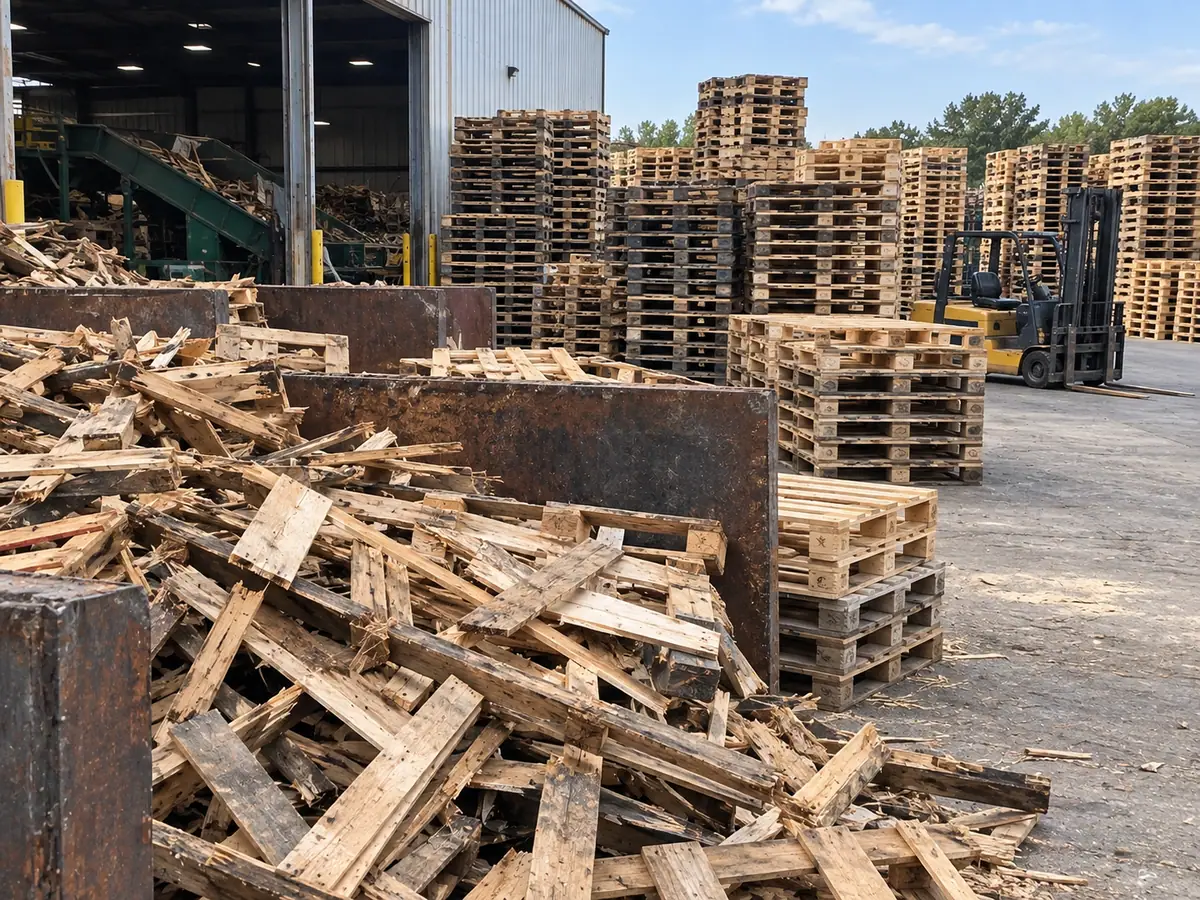
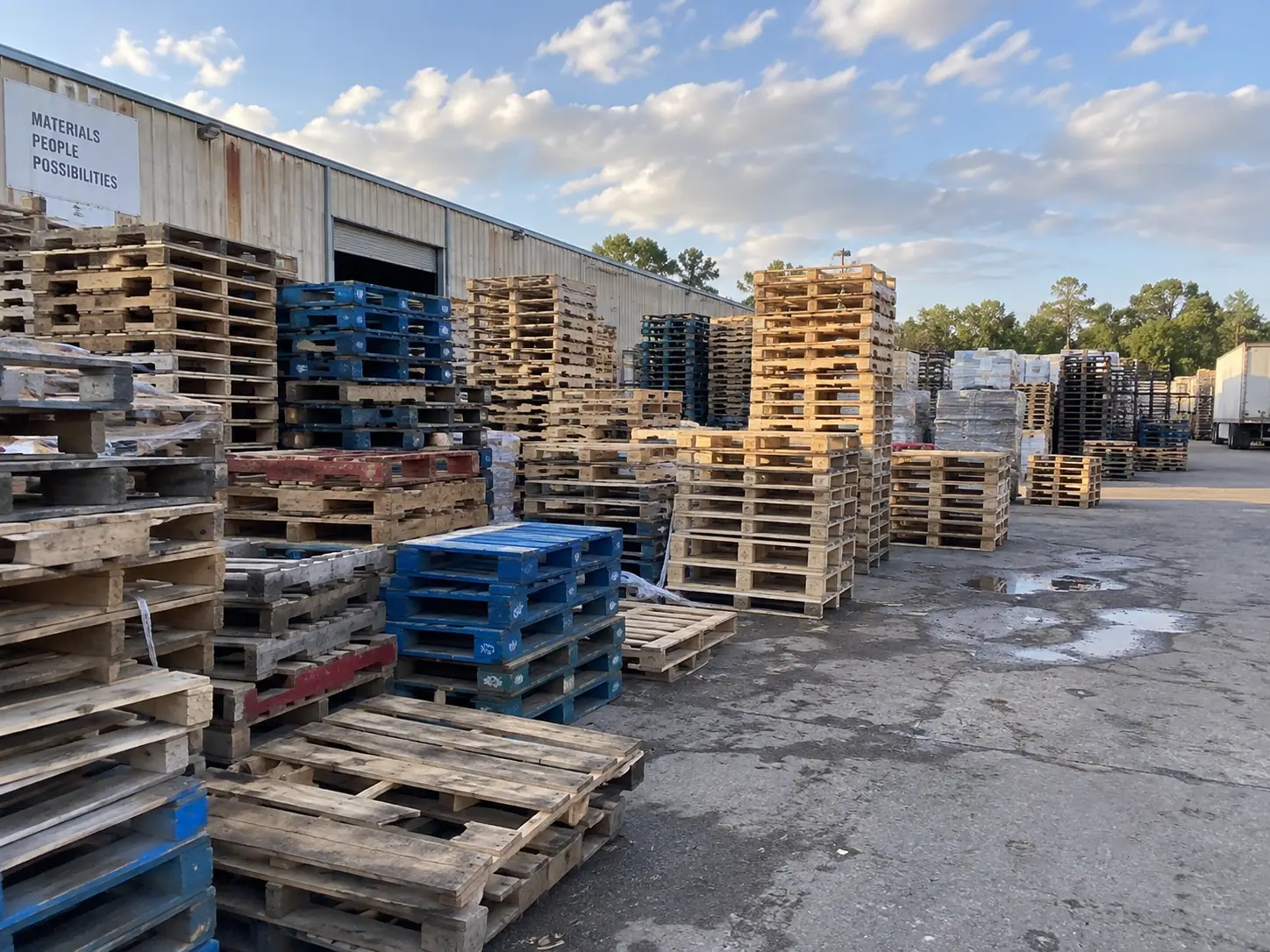
A stringer cracks. You have three options: nail a full-length companion stringer along its face, dismantle the unit for lumber, or grind it.
The arithmetic is close enough that reasonable yards reach different conclusions, which is why 'does your Grade A permit a repaired stringer' is the most informative question you can ask a pallet supplier.
What the repair is
A second stringer, full length, glued and nailed along the face of the cracked one. Done properly it restores most of the original bending capacity, because you are adding a parallel member rather than patching a break.
Done improperly — a short piece across the crack, or nailed without glue, or a companion that stops short of the ends — it restores considerably less and produces a pallet that looks repaired and behaves cracked.
The difference is about four minutes of a repair hand's time, and it is invisible from three feet away.
The arithmetic
A cracked-stringer 48×40 has three possible values. As a repaired Grade B pallet, roughly $6.50 to $8.50 depending on the market. As dismantled lumber, the recovered boards and stringer sections are worth perhaps $2.75 internally as repair stock. As grind, maybe forty cents.
The repair costs $2.75 to $3.75 in labour and materials. So repairing produces $3 to $5 of value over dismantling, which is a real margin.
But it only works if the repair is done properly and if the unit genuinely sells as Grade B. A repaired unit sold as Grade A that comes back as a claim has destroyed more value than the repair created.
| Route | Cost | Output value | Net |
|---|---|---|---|
| Companion repair, sold Grade B | $2.75 – $3.75 | $6.50 – $8.50 | +$3.00 – $5.00 |
| Dismantle for lumber | $0.90 (labour) | ≈ $2.75 as repair stock | +$1.85 |
| Grind | Marginal | ≈ $0.40 | +$0.40 |
| Repair badly, sold as A | $2.75 | $9.50 then a claim | Negative |
Why we drop it a grade
Because racking is where a repaired stringer is tested, and racking is where a failure drops product from height.
In a rack the stringers act as beams and fail in bending, with the highest stress in the bottom fibre at mid-span. A crack is a stress concentration in exactly that region. A companion stringer shares the load, but the repaired member is no longer a homogeneous beam and its behaviour under repeated cycles is less predictable.
For floor stacking, one-way outbound shipping and internal movement, none of that matters and a companion-repaired unit is a perfectly good pallet. Which is precisely what Grade B is for.
Other yards disagree, honestly
Plenty of well-run operations permit a companion stringer within Grade A, on the reasonable argument that a properly executed repair restores the capacity and the grade should describe capability rather than history.
We are not saying they are wrong. We are saying the two definitions produce a meaningful price difference, and if you are comparing quotes without knowing which definition each supplier uses, you are not comparing anything.
Ask the question. Any yard grading to an actual standard will answer it immediately.