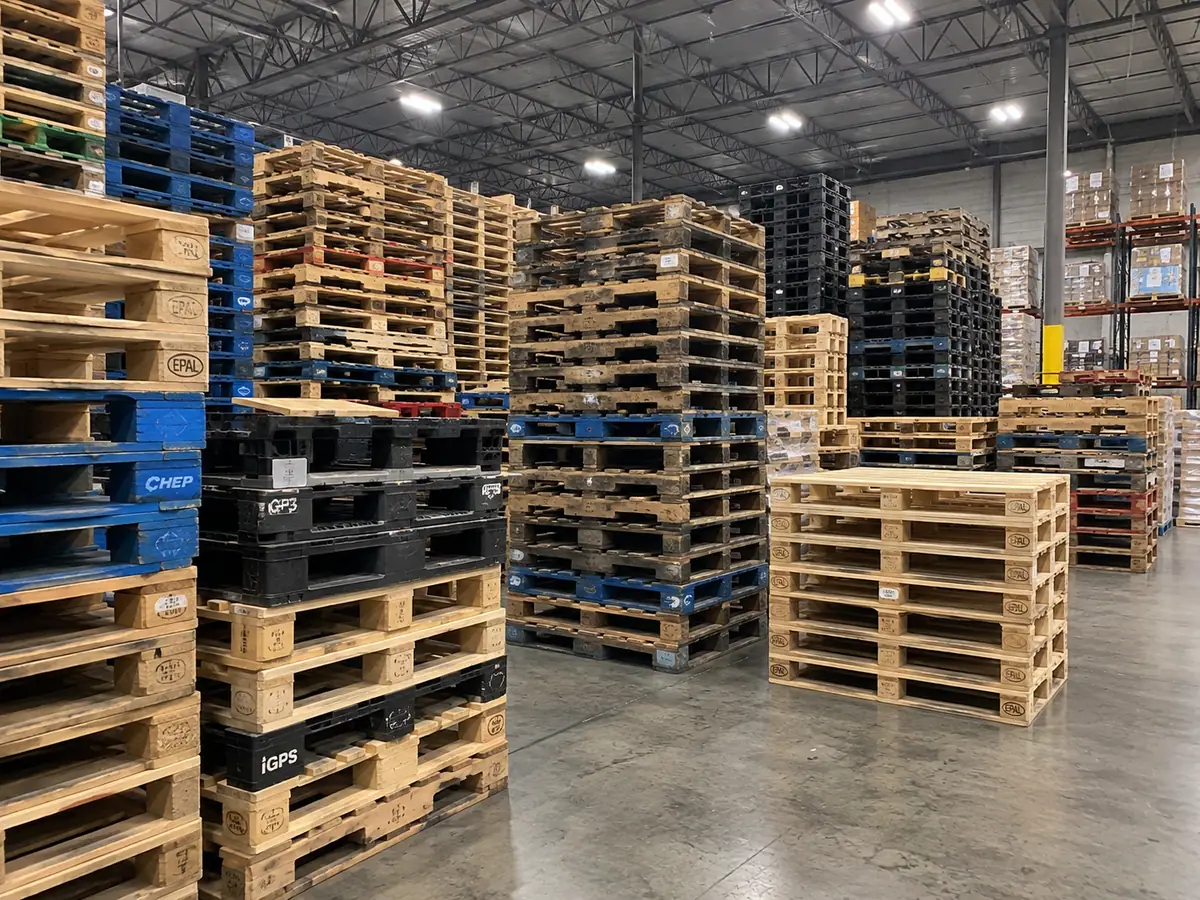
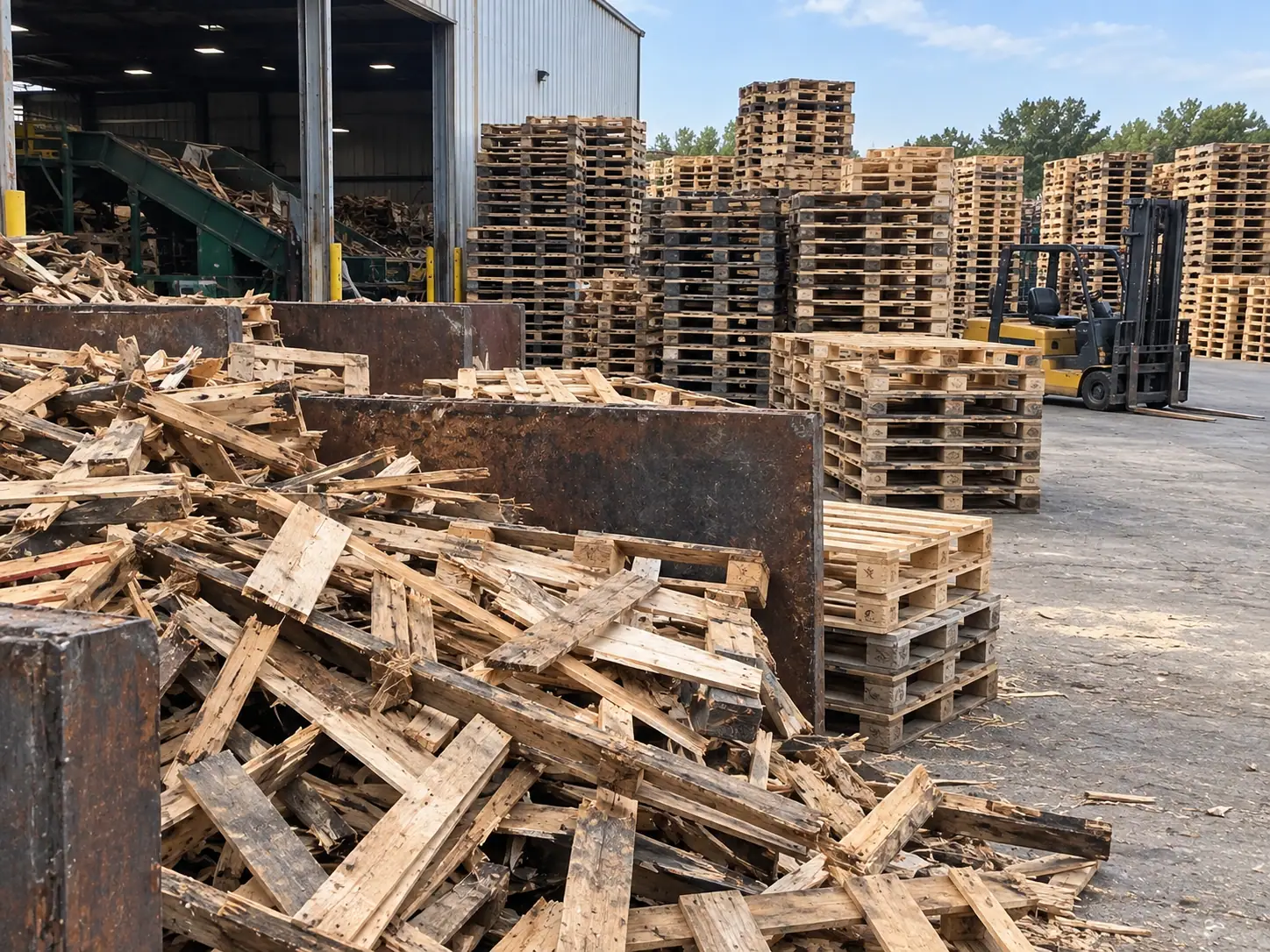
A standard 48×40 GMA pallet is held together by something in the region of 78 to 90 nails, depending on who built it and to what pattern. Call it 84 as a working average.
A trailer holds 330 of them. That is roughly 27,700 nails per inbound load, and we receive about nineteen loads on a normal day.
The arithmetic
A helically-threaded pallet nail weighs about 4 grams. Eighty-four of them is roughly 340 grams — three-quarters of a pound of steel in a pallet that weighs 45 lb.
Across a year, at our throughput, that comes to approximately 175 tons of ferrous metal. It is 0.4% of everything that crosses our scale, and it is the stream nobody in this industry talks about because it is small and unglamorous.
It also has to go somewhere. Ground wood with nails in it is not landscape mulch; it is a liability. Anyone who has run a mower over a mulched bed containing pallet nails has strong feelings about this.
How separation works
After grinding, the fibre stream passes under a magnetic drum. Ferrous material lifts out of the flow and drops into a separate hopper; the wood carries on to the screening deck.
It is not perfect. Nails that have been driven deep into a dense section of hardwood sometimes stay embedded in a chunk of fibre that is too large for the magnet to lift free. Those get caught on the second pass, and the screening deck rejects anything oversized back into the grinder.
The stuff we recover is dirty scrap — steel with wood fibre and rust on it — and it sells accordingly. It is not a profit centre. It is the difference between a mulch product you can sell and one you cannot.
| Unit | Nails, approx. | Steel weight | Notes |
|---|---|---|---|
| 48×40 GMA stringer pallet | 78–90 | ≈ 0.75 lb | Helical or stiff-stock, 2¼″ typical |
| Trailer of 330 units | ≈ 27,700 | ≈ 250 lb | One inbound load |
| A day at our yard | ≈ 525,000 | ≈ 0.7 tons | Across roughly 19 loads |
| A year | ≈ 134 million | ≈ 175 tons | Sold to a scrap processor |
Why the fastener choice matters upstream
Not all pallet nails are equal, and the difference shows up years later at our end.
Helically-threaded and stiff-stock nails hold far better than smooth shank, which means the pallet stays square longer and survives more cycles. They are also considerably harder to remove without splintering the board, which slows the dismantling line down.
Staples, which appear on some imported and lightweight units, are the worst of both: poor holding power and a tendency to shear off in the wood where the magnet cannot reach them. We grade units built with staples more conservatively for exactly that reason.
The point of counting it
0.4% is a small number. It is also 175 tons of steel a year from one yard in one city, and there are hundreds of yards.
We count it because the alternative is not counting it, and a diversion figure that ignores every stream too small to be interesting is not a measurement. Our published rate of 99.4% includes the nails on the numerator and the nails on the denominator, which is the only way that number means anything.